U.S. Treasury Secretary, USTR Representative, and Chinese Vice Premier to Meet in Switzerland
The United States and China, which clashed in a "tariff war" during the second Trump administration, will hold their first official talks this week in Switzerland.
On May 6 (local time), the U.S. Department of the Treasury announced that Secretary Scott Besant will visit Switzerland on May 8 and meet with China's chief representative in charge of economic affairs.
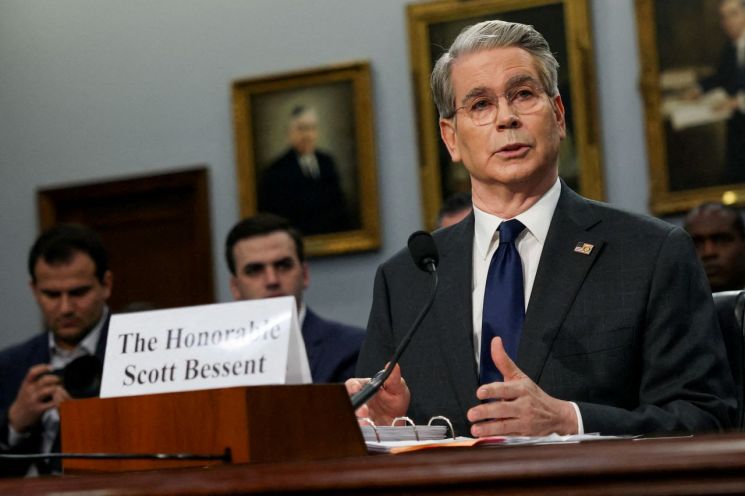
Secretary Besant stated, "Economic security is national security, and President Trump is leading the way toward a stronger and more prosperous America both at home and abroad." He added, "As we work to realign the international economic system to better serve America's interests, I look forward to having productive discussions."
The Office of the United States Trade Representative (USTR) also announced that Representative Jamison Greer will meet his Chinese counterpart in Switzerland this week. Greer said, "Under President Trump's direction, we are negotiating with countries to rebalance our trade relationships, achieve reciprocity, open new markets, and protect America's economic and national security." He added, "I look forward to meeting some of my counterparts for productive meetings and to meeting my team in Geneva, who are working diligently to advance America's interests on a range of multilateral issues."
At the same time as the U.S. announcement, China's Ministry of Foreign Affairs stated that Vice Premier He Lifeng, a key economic official, will visit Switzerland from May 9 to 12 at the invitation of the Swiss government. "During his visit, Vice Premier He, as China's lead representative on economic and trade matters, will hold talks with U.S. Treasury Secretary Besant, the U.S. lead representative," the ministry said.
In this regard, China's Ministry of Commerce stated, "Recently, senior U.S. officials have continuously spread rumors about adjustments to tariff measures, and through various channels have voluntarily provided information to China, expressing a desire to discuss issues such as tariffs." The ministry added, "Any dialogue and negotiations must be conducted on the basis of mutual respect, equal consultation, and reciprocity. If words and actions are inconsistent, or if threats and coercion continue under the guise of negotiation, China will never respond."
Since the beginning of the Trump administration, the U.S. has imposed an additional 145% tariff on China, while China retaliated with a 125% tariff on U.S. products, escalating trade tensions between the two countries to their peak. As the U.S. and China hold their first talks under the second Trump administration, expectations are rising that a tariff agreement may be reached and that virtually suspended trade may resume. Bloomberg News predicted that the upcoming talks will focus more on easing tensions rather than achieving a large-scale trade agreement.
President Trump recently stated that he is willing to lower tariffs on China at some point. During a summit with Canadian Prime Minister Mark Carney at the White House that day, he said, "China wants to negotiate and wants to meet. We will meet with China at the appropriate time," while also claiming that the U.S. loses nothing by not trading with China.
© The Asia Business Daily(www.asiae.co.kr). All rights reserved.