Highlighting Strengths Such as Early Delivery Through a Unified Team
Targeting a Market Worth Up to 60 Trillion Won with European and Japanese Competitors
Hanwha Ocean and HD Hyundai Heavy Industries are making a bid to export submarines to Canada in a deal that could be worth up to 33 trillion won. As anti-American sentiment has spread in Canada due to a series of controversial remarks by U.S. President Donald Trump, the country, which has traditionally relied on American-made weapons, is now seen as providing new opportunities for "K-Defense" companies.
According to industry sources on May 7, Hanwha Ocean and HD Hyundai Heavy Industries submitted an unsolicited proposal to the Canadian government in early March. An unsolicited proposal is a document that explains and proposes key specifications, expected delivery timelines, and other conditions of Korean-made submarines in advance; it is distinct from an official request for proposal (RFP). The proposal includes an innovative offer to supply four submarines by 2035 and to build maintenance facilities in Canada, creating local jobs.
Previously, in February, the two companies signed a memorandum of understanding (MOU) to form a "one team" for naval vessel export projects. Through the MOU, the government and shipbuilding industry will form a unified team when participating in future naval vessel export projects. Under this structure, HD Hyundai Heavy Industries will lead surface ship exports, while Hanwha Ocean will head submarine exports, each focusing on their respective strengths.
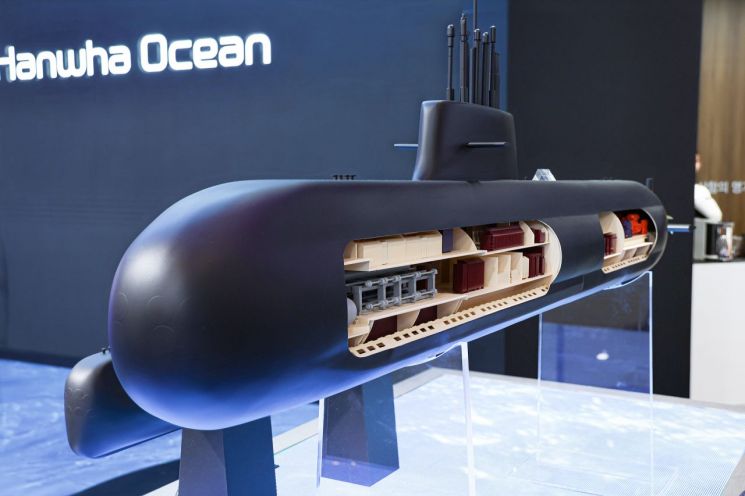
Hanwha Ocean possesses world-class submarine technology, having become the eighth company in the world to independently develop a 3,000-ton class submarine. The company has secured orders for a total of 22 submarines to date, including six submarines exported to Indonesia?the first time a country that imported submarine technology has actually exported submarines. Hanwha Ocean and HD Hyundai Heavy Industries believe that, by forming a "one team," they can meet the requirements of the Canadian Navy and deliver submarines ahead of schedule, unlike their European competitors.
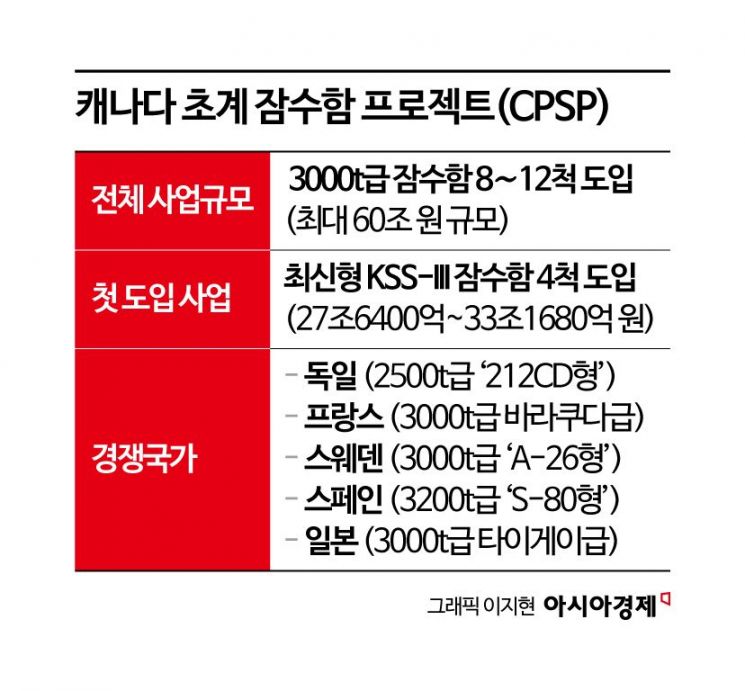
The companies submitted their proposal because Canada is pursuing the "Canadian Patrol Submarine Project" (CPSP), a program to acquire 8 to 12 submarines of 3,000 tons each, with a total value of up to 60 trillion won. While the full timeline for CPSP has not been disclosed, the Royal Canadian Navy plans to first acquire four state-of-the-art KSS-III submarines to replace its aging fleet. This initial phase is estimated to be worth between $20 billion and $24 billion (approximately 27.64 trillion to 33.17 trillion won).
European countries such as Germany, France, Spain, and Sweden are also competing for the project. Germany has proposed the 2,500-ton "212CD class," France the 3,000-ton "Barracuda class," Sweden the 3,000-ton "A-26 class" (Blekinge class), and Spain the 3,200-ton "S-80 class" submarine. Japanese shipbuilders are also expected to participate. In May 2022, a Canadian submarine inspection team, including officials from the federal procurement agency and the Navy, visited Japan to observe the construction and operation of the "Taigei class" submarines at Mitsubishi Heavy Industries, Kawasaki Heavy Industries, and the Japan Maritime Self-Defense Force.
The spread of anti-American sentiment in Canada is also a positive factor for South Korean defense companies. Previously, Canadian Prime Minister Mark Carney declared to President Trump, known for his provocative remarks, that "the era of relying on the U.S. for economic integration and strong security and military cooperation is over." During his recent successful snap election campaign, he also pledged to reduce dependence on the United States and strengthen ties with other allies. The Liberal government led by Prime Minister Carney, taking into account past trade conflicts with the Trump administration, has ordered a review of the F-35 fighter jet procurement plan and is also negotiating participation in "ReArm," the European Union's joint defense procurement initiative.
Korean defense companies are proposing a variety of weapons. The Canadian military is currently facing equipment obsolescence issues. In February, Army Lieutenant General Mike Wright acknowledged, "The current army is not the army we need for the future." He pointed out that the NATO contingent stationed in Latvia lacks sufficient modern anti-tank weapons, air defense systems, and counter-drone technologies, as well as rocket systems.
Hanwha Aerospace has proposed selling the Canadian Army a multiple rocket launcher system similar to the U.S. High Mobility Artillery Rocket System (HIMARS), as well as K-9 self-propelled howitzers. If the purchase of Korean-made multiple rocket launchers and self-propelled howitzers is finalized, the deal could be worth up to $1 billion (approximately 1.4 trillion won), depending on the quantity, delivery schedule, and construction of local maintenance facilities.
© The Asia Business Daily(www.asiae.co.kr). All rights reserved.

![Clutching a Stolen Dior Bag, Saying "I Hate Being Poor but Real"... The Grotesque Con of a "Human Knockoff" [Slate]](https://cwcontent.asiae.co.kr/asiaresize/183/2026021902243444107_1771435474.jpg)
















