Pledge to Introduce the "National Science Hero Recognition System"
Serious Outflow of Science and Engineering Talent; Time for Policy Action
Lee Junseok, the presidential candidate of the Reform New Party, has pledged to provide a monthly pension of 5 million won to domestic scientists who have received the world’s most prestigious awards, such as the Nobel Prize and the Fields Medal.
On this day, through a policy briefing, Lee stated, "We will introduce the 'National Science Hero Recognition System,' which will provide a one-time reward and a monthly pension to recipients of certain international and domestic science awards, as well as to outstanding research paper authors."
Lee explained, "The outflow of talented individuals in science and engineering to overseas continues," and added, "Another cause is presumed to be the recent government’s deliberate reduction of research funding, which has undermined the pride of scientists and engineers." He further stated, "It is time for the government to regard the achievements of scientists and engineers as a matter of national honor, to provide appropriate rewards, and to implement policies that restore the pride of researchers by recognizing their contributions."
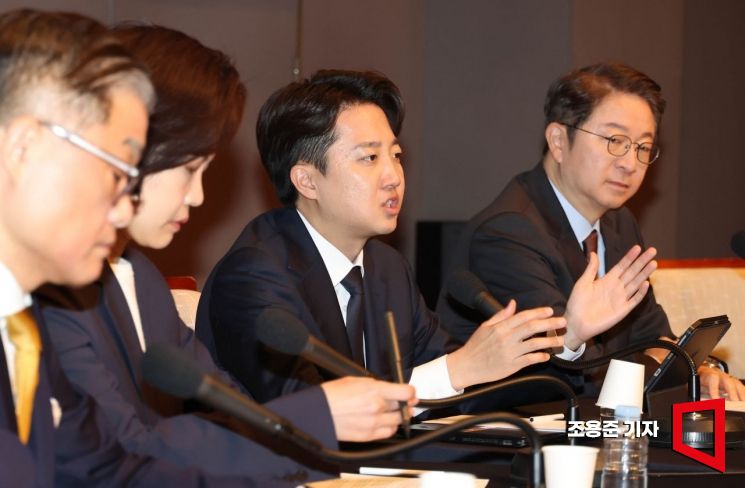 Lee Junseok, the presidential candidate of the Reform New Party, is attending and speaking at the Kwanhun Debate held at the Press Center in Jung-gu, Seoul on April 30, 2025. Photo by Jo Yongjun
The National Science Hero Recognition System is centered on providing a one-time reward of up to 500 million won and a monthly pension of up to 5 million won to recipients of the Nobel Prize, Turing Award, Fields Medal, the so-called "Oscars of Science" Breakthrough Prize, IEEE awards, and domestic science and technology medals.
Benefits will also be given to authors of outstanding research papers. For example, if a paper is published in one of the world’s top three academic journals?Nature, Science, or Cell?and falls within the top 1% in terms of impact factor, it will receive an A grade, with 1 million won per paper and up to 5 million won in total. Lee explained, "The requirements for each grade will be established later through the deliberation guidelines of a (tentatively named) National Researcher Pension Criteria Review Committee, which will collect expert opinions and set objective standards based on impact factor, journal quartile, and other indicators, taking into account the characteristics of each field."
He also pledged to introduce a Science and Technology Fast-Track System. This system will grant fast-track departure screening benefits, similar to those given to diplomats and flight attendants, to scientists and engineers who meet certain criteria, thereby providing institutional support for researchers’ international activities.
© The Asia Business Daily(www.asiae.co.kr). All rights reserved.

















