Public Recruitment for 21st Presidential Election Ballot Counting Observers Heats Up
Controversy Over Election Fraud Fuels Interest in Observer Applications
With the 21st presidential election approaching, recruitment for 'ballot counting observers,' who monitor the ballot counting process on site, was quickly closed across the entire Seoul metropolitan area.
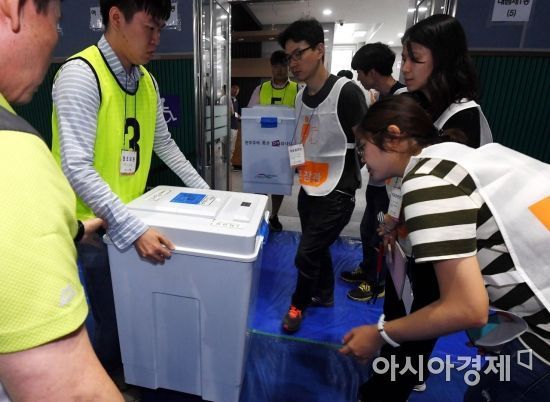
According to the National Election Commission's public recruitment results for 'ballot counting observers for the 21st presidential election' as of 9 a.m. on May 6, recruitment had already closed not only in the entire Seoul metropolitan area, including Seoul, Gyeonggi, and Incheon, but also in major cities such as Busan, Daegu, and Gwangju. In some areas, including the metropolitan region, the quota was filled within just two hours of the application opening, resulting in early closure. The number of applicants accepted for public recruitment is five times the number of available positions. If the number of applicants exceeds this fivefold quota, recruitment is closed, and the final list of observers will be determined through a draw on the 26th.
This public recruitment will close at 6 p.m. on May 9. Applicants must be citizens aged 18 or older as of election day; foreigners, minors, and those restricted under the Public Official Election Act are excluded. Those wishing to become ballot counting observers can either fill out an application on the National Election Commission website or submit a written application to the district or county election commission with jurisdiction over their registered address.
A ballot counting observer is a person who monitors or records the ballot counting process to ensure its transparency. If they discover any illegal activity related to the ballot counting, they may request corrective action. However, observers must cooperate in maintaining order at the counting center, and any actions that interfere with or delay the counting process are strictly prohibited.
The duties of ballot counting observers are not particularly difficult. However, the compensation is relatively high, making it a popular part-time job. For the 21st presidential election, ballot counting observers will receive approximately 100,000 won for six hours of work in a single day. If the work extends past midnight, the maximum compensation can reach up to 200,000 won, and meal expenses are provided separately from the daily wage. The exact compensation will be announced separately by each city and provincial election commission at a later date.
Meanwhile, during the Guro District Office by-election held on April 2, three ballot counting observers caused a disturbance by loudly claiming, "A 'HUAWEI-76A5' Wi-Fi name is appearing on my mobile phone," and alleging that Chinese entities were hacking the ballot counting reporting system. When a Guro District election official explained that it appeared an observer had enabled tethering (a service that shares Wi-Fi) on their own mobile phone and changed the Wi-Fi name to Huawei, the 'HUAWEI-76A5' Wi-Fi name reportedly disappeared shortly thereafter.
The National Election Commission stated, "The communication network used for reporting at the counting centers is a dedicated closed wired network completely separated from external networks," and explained, "The claim that Huawei networks are related to election commission equipment is entirely unfounded."
© The Asia Business Daily(www.asiae.co.kr). All rights reserved.

















