Survey of 160 Outside Directors at Listed Companies
Automatic Affiliate Inclusion Regulation under the Fair Trade Act
Only 15 Percent of Outside Directors Are Former Executives
Economic organizations have argued that revisions to the Fair Trade Act are necessary to enhance the expertise and independence of outside directors. They point out that the regulation under the Fair Trade Act, which automatically classifies an outside director's personal company as an affiliate of a large business group, acts as an obstacle to the appointment of outside directors.
According to the "Current Status of Outside Director Activities and Institutional Improvement Tasks" report released by the Korea Chamber of Commerce and Industry on May 7, outside directors of domestic listed companies have so far been concentrated in specific occupational groups such as professors and former government officials. As a result, the expertise of outside directors in Korea has been assessed as lacking compared to countries like the United States. The Chamber interprets this as being significantly influenced by the "affiliate inclusion" regulation under the Fair Trade Act, which is unique to Korea. The survey was conducted from April 9 to April 25, targeting 160 outside directors of listed companies.
The affiliate inclusion regulation under the Fair Trade Act stipulates that, in principle, an outside director's personal company is automatically classified as an affiliate of a large business group, and is excluded only if independent management is applied for and approved as an exception. The Chamber explained that, as a result, there have been many cases in which candidates have declined appointments as outside directors due to these Fair Trade Act regulations.
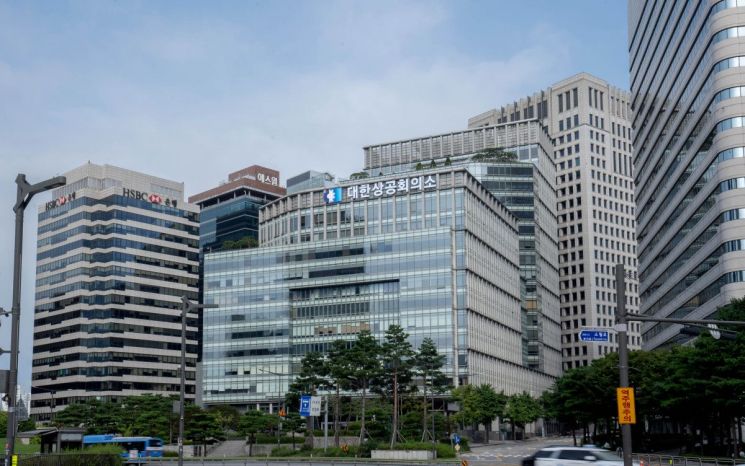 Exterior view of Sangui Hall, Jung-gu, Seoul, provided by the Korea Chamber of Commerce and Industry
In fact, last year, 36% of outside directors at domestic listed companies came from academia and 14% from the public sector, meaning professors and former government officials accounted for half of all outside directors, while only 15% were former executives. In contrast, in the United States S&P 500 and Japan's Nikkei 225 companies, executives accounted for 72% and 52% respectively, exceeding half, while those from academia were only 8% and 12% respectively.
In response, at the end of 2022, the Fair Trade Commission partially eased the regulation by revising the enforcement decree of the Fair Trade Act, so that after the appointment of an outside director, their personal company is, in principle, excluded from being classified as an affiliate only in relation to the controlling company.
According to a survey conducted by the Chamber to assess the effect of this regulatory improvement, 27.7% of respondents said the partial easing of the affiliate inclusion regulation for outside directors in 2022 "greatly helped" their decision to accept the position, while 70.2% said it "somewhat helped." In total, 97.9% of outside directors responded that the regulatory easing was helpful, while only 2.1% said it was not.
However, regarding the "post-appointment controlling company affiliate inclusion regulation," which still remains, 33.1% of outside directors said they plan to start a personal company during their tenure. Among them, 37.7% said they plan to resign from their outside director position because their startup would be automatically classified as an affiliate. Additionally, 32.1% said they plan to sell their shares in the company soon after founding it.
The Chamber stated, "There is no affiliate inclusion regulation under the Fair Trade Act in other countries, so the proportion of former executives who operate other businesses or have separate startup plans is very high." The Chamber also explained, "When outside directors lack expertise in management or industry, it is realistically difficult for them to oppose board agenda items, so a lack of expertise is highly likely to lead to diminished independence of outside directors."
Comparing the occupational backgrounds of outside directors at leading companies in Korea and the United States, all seven outside directors at the U.S. information technology company Apple are former or current CEOs with experience and expertise in various industries. In contrast, at a leading Korean company (Company A), out of six outside directors, three were professors, two were former government officials, and one was from the finance or accounting sector, indicating a lack of management or industry experts capable of providing strategic direction for the company.
Regarding criticism that the opinions of outside directors are not reflected within companies, most outside directors responded that their opinions are indeed taken into account. According to the survey, 84.4% of outside directors said the company goes through a process of collecting and discussing opinions in advance regarding board agenda items. Additionally, 55.6% said that even when they agreed with board agenda items, they had expressed "conditional opinions" after considering concerns or potential side effects related to the items.
Kang Seokgu, head of the Research Division at the Korea Chamber of Commerce and Industry, stated, "Compared to major countries such as the United States and Japan, Korea tends to place excessive emphasis on the independence of outside directors rather than their expertise." He added, "With growing uncertainty in the global market and intensifying competition in future industries, it is necessary to view the role of outside directors not just as monitors, but as strategic decision-making partners."
© The Asia Business Daily(www.asiae.co.kr). All rights reserved.

















