FT: Building an 'AI Supply Chain' in Shenzhen with Equipment, Design, and Production
It has been reported that Huawei in China is building large-scale production facilities to handle the entire process required for high-performance semiconductor manufacturing domestically. After the U.S. government imposed restrictions on the export of advanced semiconductors, analysts say that Huawei has embarked in earnest on so-called "vertical integration," establishing technological self-sufficiency and its own production system for semiconductors.
On May 5 (local time), the British daily Financial Times (FT) reported, by comparing satellite images taken in 2022 and last month, that Huawei is constructing three advanced semiconductor factories in the Guanlan area of Shenzhen, China.
Of the three factories, two are reportedly owned not by Huawei but by Chinese semiconductor chip manufacturing equipment company Saic Carrier and state-owned memory chip producer Shengwei Xu, respectively. However, it is widely assessed that these facilities are, in effect, under Huawei's control.
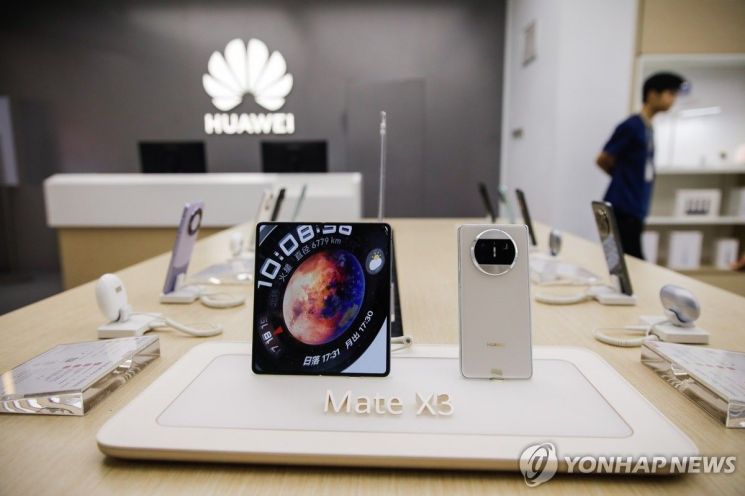
Saic Carrier, established in 2021, is a company spun off from a Huawei-affiliated research lab. It was created with funding from the Shenzhen local government, and the company is currently developing advanced deep ultraviolet (DUV) equipment through its subsidiary. Shengwei Xu, which operates another factory, supplies memory chips for automobiles and electronic devices to Huawei. It is currently known to be engaged in research and development of high-bandwidth memory (HBM) stacked packaging technology.
FT noted that although Huawei has denied any connection with these two companies, it is, behind the scenes, attracting investment and sharing personnel and technology. The report added that even if the factory construction is completed within a few months, the facilities are still in the testing phase, and it may take at least another year before they become fully operational.
These factories are seen as part of Huawei's goal to achieve complete semiconductor independence, enabling the company to handle everything from the design of semiconductors needed for AI technology to manufacturing equipment and final production.
Since 2019, when U.S. sanctions made it difficult for Huawei to acquire semiconductor technology from overseas companies, the company has been working to strengthen its own semiconductor capabilities. When the U.S. government restricted access to Google's Android operating system (OS), Huawei developed its own OS, 'Hongmeng' (Harmony). Currently, with imports of NVIDIA's advanced AI chips blocked, Huawei is accelerating the development of its own AI chips.
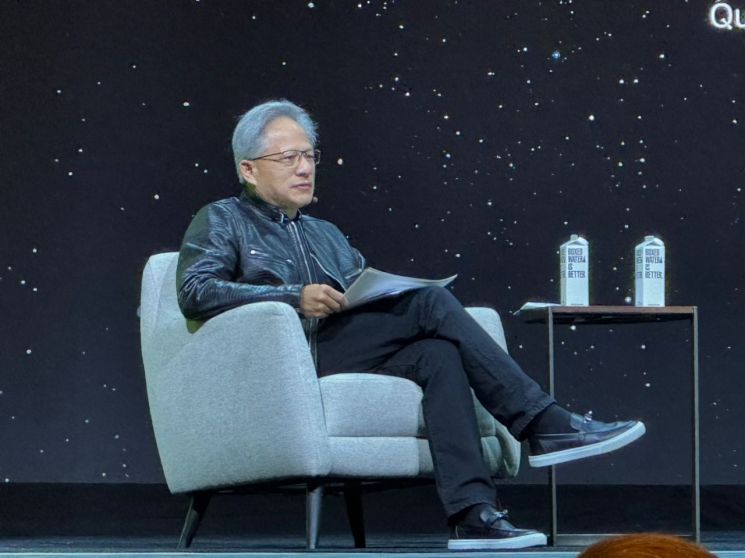 Jensen Huang, CEO of NVIDIA, attended 'Quantum Day' on March 20 (local time) in San Jose, California, USA, where he discussed the current state and future of the industry with leaders of quantum computing companies. Photo by Yonhap News
Recently, the Wall Street Journal (WSJ) reported that Huawei is developing the 'Ascend 910D,' which is said to have even greater performance than NVIDIA's flagship AI chip, the H100. If this is combined with Huawei's self-developed advanced equipment and packaging technology, the pace of technological self-sufficiency could accelerate further.
A senior semiconductor industry official told FT, "When the U.S. first sanctioned Huawei, everyone thought it was the end for the company. However, Huawei's ambitions only grew, and its subsequent actions have been astonishing."
There is also analysis that the construction of Huawei's semiconductor factories has been spurred by U.S. export controls. Jensen Huang, CEO of NVIDIA, recently pointed out that the U.S. government's export restriction policies are weakening America's dominance in the technology market. At the recent 'Hill & Valley Forum' technology conference held in Washington, D.C., he said, "China is not lagging behind the U.S. in the AI chip sector. China is right behind us, very close," and specifically named Huawei as "one of the most powerful technology companies in the world."
© The Asia Business Daily(www.asiae.co.kr). All rights reserved.


















