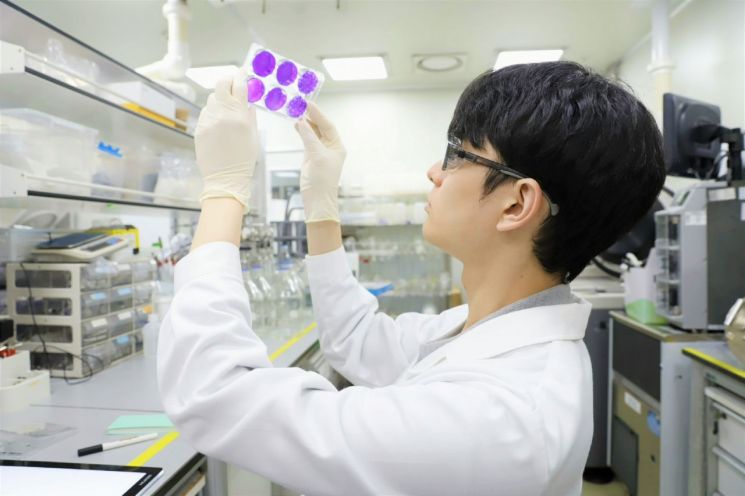
 A researcher at SK Bioscience is conducting an analysis experiment on a candidate substance for the avian influenza vaccine. SK Bioscience
SK Bioscience is embarking on the development of a next-generation avian influenza vaccine.
On May 6, SK Bioscience announced that it has been selected for the "Priority Infectious Disease Pandemic Preparedness Rapid Development Technology Support Project," led by the Korea Disease Control and Prevention Agency (KDCA). This is a national project aimed at developing vaccines to prepare for avian influenza viruses, which are considered highly likely to cause the next pandemic. SK Bioscience was chosen as the target company in recognition of its technological capabilities, as it is the only company in Korea to have commercialized preventive vaccines for influenza and COVID-19 using cell culture technology.
For this project, SK Bioscience and the KDCA will jointly invest approximately 5.25 billion won in initial development costs. With this investment, SK Bioscience will begin developing a cell-cultured avian influenza vaccine, aiming to enter Phase 1/2 clinical trials in the second half of next year.
Unlike conventional vaccines developed using the egg-based method, cell-culture vaccines are known to be more effective in terms of production speed and supply volume when responding to a pandemic. Egg-based vaccines face challenges in securing uncontaminated eggs for mass production during an avian influenza outbreak, due to mass culling of chickens, which can disrupt large-scale production and make it difficult to respond effectively to variant viruses.
In contrast, cell-culture vaccines use animal cells in advanced aseptic production facilities to culture viruses, which minimizes the risk of infection and contamination, enables rapid mass production, and allows for quick adaptation to mutations.
SK Bioscience has already developed vaccines for various viruses, including influenza, based on its cell-culture technology. The company also utilized this technology to contract-manufacture vaccines for global companies during the COVID-19 pandemic and succeeded in developing its own vaccines, thereby demonstrating both leading technological capabilities and production capacity. This experience is expected to be a significant advantage in developing, mass-producing, and supplying vaccines in response to the next pandemic.
Although avian influenza currently has a low rate of human-to-human transmission, highly pathogenic viruses such as H5N1 and H7N9 can infect humans, raising ongoing concerns about a potential pandemic. According to the World Health Organization (WHO), more than 950 human infection cases were reported between 1997 and January 2025, with approximately half resulting in death. Experts warn that if the H5N1 virus mutates to acquire human-to-human transmissibility, it could trigger a devastating pandemic.
The spread of avian influenza is not just an issue for specific countries or regions but is a critical matter directly affecting global public health and safety. Therefore, SK Bioscience plans to pursue transnational cooperation alongside its vaccine development efforts.
Meanwhile, SK Bioscience is also developing an mRNA (messenger ribonucleic acid) vaccine platform to respond to pandemics. mRNA vaccines, which were used to overcome the COVID-19 pandemic, are recognized for their ability to be developed and mass-produced rapidly, making them an effective technology for responding to highly transmissible viruses.
SK Bioscience is collaborating with the international organization CEPI (Coalition for Epidemic Preparedness Innovations) to conduct a global Phase 1/2 clinical trial of its Japanese encephalitis vaccine candidate "GBP560" based on mRNA technology, with interim results expected next year. Through this, the company aims to secure another technological capability for pandemic response.
SK Bioscience CEO Ahn Jae-yong stated, "Our collaboration with the Korean government and international organizations to respond to infectious disease pandemics is a result of our globally recognized technological capabilities and production capacity. We will secure the technological capabilities needed to respond to the next pandemic, fulfill our mission to protect global health, and lay the foundation to grow into a top-tier global vaccine and bio company."
© The Asia Business Daily(www.asiae.co.kr). All rights reserved.

















