As President Donald Trump announced plans to impose a 100% tariff on foreign films, voices of discontent have emerged from the Hollywood industry.
On May 5 (local time), The Wall Street Journal (WSJ) reported on Hollywood's negative sentiment toward the tariff policy with the headline, "Hollywood Wanted Trump to Bring Movie Production Back to the U.S., But Not Like This."
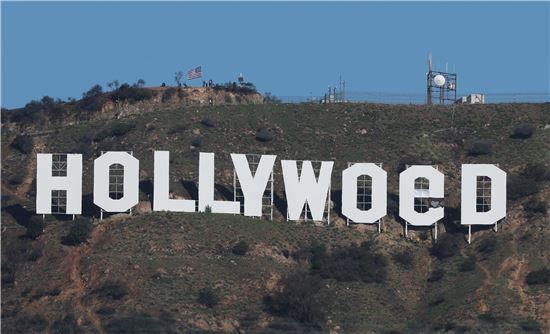 Hollywood sign. EPA Yonhap.
According to the WSJ, Hollywood industry executives are concerned that retaliatory tariffs imposed by other countries in response to U.S. tariffs could hurt their overseas business. This is especially worrisome for blockbuster films with large budgets, as the majority of their box office revenue comes from international markets.
As concerns grow that tariffs could cast a shadow over the future business outlook of major Hollywood companies, Disney's stock price fell more than 3% in early trading on the New York Stock Exchange that day, and Netflix, which had risen for 11 consecutive trading sessions through last week, closed down about 2%.
Various organizations in the Hollywood industry have long called on the U.S. federal government to provide tax incentives to enhance the competitiveness of the film industry.
Production crews responsible for camera work and makeup point out that, for years, jobs in the U.S. have declined as foreign governments such as the United Kingdom have attracted film and TV production with generous tax benefits and lower labor costs.
This year’s top-grossing Hollywood film, "Minecraft Movie," was filmed in Canada, and the upcoming new installment of the "Mission: Impossible" series was produced entirely overseas, including in the United Kingdom.
Citing sources, the WSJ reported that John Voight, a veteran actor and President Trump's Hollywood envoy, has discussed the possibility of shaping federal policy to provide tax incentives.
President Trump stated the previous day on Truth Social that he had instructed the Department of Commerce and the United States Trade Representative (USTR) to impose a 100% tariff on all films produced abroad. However, when asked about the issue that day, he stepped back, saying, "I will meet with people in the (film) industry. I want to make sure they are happy with it."
Morgan Stanley's analyst team assessed in a memo to clients that imposing tariffs on foreign-made films would ultimately "lead to a decrease in film production, higher film costs, and a reduction in overall industry profits."
Mark Young, a professor at the University of Southern California's business school, said in an interview with ABC News that "essentially, what Trump is trying to do is make it unsustainable for American film studios to produce movies overseas," adding, "However, this will only increase the cost of film production in the U.S., and that would be disastrous."
Professor Young also pointed out that, in order to absorb the high costs of domestic production, the Hollywood industry may become even more dependent on large-budget franchise series films, significantly reducing opportunities for the production of small- and medium-budget movies.
Furthermore, experts warned that if tariffs are imposed on films produced abroad, American audiences could end up paying higher ticket prices.
© The Asia Business Daily(www.asiae.co.kr). All rights reserved.
















