Consensus on Housing Supply, but Different Approaches
Lee Jae Myung: Less Intervention, More Construction
Kim Moonsoo: Easing Regulations for Half-Price Housing
Lee Junseok: Tax Cuts to Support Moving Up the Housing Ladder
With the early presidential election scheduled for next month, major candidates are unveiling a series of pledges targeting public sentiment on real estate. The main focus is on expanding housing supply for young people, those without homes, and the middle class with real demand.
According to political circles and the real estate industry on May 6, Lee Jae Myung, the Democratic Party presidential candidate, and Kim Moonsoo, the People Power Party presidential candidate, have both promised to expand housing supply and address housing insecurity among young people. Easing building regulations and expanding the metropolitan area express railway (GTX) are also common pledges. However, their approaches and specific responses differ. For example, while both share the goal of expanding supply, they may differ on who should take the lead. The Democratic Party has emphasized public institution-led redevelopment projects, centering on organizations such as Korea Land and Housing Corporation (LH), while the People Power Party advocates for private sector-led supply.
Lee Jae Myung Responds to Jeonse Fraud and Monthly Rent Burden... Expansion Beyond GTX to KTX and Expressways
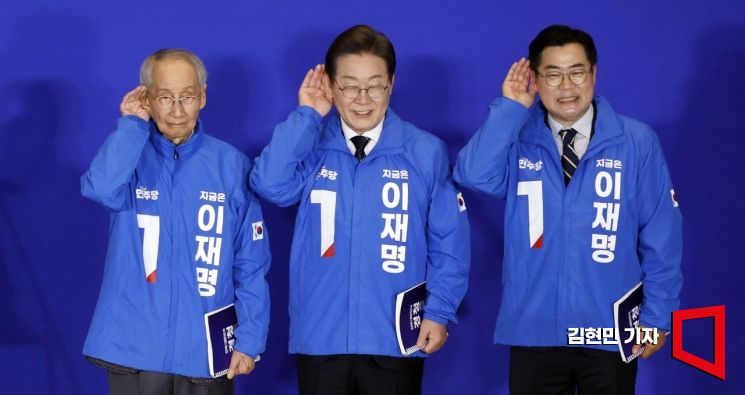 Lee Jae Myung, the Democratic Party presidential candidate (center), is performing a "listening performance" symbolizing the commitment to listen to the voice of the people, together with Yoon Yeo Joon and Park Chan Dae, the standing general election committee chairmen, at the launch ceremony of the Democratic Party's 21st presidential election "Real Republic of Korea" Central Election Countermeasures Committee held at the National Assembly Members' Office Building in Yeouido, Seoul on the 30th of last month. Photo by Kim Hyun Min
Lee officially entered the presidential race after winning the Democratic Party primary on April 27. Rather than focusing on regulations as in the past, he has maintained a policy of minimizing market intervention, placing emphasis on alleviating housing insecurity among young and working voters. On April 30, Lee announced pledges on Facebook to support jeonse and monthly rent, stating, "Housing is a basic need of life." His pledges included expanding interest subsidies for jeonse loans and raising the income threshold for monthly rent tax credits. He also stated, "We will improve the guarantee system so that people do not have to worry about jeonse fraud or have responsibilities unfairly shifted onto them."
On April 25, Lee unveiled four major real estate pledges under his "K-Metropolitan Area" vision: ▲ comprehensive redevelopment of first-generation new towns and aging central districts in Seoul, ▲ development of fourth-generation smart new towns, ▲ housing supply utilizing idle public land, and ▲ creation of a one-hour economic zone in the metropolitan area through expanded transportation networks.
Lee pledged to completely overhaul infrastructure in first-generation new towns such as Bundang, Ilsan, Sanbon, Jungdong, and Pyeongchon, and to actively support the redevelopment of aging planned cities such as Suwon, Yongin, Ansan, and Incheon (Yeonsu, Guwol). For Seoul's aging central districts, he promised to lower the barriers to reconstruction and redevelopment, increase floor area ratios, and ease cost-sharing requirements. Residents in these areas can expect to benefit from stabilized home prices and improved living conditions.
He also announced plans to prepare for the development of fourth-generation smart new towns for young people and newlyweds, aiming to provide affordable, comfortable housing in locations with convenient transportation. In addition, he proposed creating mixed-use complexes on idle state- or publicly-owned land, such as public office sites and detention basins, combining public housing, green spaces, and community facilities. Considering the difficulty of securing new development sites, his plan is to utilize public land within city centers to supply housing.
Lee promised to proceed with GTX A, B, and C lines without delay and to actively support their extension to the outskirts of the metropolitan area and even to Gangwon Province. He stated that new D, E, and F lines would be pursued in stages according to demand and efficiency. He also pledged to extend KTX (to Paju) and SRT (to Yangju) to northern Gyeonggi Province, and to build high-speed expressways connecting east and west, such as the Seoul-Yeoncheon Expressway. This is intended to reduce commuting times between Seoul and its outskirts and to enable people in outlying areas to have more choices for housing and jobs.
Lee's real estate policy direction was already apparent in February. Appearing on the economic YouTube channel "SampyoTV," he said, "Real estate policies cause problems every time they are touched," and that "it is best not to intervene as much as possible." Regarding owners of multiple homes, he drew a line against further regulation, saying, "As long as they pay taxes diligently, that's enough." He effectively withdrew his previous presidential pledges, such as the national land ownership tax, stating, "Public acceptance is too low."
Regarding single-home ownership for actual residence, he said, "If someone makes money and wants to live in an expensive house, there is no need to treat that as a crime," suggesting a likely pledge to ease taxes for single-home owners. Previously, at a press conference announcing his candidacy for party leader last year, Lee stated, "The comprehensive real estate tax seems to have unnecessarily created excessive conflict and resistance," expressing his intention to ease or abolish the tax.
Kim Moonsoo Proposes Youth-Oriented Housing... "GTX Nationwide"
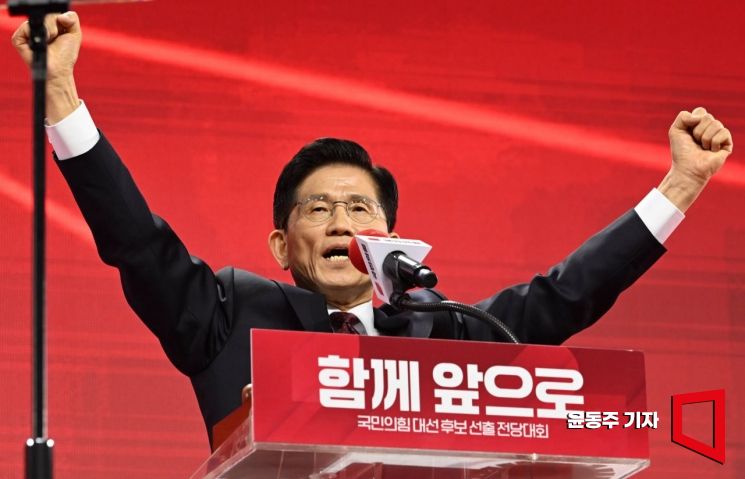 Kim Moonsoo, the People Power Party presidential candidate, is delivering his acceptance speech after being confirmed as the final candidate at the 5th party convention held on the 3rd at KINTEX in Goyang, Gyeonggi Province. Photo by Yoon Dongjoo
Kim, who won the People Power Party primary on May 3, emphasized the need for youth-oriented housing policies that support the transition from university to employment, marriage, and childbirth, and presented three key pledges: ▲ half-price monthly rent zones near universities, ▲ public housing dedicated to single-person households, and ▲ apartments designed for intergenerational cohabitation.
The half-price monthly rent zone would be achieved by easing private construction regulations. "We will relax floor area ratios and building coverage limits for one-room housing districts near universities so that private one-room apartments can be supplied at half the current rent," Kim said. He also promised that more than 10% of public housing would be specially supplied as single-person officetels, and that owning multiple officetels would not count as being a multi-homeowner. In addition, he pledged to reduce taxes by 5% per year for those who hold such properties for more than 10 years before selling.
He also promised that 25% of public housing sites would be used to build life-separated cohabitation housing with structures suitable for childcare and caregiving, designed so that parents and children can live close together but independently. To facilitate this, he plans to introduce a combined application system that grants additional points.
Kim highlighted the GTX project, which he promoted as governor of Gyeonggi Province, calling it "the world's best urban railway." He pledged to complete all six GTX lines in the metropolitan area, establish a new Dongtan~Cheongju Airport GTX line, and expand GTX to the five major metropolitan zones nationwide: Busan-Ulsan-Gyeongnam, Daejeon-Chungcheong, Daegu-Gyeongbuk, and Gwangju-Jeonnam. He plans to include these initiatives in the 5th National Rail Network Construction Plan and pursue them within his term.
However, since a merger between Kim and Han Ducksoo, the independent presidential candidate, has been announced, it is uncertain whether these policies will remain unchanged. Han, who declared his candidacy on May 2, has not yet announced any real estate-related pledges.
Lee Junseok, the Reform New Party presidential candidate from the "third zone," has pledged to reduce the burden of moving up the housing ladder for those without homes and real demand buyers through life-cycle tax reductions. He has proposed detailed measures such as acquisition and capital gains tax reductions and expanded long-term holding deductions for specific groups, including young adults, newlyweds, families with multiple children, and the elderly. He also pledged to encourage private supply by raising floor area ratios, abolish regional housing cooperatives, and revitalize the rental registration system to address unsold housing in provincial areas.
© The Asia Business Daily(www.asiae.co.kr). All rights reserved.


















