Credit Rating Upgraded from B to B+
"PF Contingent Liabilities Remain Manageable"
Despite the downturn in the real estate market, Doosan Construction has managed to secure an upgrade in its credit rating from major domestic credit rating agencies. This reflects its highest operating profit in a decade, improvements in its debt ratio, and successful asset sales. Such an assessment is considered unusual at a time when the construction industry as a whole is experiencing a liquidity crisis.
According to the construction industry on May 4, Korea Ratings and NICE Investors Service recently raised Doosan Construction's commercial paper and electronic short-term bond credit ratings from 'B' to 'B+'. Although B+ remains a speculative grade, the upgrade partially reflects the company's potential for stable profit generation and improvements in its financial indicators. Both agencies cited strong business performance and improved financial structure due to capital expansion as the basis for their upward revision.
Last year, Doosan Construction recorded an operating profit of KRW 108.1 billion, marking its highest result in 10 years since 2014 (approximately KRW 132.8 billion). This represents a 77% increase year-on-year, while revenue also rose by 27% to KRW 2.1753 trillion. The architectural division was the main driver of these results, posting over KRW 100 billion in operating profit for the second consecutive year. With the increase in profits, Doosan Construction paid out 10% of its operating profit as performance bonuses. This stands in stark contrast to the wave of construction companies entering court receivership due to the economic downturn.
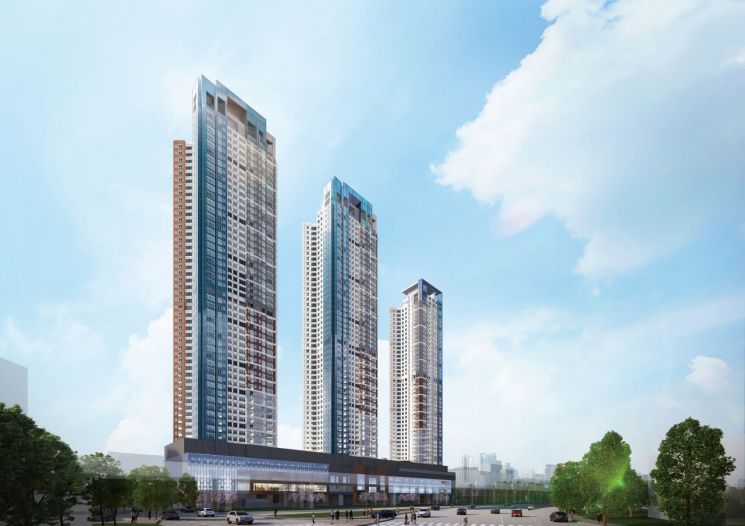 An aerial view of the CentralN49 mixed-use complex in Namyangju, Gyeonggi, contracted by Doosan Construction. Provided by Doosan Construction.
NICE Investors Service stated, "Doosan Construction has demonstrated strong order-winning competitiveness, particularly in the housing sector, including urban redevelopment projects," and added, "The ongoing housing projects are highly profitable, so we expect the company to maintain stable operating profits centered on its housing business for the time being." Korea Ratings commented, "The order backlog stood at KRW 9.9 trillion as of the end of last year based on contracts. Considering that 58.7% of the planned housing supply for this year comes from redevelopment projects, Doosan Construction is likely to manage its working capital burden well and generate stable cash flow, even amid uncertainties in the real estate market."
Asset disposals and reduced bad debt expenses also contributed to the company's recovery in financial soundness. The company improved its cash flow by selling investment properties, including the Changwon Plant 2 site (proceeds of KRW 110 billion), and recovering part of its long-term overdue loans (such as Yonginsamga, Uam2, and Khan Resort). As of the end of last year, the debt ratio stood at 378.2%, down 161.5 percentage points from the previous year. The reclassification of KRW 82.2 billion in redeemable preferred shares as equity also played a role. Korea Ratings noted, "With the sale of investment properties such as the Changwon Plant 2 site completed and the scale of impairment losses related to long-term overdue receivables reduced compared to the past, Doosan Construction posted a net profit of KRW 19.8 billion last year, returning to profitability."
NICE Investors Service assessed that the likelihood of contingent liabilities materializing in the short term is low. It stated, "Excluding redevelopment projects, the company has KRW 355 billion in PF joint guarantee liabilities, of which 72% are associated with projects where the pre-sale rate exceeds 70%. Therefore, the burden of PF contingent liabilities is not significant."
However, the increase in long-term unstarted projects and unsold assets were identified as potential risk factors. Major long-term accounts receivable for Doosan Construction include Ilsan Zenith Shopping Center (KRW 10.7 billion), Hanuri Resort (KRW 9.2 billion), Cheonan Cheongdang (KRW 124.1 billion), and Yonginsamga (KRW 27.9 billion). The rating agencies pointed out, "It is necessary to continuously monitor the recoverability of these assets and the possibility of additional bad debt losses."
Meanwhile, the domestic construction industry is under pressure to downgrade credit ratings as outstanding construction receivables and working capital burdens accumulate. According to Korea Ratings, the balance of outstanding construction receivables for 16 construction companies with valid ratings stood at approximately KRW 29 trillion at the end of last year, up KRW 3 trillion from a year earlier, and the delinquency rate for accounts receivable increased across most rating categories.
© The Asia Business Daily(www.asiae.co.kr). All rights reserved.

















