Deliberately Bitten and Injected with Venom for 18 Years
Collaboration with Company Contributes to Antivenom Development
There have been some research achievements reported in the ongoing development of a universal antivenom using the blood of a man who has been bitten by venomous snakes 200 times in the United States.
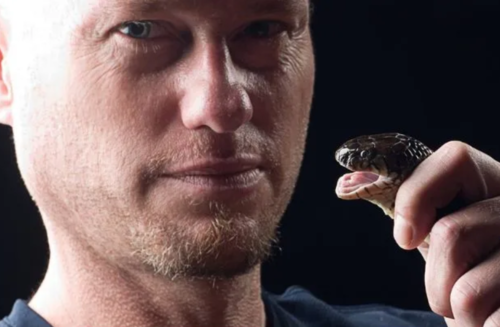
On May 2 (local time), foreign media including the BBC in the United Kingdom reported that Tim Friede, a 57-year-old former truck mechanic, has deliberately allowed himself to be bitten more than 200 times over 18 years by deadly snakes such as cobras, black mambas, and taipans in order to build immunity to snake venom. He has also extracted snake venom and injected it into himself more than 700 times. The black mamba can kill a person within an hour, the taipan's venom is even more potent than the black mamba's, and it is said to be 50 times more toxic than that of the king cobra.
He became fascinated with snakes after being bitten by a non-venomous snake at the age of five, and around the year 2000, he shifted his experiments from scorpions to snakes. In the early days, he was bitten by two cobras in succession and fell into a coma for six days. Nevertheless, he continued these extremely dangerous experiments with the goal of contributing to the development of a treatment. Friede also shared his experiments on YouTube.
Jacob Glanville, CEO of the American biotechnology company Centivax, contacted Friede after learning about his story. He believed that Friede's blood, having been exposed to snake venom hundreds of times, could help in the production of antibodies.
Dr. Glanville's team is aiming to develop a 'broad-spectrum neutralizing antibody' effective against various types of snake venom using Friede's blood. Traditionally, because each snake species has its own unique venom, separate antivenoms had to be developed for each. However, Dr. Glanville hypothesized that if they targeted the common components found in all snake venoms, it would be possible to develop an antivenom with broad applicability.
Dr. Glanville's research team extracted antibodies from Friede's blood and discovered through animal testing that they were effective against various types of venom. The team selected 19 species of elapids, a family that includes cobras and is classified by the World Health Organization (WHO) as the most deadly snakes, and tested the antivenom made from Friede's blood on mice. The results showed perfect neutralization in 13 species, and partial neutralization (20-40%) in the remaining 6 species.
Dr. Glanville described the results as "unprecedented" and explained that there is a possibility the antivenom could be effective even against elapid venoms for which no current antivenom exists. According to the BBC, an estimated 140,000 people die each year from snakebites, and three times as many suffer disabilities such as limb amputations. Friede stated, "I am proud to be doing something good for humanity."
However, more research and testing are still required before the antivenom can be commercialized.
Meanwhile, Friede stopped his experiments in November 2018, after being bitten by a water cobra. Following his divorce, his wife and children left home, and he said, "I think it's enough now," adding, "I may start again someday, but for now, I am satisfied as things are."
© The Asia Business Daily(www.asiae.co.kr). All rights reserved.

















