Lee: "Connecting Major Hubs Within One Hour"
Transportation Network Expansion Plan
Coincides With Timing of Statutory Plan Revisions...
Increased Likelihood of Inclusion
Lee Jae Myung, the Democratic Party presidential candidate, announced a set of pledges targeting the Seoul metropolitan area on April 25, stating, "I will connect major hubs in the metropolitan area into a one-hour economic zone." This pledge is considered feasible if the ongoing or near-completion high-speed and metropolitan railways, as well as major regional transportation systems, are fully established. Given that Lee previously served as the governor of Gyeonggi Province, he is expected to be well-versed in the transportation network within the metropolitan area.
Lee identified railways and expressways as the means to realize his vision. He specifically mentioned the Metropolitan Area Express Railway (GTX) and expressways. Social infrastructure, especially railways and expressways, is structured in a way that heavily reflects the intentions of central government ministries. While the National Railway Network Construction Plan and Expressway Construction Plan are established as the highest-level statutory plans in their respective fields and involve various stakeholders such as local governments during the planning process, the official authority lies with the Minister of Land, Infrastructure and Transport.
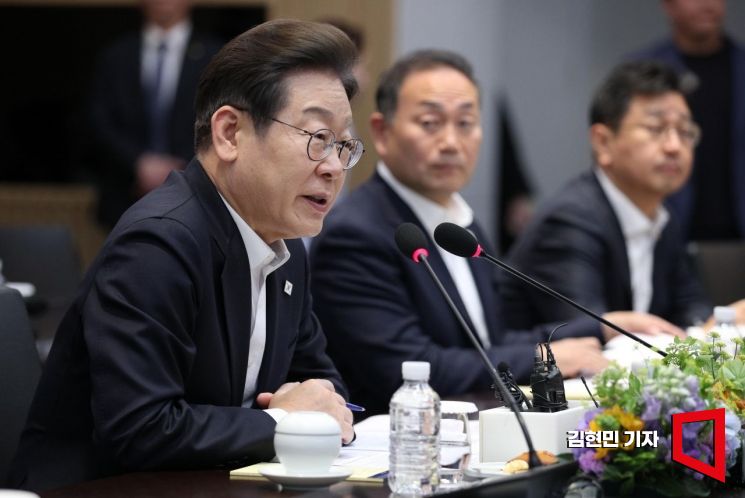 Lee Jae Myung, the Democratic Party presidential candidate, is speaking at the 'K-Semiconductor' AI memory semiconductor company meeting held at SK Hynix in Icheon, Gyeonggi Province on April 28, 2025. Photo by Kim Hyun Min
Coincidentally, both plans are scheduled to announce their next iterations this year. The National Railway Network Construction Plan is a ten-year plan that is revised and supplemented, or has new content added, every five years. The current, fourth plan was released in 2021. The fifth National Railway Network Plan will cover the period from 2026 to 2035.
Looking at past patterns, it was common for the plan to be finalized around May or June after a series of procedures such as public hearings at the beginning of the year. According to government sources, the fifth National Railway Network Plan is expected to be delayed until the end of this year due to the presidential election, which was not originally scheduled for this year. An official familiar with the matter said, "It is not easy to finalize a long-term plan that is difficult to change frequently in a situation where there is a possibility of a change in administration," adding, "There is a high possibility it will be released at the end of the year."
The situation is similar for expressways. The second Expressway Construction Plan, currently in effect, covers the period from 2021 to 2025. The upcoming third plan will span from 2026 to 2030. While it is scheduled to be released as early as the end of this year, both internal and external sources within the ministry suggest that, depending on progress, it could be pushed to early next year.
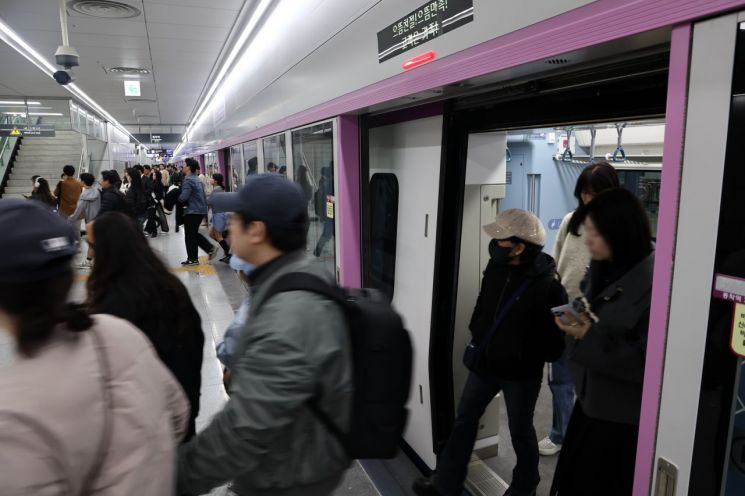 GTX-A Seoul Station, a metropolitan express railroad line in the Seoul metropolitan area. Photo by Yonhap News
The GTX-D, E, and F lines mentioned by Lee are expected to be included in the fifth National Railway Network Plan. In addition, Gyeonggi Province has proposed additional routes (GTX Plus), and Lee has also pledged to actively pursue these routes.
The concept of digging down to depths of more than 40 meters underground to lay railways was first proposed during the tenure of Kim Moon Soo, the People Power Party primary candidate, who served as governor of Gyeonggi Province before Lee. It is known that Lee Han Jun, the current president of Korea Land and Housing Corporation (LH), refined this concept while serving as president of Gyeonggi Housing and Urban Development Corporation during Kim's term. Lee Han Jun is an expert in urban engineering who has conducted extensive research at national policy research institutes such as the Korea Transport Institute.
The expansion and improvement of transportation infrastructure is an issue that most policymakers pay attention to, regardless of their political standing. The East-West Peace Expressway and the Seoul-Yeoncheon Expressway, which Lee specifically mentioned, have already been included in statutory plans, so their progress is expected to accelerate depending on the government's commitment to implementation.
© The Asia Business Daily(www.asiae.co.kr). All rights reserved.


















