Bill Led by Son Myungsoo Passes Plenary Session
Legal Basis Established for PF Integrated Information System
Shift from Post-Event Management to Proactive Detection and Prevention
The government has established a legal foundation that allows it to proactively monitor and assess risks in the real estate project financing (PF) market, which is valued at 230 trillion won. With the passage of the relevant legislation in the National Assembly, it has become possible to build a system that integrates and manages PF project information nationwide and makes this information accessible to the general public. The intent is to prevent a repeat of situations like the Legoland incident, where delayed understanding of the situation led to increased confusion.
According to the Ministry of Land, Infrastructure and Transport (MOLIT) on May 3, the "Real Estate Development Project Management Act," which passed the National Assembly plenary session on May 1, will enable the full-scale operation of the "PF Integrated Information System" starting in 2027. This system will collect and share information on all stages of PF projects, from land acquisition to permits, loans, and sales rates. Real estate PF refers to the practice of borrowing funds from financial institutions for real estate development, using future revenues as collateral.
A MOLIT official stated, "We are currently conducting an Information Strategy Planning (ISP) service at the preliminary planning stage," and added, "We plan to begin full-scale system construction next year and complete it by the end of the year." Previously, the government announced its plan to build this system in the "Real Estate PF System Improvement Plan" released in November last year and included the ISP service cost in the 2025 budget proposal.

The PF Integrated Information System was established to address the shortcomings revealed during the 2022 Legoland incident, when the government failed to promptly grasp the actual market situation. At that time, the information available to the government was limited to loans from banks and secondary financial institutions, and it lacked a proper understanding of capital flows in the tertiary financial sector or development projects at the permit stage. Since permitted development projects typically lead to PF, the absence of such information was a decisive factor in the government's inability to detect market risks.
Once the law is implemented, developers carrying out projects above a certain scale will be required to report their project plans and progress to MOLIT. MOLIT will then manage this data through the PF Integrated Information System. The threshold for the scale of projects subject to management has not yet been determined. A MOLIT official said, "If the project scale is too small, it could impose an excessive burden on the private sector, so we are reviewing this carefully," and added, "We plan to specify the details through an enforcement decree."
The core of this system is not merely the accumulation of information, but enabling the general public, financial institutions, and local governments to jointly access PF project information. A MOLIT official explained, "There are cases where the number of permits suddenly increases and then decreases, resulting in significant fluctuations in PF projects by region," and added, "It is necessary to disclose information so that the public can know who is developing what and at what scale." For example, if permits are concentrated in a specific period in a city like Daegu, publishing the data in advance will allow subsequent developers to assess whether the market is overheating and avoid reckless entry. The official further emphasized, "This system is not intended to control developers, but to provide transparent information so that the market can operate rationally."
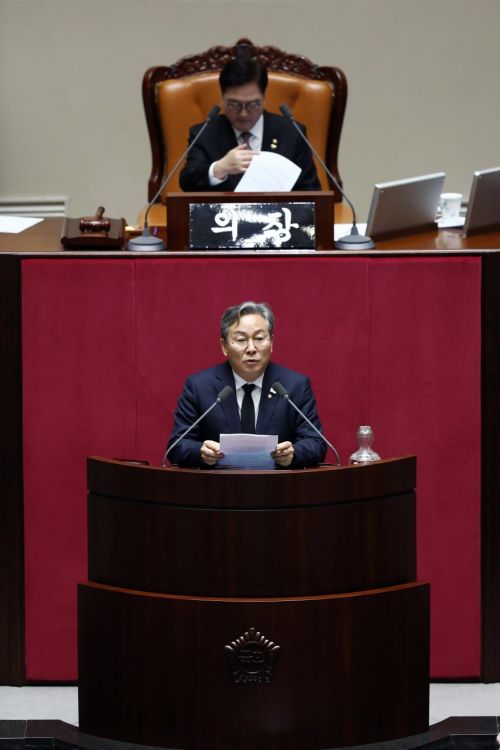 Son Myungsoo, a member of the Democratic Party of Korea, explaining a proposal at the National Assembly plenary session. Photo by Son Myungsoo's office
However, the government will not disclose all sensitive information about individual projects. Sensitive items, such as equity ratios, will be used solely for policy decisions, while only statistical data focused on the status of PF projects by region and stage will be made available to the public. The plan is to protect business secrets of developers while ensuring that anyone can monitor market trends.
Son Myungsoo, a member of the National Assembly's Land, Infrastructure and Transport Committee from the Democratic Party of Korea, who sponsored the bill, stated, "With the passage of the bill, it is now possible to build the PF Integrated Information System, allowing us to diagnose supply conditions and risks in advance and enhance the government's policy responsiveness." He added, "By systematically managing PF projects, we expect to prevent market instability in advance, such as a downturn in the construction sector or an increase in unsold properties." The bill also includes provisions for establishing a "Real Estate Development Project Mediation Committee" to resolve PF-related disputes.
The law will take effect six months after promulgation, and major procedures such as project reporting will be applied two years after promulgation to allow the industry sufficient preparation time.
© The Asia Business Daily(www.asiae.co.kr). All rights reserved.


















