Cases of Abuse of the “Individual Out-of-Pocket Payment Ceiling System” Detected in Health Insurance Audit
39 Billion Won Paid to 4,089 High-Amount, Long-Term Delinquent Payers Over the Past Four Years
It has been revealed that health insurance premiums diligently paid by responsible contributors have, in fact, been used to provide benefits to individuals who have failed to pay their premiums and are in arrears.
According to the results of a comprehensive audit by the National Health Insurance Service, released by the Ministry of Health and Welfare on May 2, it was found that over the past several years, tens of billions of won in health insurance benefits have been paid out to high-amount, long-term delinquent payers.
This occurred under the “individual out-of-pocket payment ceiling system,” which stipulates that if a patient’s annual hospital expenses (excluding non-covered items) exceed a certain amount (ranging from 870,000 to 8.08 million won in 2024, depending on income level), the National Health Insurance Service covers the excess amount. Although this system was introduced to prevent excessive medical expenses from becoming a heavy burden on households, such benefits were also provided to those who had failed to pay more than 10 million won in health insurance premiums for over a year.
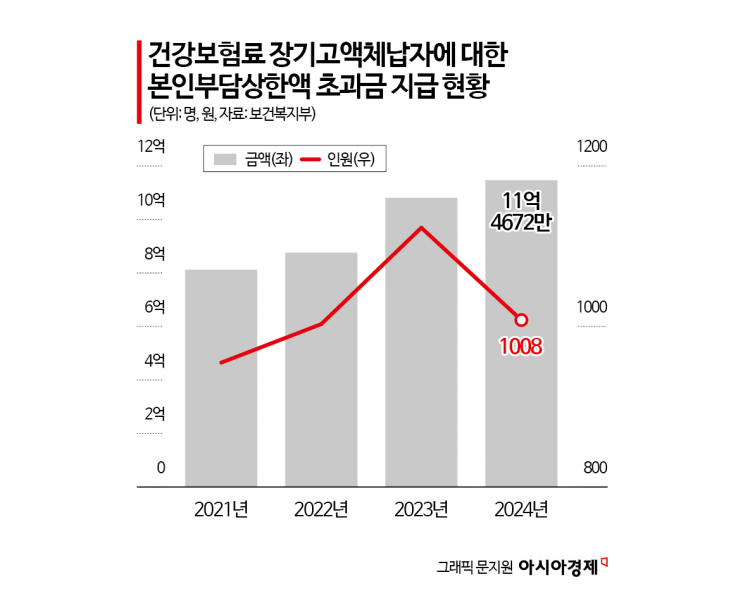
According to audit data, from 2021 to 2024, a total of more than 3.9 billion won in excess out-of-pocket payments was provided to 4,089 high-amount, long-term delinquent payers.
In 2024 alone, 1,008 delinquent payers received approximately 1.15 billion won. While this represents about 3% of all delinquent payers, critics argue that providing such benefits to those in arrears using funds contributed by responsible payers contradicts the original intent of the system.
To address this issue, a bill was proposed in the 21st National Assembly to offset unpaid premiums and refundable amounts. However, it was discarded due to legal issues, such as the prohibition of seizure of the right to receive insurance benefits.
The National Health Insurance Service has expressed its intention to revise the law so that overdue premiums can be deducted from refundable amounts instead of direct offsetting. However, more than three years have passed since the problem was first raised, and no improvements have been made. In the meantime, more than 3,000 delinquent payers have received over 3 billion won.
A similar issue has been discovered in the “refund of out-of-pocket payments” system, which returns excess payments to subscribers when hospitals or pharmacies accidentally charge more than the actual medical costs.

Under current law, this refund can be offset against unpaid premiums. However, due to loopholes in the National Health Insurance Service’s system, some high-amount, long-term delinquent payers received these refunds without any offset against their overdue premiums. Between 2021 and 2024, as many as 2,500 to 2,800 delinquent payers each year received refunds, with some individuals receiving over 30 million won.
The National Health Insurance Service has stated that it will introduce a deduction system for excess out-of-pocket payments through legal amendments, and ensure proper offsetting of out-of-pocket payment refunds through interdepartmental cooperation and system improvements.
© The Asia Business Daily(www.asiae.co.kr). All rights reserved.


















