Posing as Financial Supervisory Service Employees... Raised Suspicion of Money Laundering Involvement
Instilled Trust by Saying, "We Will Visit Your Home for Investigation"
Five People Actually Came to the Victim's House for an On-Site Inquiry
Caller Impersonating a Prosecutor Repeatedly Mentioned Possible Criminal Activity
Exerted Psychological Control by Referring to the Son and Daughter-in-Law's Personal Details
Demanded Exchange of 110 Million Won for Cashier's Checks After Checking Account Balances
Induced an Additional Loan of 20 Million Won Before the Group Fled
Nonghyup Suspected Unusual Transaction but Took No Action
Main Perpetrators Arrested, but Recovery of Stolen Funds Seems Unlikely
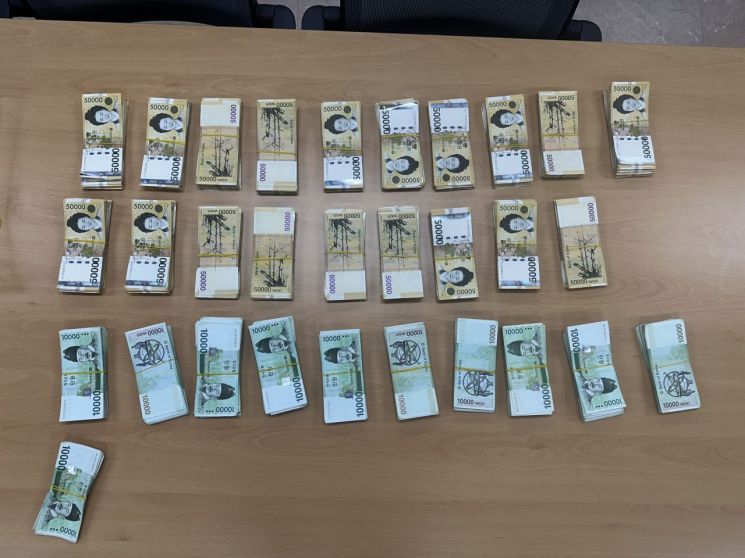 Bundles of cash seized from a boyce phishing criminal organization recently apprehended by the Jeonnam Police. The photo is a reference image to aid in understanding the article. Provided by Jeonnam Police.
At 9:30 a.m. on February 17, in Mokpo, Jeonnam, a phone call from an unfamiliar number marked the beginning of a nightmare for a woman in her 60s, referred to as Ms. A.
"Have you recently made a new card? An account under your name has been linked to an overseas money laundering case."
This was the first thing said to Ms. A by a very polite-sounding man, estimated to be in his 50s or 60s.
Ms. A had heard a lot about voice phishing crimes and initially intended to ignore the call. However, she decided to ask about the details, just in case.
"What do you mean by that?" she asked. The caller then claimed to be an employee of the Financial Supervisory Service, saying, "I will visit you soon," and instructed her, "For now, since your account may be linked to a crime, please install the app I send you and wait."
Startled by the claim that someone would come to her house, Ms. A’s initial suspicion quickly turned into worry.
She clicked on the mysterious app that was sent to her phone.
After Ms. A downloaded the app, she was told to call 1332, the Financial Supervisory Service’s complaint number.
She then had a second call, this time with someone who introduced himself as "Manager 000" from the Financial Supervisory Service, and once again heard about her alleged involvement in an overseas illegal account case.
Just about 20 minutes later, a third call came from someone claiming to be "Prosecutor 000" from the prosecutor’s office.
The content of this call was even more intense.
The person, claiming to be a prosecutor, began reciting all of Ms. A’s personal information, as well as her children’s and family members’, as if he were reading from a file. He especially threatened her by saying that even her son was implicated in the crime.
It was a series of truly shocking events for Ms. A.
While she was still on the phone with the so-called prosecutor, her doorbell rang. About five people arrived at her home, claiming to be from the Financial Supervisory Service, as mentioned in the previous call.
Unlike the threatening prosecutor, these individuals reassured Ms. A, saying, "We can protect your money and minimize the damage."
They then asked how much cash and how many bankbooks she had.
At that time, Ms. A had about 110 million won in her Nonghyup Bank account and others, and she informed them of this fact.
They said, "Thank you for letting us know," and repeatedly instructed her to wait for further contact and not to communicate with her family, just in case, before ending the call.
Two days later, on February 19, they called Ms. A again.
They told her to convert the money in her account into cashier’s checks first, claiming that there should be no money left in her account. They persuaded her by saying that cashier’s checks are traceable by serial number and therefore difficult to use for criminal activity.
Following their instructions, Ms. A went to a nearby Nonghyup branch and exchanged 100 million won for one cashier’s check and 10 million won for another, out of her total 110 million won in cash.
The Nonghyup staff only asked a basic question, "Why are you converting such a large amount into cashier’s checks?" and then issued the checks without further action.
Although this was an unusual transaction, and there was sufficient reason and justification to suspend payment or report to the police based on suspicion of a suspicious transaction, the bank did not take any special measures.
Once the check exchange was confirmed, the scammers told Ms. A that they would temporarily hold onto the checks and visited her to directly take possession of them.
After this, their demands became even more blatant.
This time, they told Ms. A to take out a card loan, claiming that they needed to check whether a normal card loan could be issued to rule out the possibility of involvement in a fraudulent case with a credit card company.
Firmly believing in them, Ms. A took out a 20 million won loan and, following their instructions, deposited the money into another bankbook and placed it in a mailbox near her home, along with the linked check card.
The 20 million won in this account was withdrawn by an unknown person on February 23, leaving the balance at zero.
In less than a week, Ms. A lost her entire fortune of about 130 million won.
It was only after everything was over that she informed her son and daughter-in-law of what had happened, but by the time she realized it was voice phishing, the criminals had already fled.
She immediately reported the incident to the Mokpo Police Station, and around mid-March, a man in his 30s from Uzbekistan, who acted as a money mule, was apprehended by the police. It was also reported that the main perpetrators were caught by police in another region while committing similar crimes.
However, it is still uncertain whether the stolen funds can be recovered.
The case has now been transferred from Mokpo Police Station to the Jeonnam Police Agency, where further investigation into additional crimes is ongoing.
An official from the Jeonnam Police said, "When people think of voice phishing, they often imagine criminals simply deceiving victims over the phone to induce them to commit crimes. However, nowadays, the so-called 'face-to-face fraud,' where scammers divide roles and meet victims in person to carry out the scam, has become commonplace. If someone suddenly calls or wants to meet you, claiming you are involved in a financial crime, you should immediately inform the police or a close family member or acquaintance and take appropriate action."
Meanwhile, as of last year, there were 111 reported cases of face-to-face voice phishing scams in the Jeonnam region.
© The Asia Business Daily(www.asiae.co.kr). All rights reserved.
![Clutching a Stolen Dior Bag, Saying "I Hate Being Poor but Real"... The Grotesque Con of a "Human Knockoff" [Slate]](https://cwcontent.asiae.co.kr/asiaresize/183/2026021902243444107_1771435474.jpg)
















