Possibility of a Swift Retrial Like the Supreme Court
Even if a Verdict Is Delivered, Awaiting Final Appeal
Difficult to Reach a Final Decision Before the Presidential Election
Unresolved Conflict Between Judiciary and Politics
With the Supreme Court overturning the Seoul High Court's previous decision and remanding the case of Lee Jaemyung, the presidential candidate of the Democratic Party of Korea, for a guilty verdict regarding his violation of the Public Official Election Act, attention is now focused on the upcoming procedures. The Seoul High Court will assign the remanded case to its election-specialized panel, and in this trial, the sentencing for Lee under the presumption of guilt will be determined. If an appeal is filed after that, the Supreme Court will proceed with the final confirmation process. Throughout this process, there are predictions that the conflict between 'judiciary' and 'politics' will intensify.
Supreme Court Emphasizes 'Voters' Rights'
On May 1, the Supreme Court ruled that Lee Jaemyung had violated election law by announcing false information, and presented the constitutional concept of 'the perspective and rights of voters' as the core standard for its judgment. The Court stated that when determining whether false information was announced under election law, it is necessary to ensure that the candidate's freedom of political expression is not excessively restricted, while also comprehensively examining whether the voters' right to know and their constitutional fundamental rights as citizens are fully protected through fair elections. In this context, the Supreme Court said, "If the overall impression given to voters is used as the standard to determine the meaning, Lee Jaemyung's golf remarks can be interpreted as 'the defendant did not play golf with Kim Moonki during the overseas business trip with Kim Moonki.'" This, the Court stated, constitutes the announcement of false information.
The Supreme Court also stated that when interpreting the specific 'meaning of an expression,' it must be viewed from the perspective of ordinary voters, not the candidate personally or the court. When determining the meaning of a statement, the overall context and circumstances must be considered, based on how voters would have understood it.
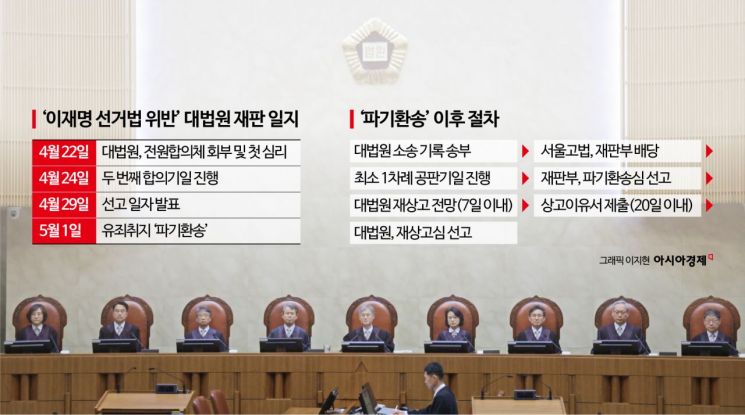
Will the Remanded Trial Conclude Before the Presidential Election?
The Supreme Court's ruling is binding on lower courts. Therefore, unless the Seoul High Court's remanded trial is presented with decisive new evidence overturning the Supreme Court's guilty finding, it is compelled to reach a guilty verdict. The key issues are the sentence and the timing of the verdict. Under election law, the threshold for disqualification from candidacy is the imposition of a 'fine of 1 million won or more.' In legal circles, the prevailing view is that unless there are special changes in circumstances, the remanded trial is likely to impose a fine of at least 1 million won. In this case, the first trial sentenced Lee to one year in prison, suspended for two years. This took into account that Lee's acts of announcing false information, which were found guilty, included two instances: his statement about not playing golf and his statement about there being threats from the Ministry of Land, Infrastructure and Transport. The Supreme Court also essentially reached the same conclusion as the first trial. Ultimately, when the remanded trial determines Lee's sentence, the first trial's sentence will inevitably serve as the benchmark.
With just over a month remaining until the presidential election, there are mixed predictions about whether the remanded trial's verdict will be delivered before the election. Typically, remanded trials do not take as long as other trials, since the main conclusion (the Supreme Court's guilty finding) has already been established. Therefore, since the Supreme Court delivered its verdict in about 30 days, there are expectations that the remanded trial could also reach a swift conclusion. However, there are also views that this may not be easy, considering Lee's right to a defense.
Even after the remanded trial, Lee can file another appeal. In that case, due to procedures such as the appeal period (7 days) and submission of opinions (20 days), it would be physically difficult to reach a final decision before the presidential election. As a result, some say that while the Supreme Court has effectively concluded the 'legal judgment,' it has left the 'political judgment' regarding Lee to the sovereign people.
Controversy Over Interpretation of Article 84 of the Constitution
If Lee is elected president before the Supreme Court's final decision, controversy over Article 84 of the Constitution, which stipulates presidential immunity, is inevitable. This provision states, "The President shall not be subject to criminal prosecution during his term of office except for crimes of insurrection or treason." The core of the controversy is the interpretation of 'criminal prosecution.' One side interprets this to mean that while no new indictments can be brought after becoming president, trials for cases already indicted and underway can continue. The other side argues that not only new indictments but also trials for already indicted cases must be suspended during the presidential term.
Although this is a hypothetical extreme, some in political circles predict that the Democratic Party, which holds a majority in the National Assembly, could revise the election law itself through legislation. They could delete the provision on the crime of announcing false information, or revise the law to allow for dismissal of cases already on trial.
© The Asia Business Daily(www.asiae.co.kr). All rights reserved.
![Clutching a Stolen Dior Bag, Saying "I Hate Being Poor but Real"... The Grotesque Con of a "Human Knockoff" [Slate]](https://cwcontent.asiae.co.kr/asiaresize/183/2026021902243444107_1771435474.jpg)
















