"Push for Pardons During Ongoing Trials Through Legal Amendments"
"Judicial Coup and Ongoing Scheme to Perpetuate Insurrection"
Concerns Over Cabinet Quorum Shortage as a Political Flashpoint
The Supreme Court's decision to remand the case of Lee Jaemyung, the Democratic Party’s presidential candidate, for a guilty verdict on charges of violating the Public Official Election Act has sent shockwaves through the presidential race. The political debate surrounding Lee’s “judicial risk” is expected to remain a major variable until the very end of the election.
On May 2, Kwon Sungdong, floor leader of the People Power Party, stated at a party strategy meeting, “The Supreme Court showed yesterday that the rule of law and freedom are alive in the Republic of Korea.” He argued, “If Lee is elected president, he could declare the relevant provisions of the Public Official Election Act unconstitutional and abolish the law itself.” Kwon claimed that Lee might attempt what he called “total legislative deprivation”-abolishing the law to grant himself a pardon and completely overturn the trial process.
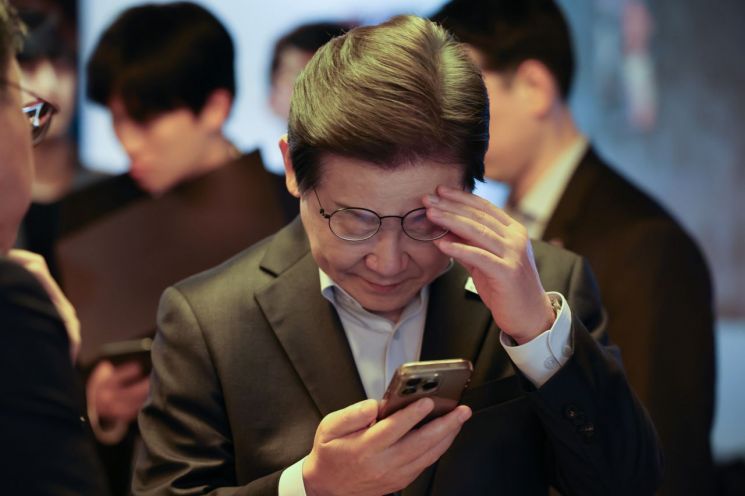 Candidate Lee Jae Myung Concludes Meeting with Atypical Workers
(Seoul=Yonhap News) On May 1, Lee Jae Myung, the Democratic Party presidential candidate, is seen checking his smartphone after concluding a meeting with atypical workers such as delivery riders and courier drivers under the theme "Invisible Heroes Who Make Your Day" at a pojangmacha restaurant in Jongno-gu, Seoul. 2025.5.1 [National Assembly Press Photographers Group]
Photo by National Assembly Press Photographers Group
photo@yna.co.kr (End)
Kwon further stated, “Under the current Amnesty Act, only those with finalized sentences can be pardoned. However, with the Democratic Party controlling the president’s right to request reconsideration, they could push through a legal amendment to allow pardons for those still on trial.” He also expressed concern that “for cases still at the first trial stage, they could appoint an ultra-leftist Minister of Justice and mobilize prosecutors with pro-Democratic Party leanings to even attempt to drop the charges.”
The Democratic Party reacted strongly, calling the Supreme Court’s remand a political ruling. Park Chan-dae, Democratic Party floor leader and chief campaign manager, said at the Central Election Committee meeting, “It is an extremely irrational and unfair verdict, a judicial coup, and election interference.” He added, “It was as if it was all prearranged-immediately after the Supreme Court ruling, Acting President and Prime Minister Han Ducksoo resigned and announced his presidential candidacy. This is part of an ongoing scheme to perpetuate insurrection.”
The Democratic Party also plans to pursue legislative measures to suspend ongoing trials if Lee is elected president. Jeong Cheongrae, Democratic Party lawmaker and chair of the National Assembly’s Legislation and Judiciary Committee, warned, “In line with the spirit of Article 84 of the Constitution, we will soon pass a bill (to suspend trials) through the committee. An eye for an eye, a tooth for a tooth.” Article 84 of the Constitution stipulates that “the president shall not be subject to criminal prosecution during their term of office except for insurrection or treason.” This move is intended to preempt constitutional conflicts between the judiciary and the executive branch, and to secure legitimacy.
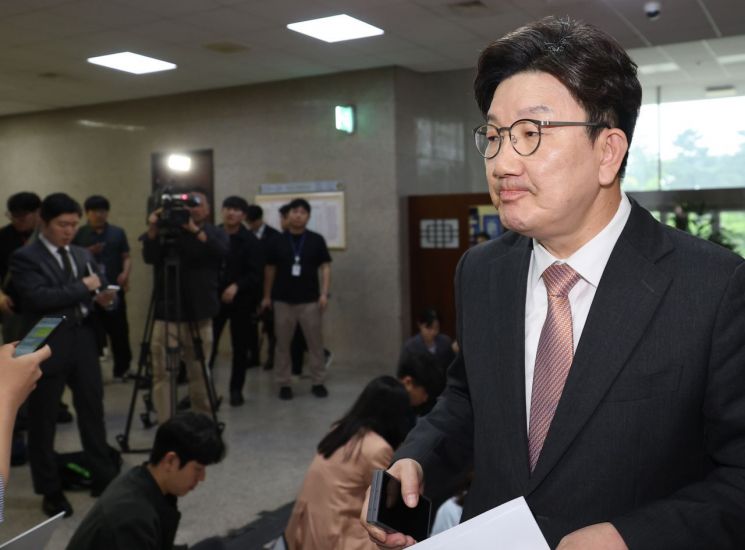 Floor Leader Kwon Sungdong Finishes Briefing (Seoul=Yonhap News) Photo by Park Dongjoo = On May 1, 2025, Kwon Sungdong, floor leader of the People Power Party, is seen leaving after finishing a briefing at the National Assembly in Yeouido, Seoul, following the Supreme Court's ruling on the appeal in the case of Lee Jae-myung, the Democratic Party's presidential candidate, accused of violating the Public Official Election Act. pdj6635@yna.co.kr (End)
 Some in political circles believe that the shortage of cabinet members resulting from the resignation of Choi Sangmok, Deputy Prime Minister and Minister of Economy and Finance, could become a flashpoint. According to Article 88 of the Constitution, the State Council must be composed of the president, the prime minister, and at least 15 but no more than 30 cabinet members. Currently, with only 14 members, the council falls short by one. However, since the quorum for convening the State Council is 11 members, it is likely that a complete paralysis of the council will be avoided. In 2009, when there were 14 cabinet members due to a vacancy in the Ministry of the Interior and Safety, the Ministry of Government Legislation interpreted that the council could be convened as long as the quorum was met.
© The Asia Business Daily(www.asiae.co.kr). All rights reserved.
![Clutching a Stolen Dior Bag, Saying "I Hate Being Poor but Real"... The Grotesque Con of a "Human Knockoff" [Slate]](https://cwcontent.asiae.co.kr/asiaresize/183/2026021902243444107_1771435474.jpg)

















