One Man, Three Roles Amid Impeachment Turmoil... Focused on Managing External Credibility
Swift Disaster Response... Government-Led Supplementary Budget Prepared
Former Deputy Prime Minister and Minister of Economy and Finance Choi Sangmok stepped down from his post on the night of May 1, relinquishing his economic leadership after one year and four months in office. Choi is credited with having stably managed state affairs as acting president in the wake of the December 12·3 Martial Law incident last year, despite challenging domestic and international circumstances.
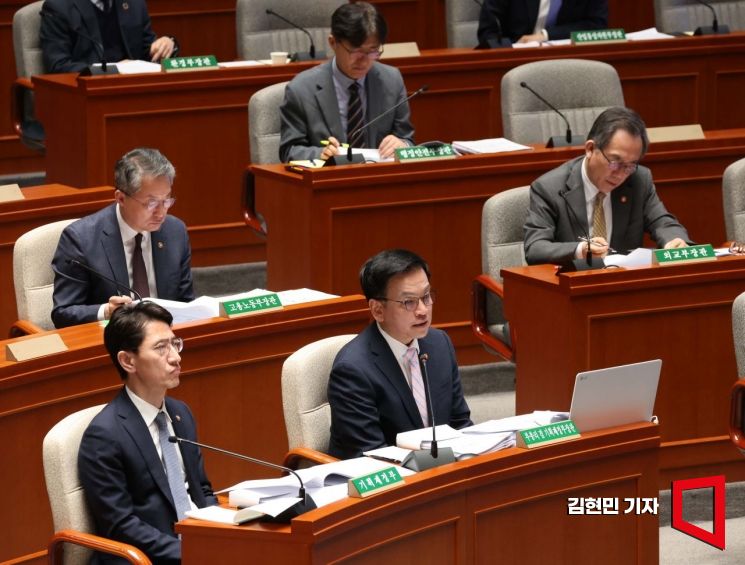 Choi Sangmok, Deputy Prime Minister for Economic Affairs and Minister of Economy and Finance, is attending the comprehensive policy questioning session on the supplementary budget review at the plenary meeting of the National Assembly's Special Committee on Budget and Accounts on the 29th, responding to members' inquiries. 2025.4.29 Photo by Kim Hyunmin
Choi announced his resignation at 10:28 p.m. on May 1. He was the second Deputy Prime Minister for Economic Affairs under the Yoon Suk-yeol administration, following former floor leader Chu Kyungho of the People Power Party. Since taking office in January 2024, Choi had promoted economic policies under the “Dynamic Economy” roadmap. This roadmap was designed to fundamentally enhance Korea’s economic productivity by addressing the structural problems of the Korean economy.
Believing that raising social mobility would invigorate society and improve overall productivity, Choi introduced a “Social Mobility Improvement Plan.” He emphasized that in order to improve economic mobility, it was necessary to promote labor market participation among youth and women, and that structural reforms were needed to create better conditions for work-family balance. He also worked to make corporate childbirth incentives fully tax-exempt as part of efforts to address the low birth rate. In addition, he pursued policies to expand large company investment to vitalize the private sector and sought to reform the inheritance tax into an acquisition-based system.
After the December 12·3 Martial Law incident last year, Choi served as acting president for 88 days, following the successive impeachments of former President Yoon Suk-yeol and acting President Han Ducksoo. He appointed two Constitutional Court justices, Jung Gyesun and Cho Hanchang, out of three candidates recommended by the National Assembly, establishing an eight-member Constitutional Court and facilitating the impeachment process against former President Yoon. A government official stated, “By enabling the Constitutional Court to function, he reduced political uncertainty.” However, Choi did not appoint candidate Ma Eunhyeok, drawing criticism from the opposition and ultimately sparking the submission of an impeachment motion to the National Assembly.
Choi is also credited with maintaining Korea’s external credibility in the difficult environment that followed the martial law and impeachment crises. From immediately after the December 12·3 Martial Law incident, he continuously convened the Macroeconomic and Financial Issues Meeting (F4), and made every effort to communicate with finance ministers of major countries, heads of international organizations, and global credit rating agencies, explaining that political uncertainty in Korea was not translating into economic uncertainty. As a result, global credit rating agency Standard & Poor’s (S&P) maintained Korea’s credit rating at ‘AA (Stable)’ as of April 15.
Choi was also recognized for his outstanding crisis response by swiftly addressing a series of disasters and accidents that occurred during the acting presidency. Immediately after assuming the acting role, he mobilized all available equipment and personnel to direct rescue operations following the aircraft accident at Muan Airport in South Jeolla Province, promptly visited the site, activated the Central Disaster and Safety Countermeasures Headquarters, and quickly designated special disaster areas. He called for an integrated government response to ensure rapid support for affected residents.
He also played a key role as Korea’s economic commander-in-chief by actively participating in the Korea-U.S. 2+2 Trade Talks held in Washington, D.C. In a situation where mutual tariffs imposed by the United States had made bilateral negotiations critical, Choi worked to establish close inter-ministerial networking before and after the talks to resolve issues. There is also internal assessment that he set up a system for all ministries to share information and respond quickly to negotiations with the United States.
The government, under Choi’s leadership, also pushed for a supplementary budget to address the livelihood economy crisis. On May 1, the National Assembly passed a 13.8 trillion won supplementary budget to respond to the trade environment and economic conditions for ordinary citizens caused by the tariff war initiated by U.S. President Donald Trump. Choi believed that, given the high level of external uncertainty, the government should focus on areas where there was little disagreement between the ruling and opposition parties to ensure swift fiscal injection, and thus directed the preparation of a government-led supplementary budget. A government official explained, “Former Deputy Prime Minister Choi prepared the supplementary budget with the premise that it needed to be structured in a way that would pass the National Assembly, which enabled the rapid process.”
© The Asia Business Daily(www.asiae.co.kr). All rights reserved.

















