If the U.S. Approaches with Sincerity,
China Eases Its Stance, Saying "No Harm to China"
Foreign Media Interpret This as a "Signal for Trade Negotiations"
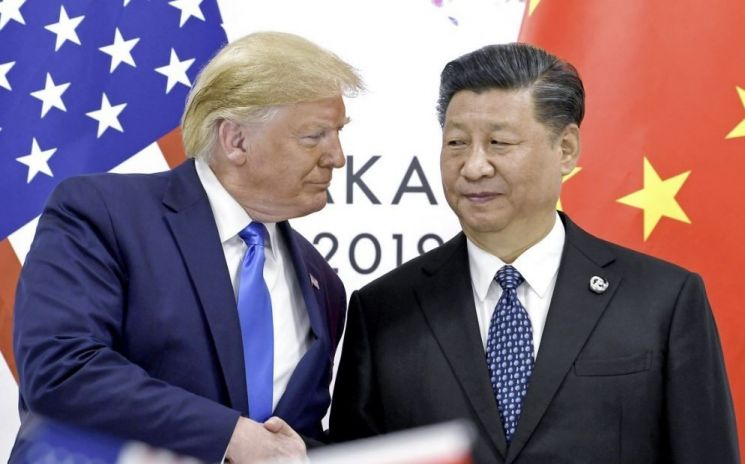 During the first term of the Trump administration, U.S. President Donald Trump met with Chinese President Xi Jinping. On the 1st, China hinted at the possibility of negotiations by stating through a social networking service (SNS) post that it could initiate dialogue with the United States.
As the U.S. and Chinese economies have suffered serious damage from the high-tariff trade war, China hinted at the possibility of negotiations with the United States through a social networking service (SNS) post on the 1st. Foreign media outlets noted that China also sent signals via SNS during the first U.S.-China trade war, interpreting this as a sign that China, which had maintained a hardline stance, is now shifting to a somewhat more conciliatory position.
On May 1, 'Weiyuantantian', an SNS account affiliated with China's state-run China Central Television (CCTV), stated in a post, "China does not need to initiate dialogue before the United States takes substantive action," but also softened its tone by adding, "If the United States wants to talk, there is nothing at this point that would harm China." This suggests that while China is not requesting talks first, it is open to entering into dialogue if the United States approaches with sincerity.
The Financial Times (FT) of the United Kingdom commented, "As both countries seek a breakthrough to escape the high-tariff trade war, Beijing's attitude appears to have softened." The Washington Post (WP) in the United States also pointed out, "Beijing and the Trump administration are shifting to a somewhat more conciliatory stance regarding negotiations."
Foreign media focused on the recent shift in China's tone over the past few days. Previously, China had maintained a hardline stance on trade negotiations between the two countries. On April 24, the Chinese Ministry of Commerce asserted, "Negotiations are only possible if the United States first withdraws its high tariffs," taking a firm position. Three days later, on April 29, the Chinese Ministry of Foreign Affairs also referred to the United States as a "bully" and a "paper tiger" in a video released on its official SNS account.
The fact that China has sent a signal via SNS indicating its willingness to leave the door open for dialogue with the United States is also seen as a sign of the possibility of negotiations between the two countries. China had previously sent signals via SNS before entering negotiations during the first U.S.-China trade war under the first Trump administration. According to the FT, Wang Zichen, a researcher at the Center for China and Globalization, analyzed through posts on Weiyuantantian and another account that "China is signaling its readiness to enter into trade negotiations." He noted, "Sending such signals through social media is a relatively new approach for China," but pointed out that a similar method was used to some extent during the first round as well.
The change in the leaders' attitudes of both countries is believed to have been influenced by public sentiment and economic indicators. President Trump received a bleak approval rating of 44% in a poll conducted during the "honeymoon" period, 100 days before his inauguration, on April 29, due in part to the impact of his tariff policy. This figure is lower than that of former President Joe Biden and also lower than Trump's first term. Although China managed to post a 5.4% GDP growth rate in the first quarter, its economic indicators worsened in April. China's manufacturing Purchasing Managers' Index (PMI) for April, announced on April 30, was 49.0, falling below the baseline of 50, indicating a contraction in the economy.
The FT diagnosed, "The (Chinese) statement came as President Trump hinted at his willingness to negotiate on trade," adding, "It coincides with a time when the impact of tariffs is beginning to be fully reflected in Chinese economic indicators, as China's April manufacturing figures saw the sharpest decline since 2023."
© The Asia Business Daily(www.asiae.co.kr). All rights reserved.
![Clutching a Stolen Dior Bag, Saying "I Hate Being Poor but Real"... The Grotesque Con of a "Human Knockoff" [Slate]](https://cwcontent.asiae.co.kr/asiaresize/183/2026021902243444107_1771435474.jpg)
















