Passed in Just 12 Days After Submission to the National Assembly...
Fastest Supplementary Budget in 20 Years
Increased Funding for Public Welfare and Construction Sector Support
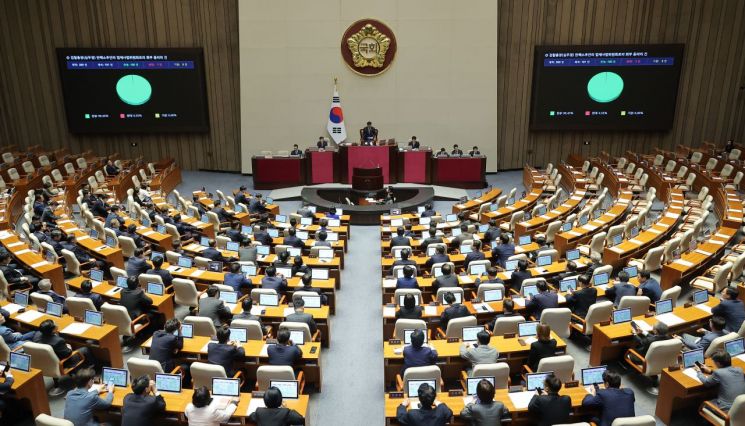
A supplementary budget bill totaling 13.8 trillion won was passed by the National Assembly’s plenary session on May 1. The ruling and opposition parties convened the plenary session at 8 p.m. that day and approved the supplementary budget. It took only 11 days for the bill to pass since the government submitted it to the National Assembly, marking the fastest deliberation in the past 20 years. The aim is to maximize the effectiveness of responses to wildfires, trade issues, and livelihood concerns by ensuring the timely execution of the budget, amid growing fears of an economic shock and worsening public welfare due to the U.S.-led tariff war and wildfire disasters.
According to the Ministry of Economy and Finance on May 1, the supplementary budget approved by the National Assembly amounts to 13.8 trillion won, an increase of 1.6 trillion won from the government’s original proposal of 12.2 trillion won. The budget was increased by 1.8 trillion won for trade, disaster response, and construction sector support, while 200 billion won was reduced through adjustments to certain loan projects.
The additional funds for the expanded supplementary budget will be secured through further government bond issuance. The Ministry of Economy and Finance explained, “Of the 1.6 trillion won increase, 100 billion won will be covered by available resources such as surplus funds, and 1.4 trillion won will be raised through additional government bond issuance.”
With the total supplementary budget increased through deficit-financing bonds, the managed fiscal balance deficit is expected to rise by 0.1 percentage points, from 3.2% to 3.3% of gross domestic product (GDP). The national debt-to-GDP ratio will remain unchanged at 48.4%.
A closer look at the individual projects shows that the supplementary budget, as passed, expanded support for public welfare and the construction sector in response to changing economic conditions since the original proposal. This reflects concerns about a deepening economic downturn, as evidenced by negative growth in the first quarter of the year.
Specifically, 5.1 trillion won will be allocated for small business support and 800 billion won for social overhead capital (SOC) projects to bolster the construction sector. During the review process, the increased funds were allocated to expanding the sales base for small and micro businesses (400 billion won) and supporting the livelihoods of vulnerable groups (400 billion won).
An additional 400 billion won will be allocated for the issuance of local gift certificates (regional currency) to support small local business owners.
A total of 115.7 billion won will be used to support national scholarships. To ease the burden of rising tuition fees, the maximum limit for national scholarship support will be raised by up to 7% starting from the second semester of this year. In addition, to help alleviate the burden of high prices on low-income households, support for discounts on agricultural, livestock, and fishery products will be expanded by an additional 100 billion won.
To support wildfire victims, the total housing support fund for residents who lost their homes will be increased from 20 million to 36 million won to over 100 million won, and a new 10 billion won project will be launched to restore and revitalize resettlement villages to improve living conditions.
To prevent sinkhole accidents in Seoul, 28.7 billion won will be allocated to begin early construction this year on 45 sections (69.6 km) of aging sewage pipelines originally scheduled for renovation next year.
An additional 100 billion won will be provided to strengthen trade risk response and artificial intelligence (AI) competitiveness. To meet the molybdenum stockpiling target early, amid concerns over supply instability due to Chinese export controls, an additional 15.3 billion won will be invested. For companies and academia requiring high-performance computing resources, the budget will include an additional 400 GPUs (8.8 billion won) for rental.
The government will hold a Cabinet meeting at 10:30 a.m. on May 2 to approve the supplementary budget. The Ministry of Economy and Finance stated, “Given the urgency of addressing wildfires, trade risks, and other pressing issues facing our economy, the finalized budget will be executed swiftly within this year.”
The ministry added, “After review by the Central Disaster and Safety Countermeasures Headquarters, the wildfire recovery plan for the Yeongnam region will be finalized this week, and payments for housing and living expenses for affected residents will be made within the month.” The government also plans to immediately implement the digital Onnuri gift certificate rebate for traditional markets in connection with the “May Accompanying Festival” as soon as the budget is allocated following the Cabinet’s approval.
© The Asia Business Daily(www.asiae.co.kr). All rights reserved.
![Clutching a Stolen Dior Bag, Saying "I Hate Being Poor but Real"... The Grotesque Con of a "Human Knockoff" [Slate]](https://cwcontent.asiae.co.kr/asiaresize/183/2026021902243444107_1771435474.jpg)
















