'Hogwang' to Be Introduced to Outdoor Enclosure Starting May 1
Rescued from a Privately Operated Indoor Zoo in Gyeonggi Province
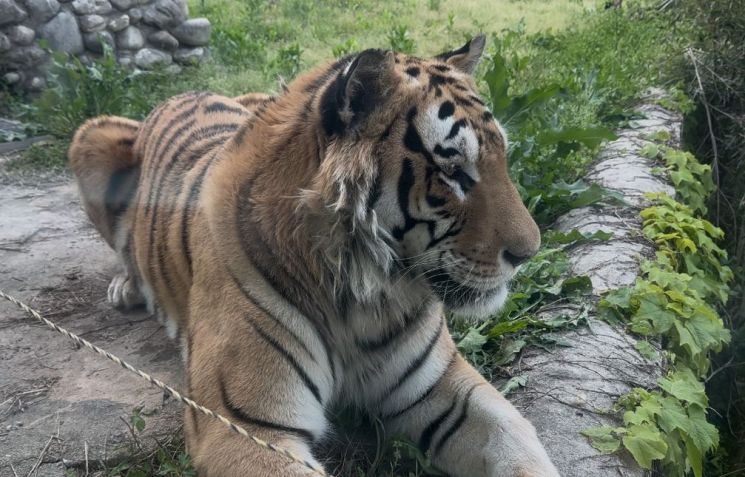
The city of Gwangju has rescued a male Bengal tiger, estimated to be about 10 years old (born in 2015), an internationally endangered species, from a privately operated indoor zoo in Gyeonggi Province and is now caring for it at Uchi Zoo.
The Uchi Park Management Office in Gwangju rescued the male Bengal tiger from an indoor zoo in Gyeonggi Province on April 10. The tiger had been kept for a long period in an indoor environment that did not meet its ecological needs, including a space without sunlight and a concrete floor.
After rescuing the Bengal tiger, the Uchi Park Management Office transported it to Uchi Zoo and conducted a health check. The examination revealed signs of bile stasis on an ultrasound, and the tiger is currently undergoing medication treatment.
The Uchi Park Management Office named the Bengal tiger 'Hogwang,' combining the Chinese character for 'tiger' (Ho) and 'Gwangju' (Gwang), to symbolize the tiger's new beginning in Gwangju. The name also carries the hope that the tiger will 'enjoy a better life' at Uchi Zoo.
This rescue is part of Uchi Zoo's animal welfare initiative, which was planned in advance. Last year, after the passing of the elderly Bengal tiger 'Love,' Uchi Zoo decided to repurpose the enclosure for animals in need and proceeded with environmental improvements.
With 'Hogwang' becoming the newest member of Uchi Zoo, there are now a total of four tigers living at the zoo. Hogwang and two other tigers (one male and one female) are Bengal tigers, while the remaining one is a Siberian tiger.
On May 1, Sung Changmin, head of the Uchi Park Management Office, stated, "Uchi Zoo is transforming into a place that realizes animal welfare through rescues, rather than by purchasing or acquiring animals mainly for exhibition." He added, "We will continue to provide new opportunities for animals in need of rescue and strengthen our role as a public zoo that conveys both ecological and emotional value."
© The Asia Business Daily(www.asiae.co.kr). All rights reserved.

















