LIG Nex1 to Lead Development of Chollian Satellite 5,
Korea's First Privately Led Geostationary Meteorological Satellite
LIG Nex1 announced that the development project for "Chollian Satellite 5," Korea's third meteorological satellite and the first geostationary satellite led by the private sector, is set to begin in earnest.
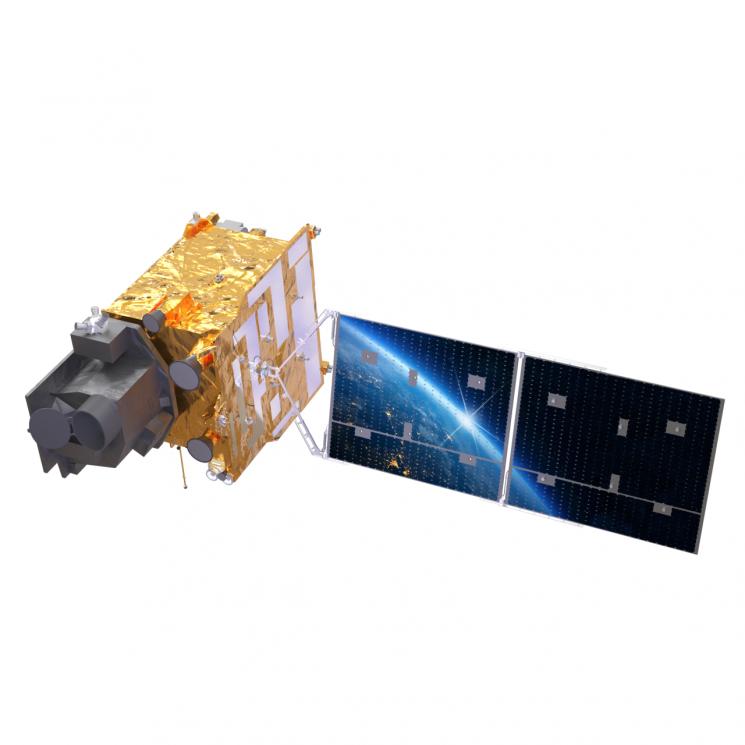
On May 1, LIG Nex1 stated that it had signed a "Geostationary Meteorological and Space Weather Satellite Development Agreement" with the Korea Meteorological Administration, Korea Aerospace Administration, and Korea Meteorological Institute of Industry and Technology. The contract is valued at 320.754 billion KRW, and the development of the Chollian Satellite 5 system and main body will proceed through 2031.
Chollian Satellite 5 is scheduled to launch in 2031. Positioned at an altitude of about 36,000 kilometers above the equator, it is expected to serve as a world-class next-generation meteorological satellite, providing real-time meteorological and space weather observations 24 hours a day.
This marks the first time in the geostationary satellite development project that a private company will take the lead, serving as a catalyst for the K-Space era. As the lead research and development institution for the Chollian Satellite 5 system and main body, LIG Nex1 plans to complete the development of a high-precision geostationary platform that will form the foundation for world-class, high-quality meteorological services, working in close cooperation with the Korea Meteorological Administration, Korea Aerospace Administration, Korea Meteorological Institute of Industry and Technology, Korea Aerospace Research Institute, and partner companies.
Since 2006, LIG Nex1 has focused on securing core technologies, including high-performance Synthetic Aperture Radar (SAR). The company has participated in a wide range of satellite system projects, such as the Geostationary Public Multipurpose Communication Satellite (Chollian Satellite 3), the Korea Positioning System (KPS), Multipurpose Practical Satellites 5 and 6, the military satellite communication system (ANASIS-I/II), and the ultra-small satellite system, thereby accumulating key competencies across all fields of satellite systems.
In particular, with the completion of the Daejeon House Satellite System Integration and Test Facility in the first half of this year through its own investment, LIG Nex1 is expected to significantly strengthen its development infrastructure specialized for the future space industry.
LIG Nex1 plans not only to further enhance its integrated satellite system development capabilities, based on nearly 20 years of experience in developing satellite payloads, main bodies, and ground systems, but also to expand its business areas into satellite applications. Furthermore, the company aims to contribute to the overseas expansion of the K-space industry and the creation of a private sector-led satellite industry ecosystem.
© The Asia Business Daily(www.asiae.co.kr). All rights reserved.

















