Mosquito Swarms Arriving Earlier Due to Climate Change
Local Governments Focus on Mosquito Larvae Control
"Bzzz bzzz."
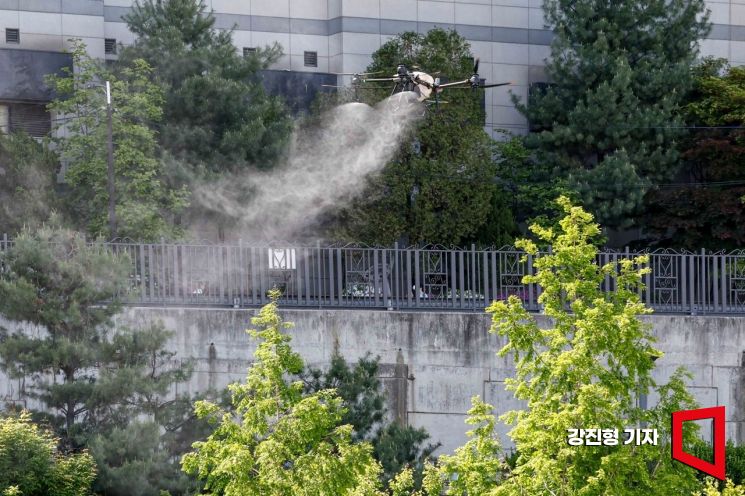 On the 30th, the Gangnam-gu Drone Disinfection Team is conducting mosquito control operations at Daechi Yusuji Sports Park in Gangnam-gu, Seoul. Photo by Kang Jinhyung
Above Daechi Yusuji Sports Park in Daechi-dong, Gangnam-gu, Seoul, a drone swiftly moved through the air, navigating areas such as forests and waterfronts that are difficult for people to reach. This so-called mosquito control drone was carrying mosquito control solution. Lee Sangyun, a 66-year-old official from the Disease Control Division of Gangnam-gu Office, who was piloting the drone, said, "There are many rivers and bushy areas in Gangnam where it is difficult for people or vehicles to spray control solution directly," adding, "Thanks to the drone, the efficiency of mosquito control has greatly improved."
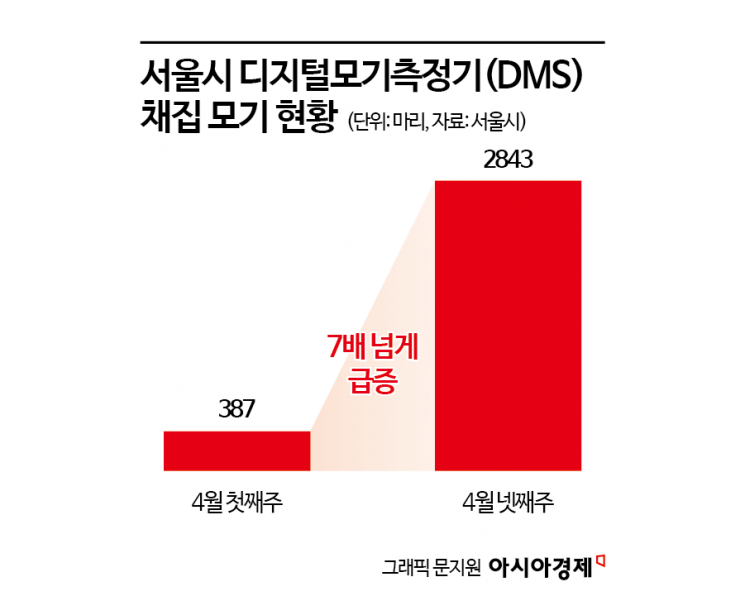
According to the Seoul Metropolitan Government on May 7, the number of mosquitoes collected from 55 locations equipped with Digital Mosquito Measuring Systems (DMS) in the city surged more than sevenfold, from 387 in the first week of April to 2,843 in the fourth week. As Korea's climate shifts toward shorter winters and longer summers, mosquito swarms are appearing earlier in the year.
The increase in mosquitoes is causing greater inconvenience for citizens. Yoon, a 41-year-old resident of Songpa-gu, said, "Recently, I noticed a scratch on my child's skin, and upon closer inspection, it turned out to be a mosquito bite," adding, "Checking my child's body for mosquito bites has become a daily routine even in April and May." On camping community forums, people post comments such as, "Every time I come back from the campsite restroom, I always end up with mosquito bites," and "Mosquito repellent is a must-have from early spring."
Japanese encephalitis, which is transmitted by mosquitoes, is also a concern. In the early 2000s, Japanese encephalitis advisories were issued in May, but by the 2010s, they were being issued in April, and since the 2020s, the trend has shifted even earlier to March. This year, the small red house mosquito, which transmits Japanese encephalitis, was found in Jeju and Jeonnam regions at the end of March. In severe cases, Japanese encephalitis has a fatality rate of 20-30%, and even among survivors, 30-50% suffer from neurological aftereffects.
Lee Dongkyu, a distinguished professor at Kosin University’s Department of Health and Environmental Science, said, "When the average temperature rises above 10 degrees Celsius, adult mosquitoes begin to become active," and added, "Due to global warming, the period when mosquitoes appear continues to get earlier each year."
 On the 30th, the Gangnam-gu Drone Disinfection Team is conducting mosquito control work at Daechi Yusuji Sports Park in Gangnam-gu, Seoul. Photo by Kang Jinhyung
Local governments are on high alert to eliminate mosquito larvae. Gangnam-gu in Seoul is distributing mosquito growth inhibitors to households to prevent larvae from maturing into adults, and has introduced control drones to conduct mosquito control operations twice a week until November. Jung-gu in Seoul has been operating a 'Mosquito Disinfection Task Force' since last month, which visits residents upon request to remove mosquito larvae directly.
Local governments especially consider it important to prevent mosquito larvae from developing into adults. Adult mosquitoes are highly adaptable and can be found even in high-rise apartments and buildings, making them difficult to control. In contrast, mosquito larvae reside only in places such as puddles, septic tanks, and drains, so these areas become the focus of control efforts. "Eliminating one mosquito larva is as effective as getting rid of more than 500 adult mosquitoes," according to a Gangnam-gu official.
Professor Lee Dongkyu said, "Since Korea is no longer a safe zone from mosquito-borne infectious diseases, it is time for a 'systematic response' with a precise mosquito surveillance system and region-specific control strategies."
© The Asia Business Daily(www.asiae.co.kr). All rights reserved.



















