McDonald's, Burger King, KFC, Lotteria
Cost Ratios Drop... Profitability Soars Last Year
Another Round of Hamburger Price Hikes This Year Sparks 'Greedflation' Controversy
Hamburger brands in South Korea posted record-breaking results last year. Sales increased as these brands raised prices one after another from early last year, citing rising raw material and labor costs, which also led to a significant improvement in profitability. This year, these hamburger brands have continued to raise prices in succession, intensifying the controversy over 'greedflation'?a term describing companies raising prices of products and services under the pretext of inflation to secure excessive profits.
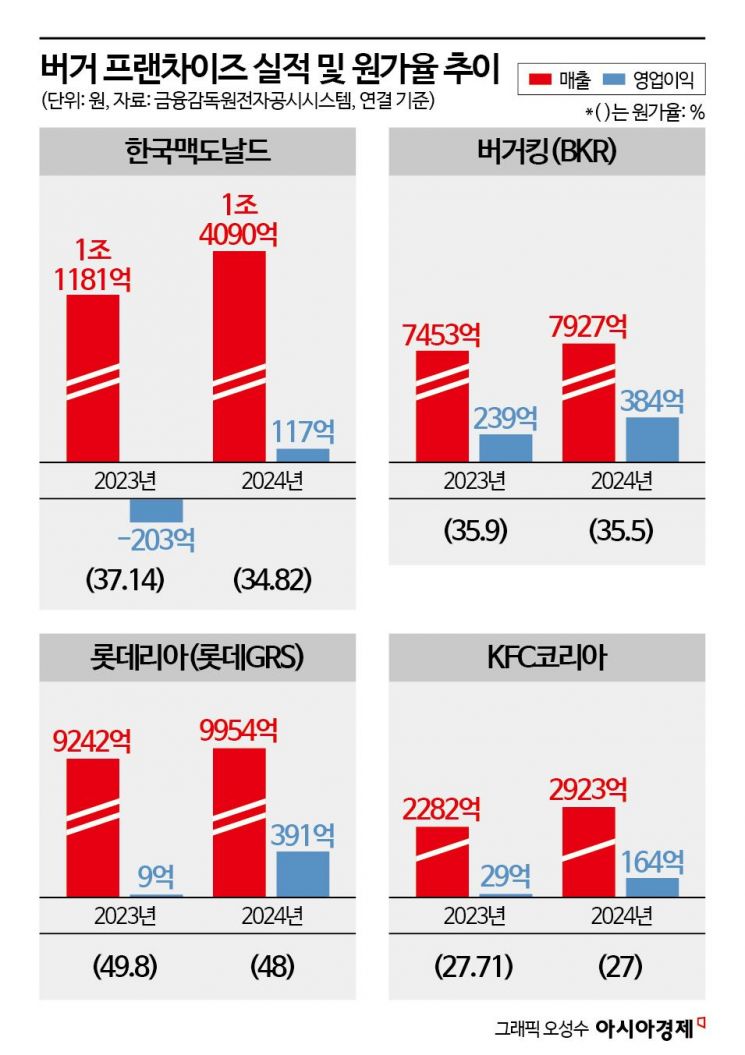
According to the Financial Supervisory Service's electronic disclosure system on May 2, McDonald's Korea recorded sales of 1.409 trillion won last year, a 9.1% increase from the previous year. This marks the fourth consecutive year of record-high sales. Sales from directly managed stores, excluding franchises, jumped 11.8% to 1.25 trillion won, maintaining double-digit growth for three consecutive years. Operating profit reached 11.7 billion won, and net profit was 115.3 billion won, marking a return to profitability for the first time in eight years since 2016.
BKR, the operator of Burger King, also saw sales rise to 792.7 billion won and operating profit to 38.4 billion won, increases of 6.4% and 60.4%, respectively, compared to the previous year. Lotte GRS, which operates Lotteria, recorded sales of 995.4 billion won and operating profit of 39.1 billion won, up 7.7% and 87.9%, respectively, from the previous year. During the same period, KFC Korea's sales rose 17.7% year-on-year to 292.3 billion won, and operating profit surged 469% to 16.4 billion won.
The main reason behind these record results for hamburger brands was price increases. McDonald's Korea raised the prices of 16 menu items by an average of 2.8% in May last year, followed by a second round of price hikes in November, increasing the prices of 13 menu items by an average of 3.7%. Lotteria also raised the prices of 20 burger items by an average of 2.2% in August last year, and KFC increased the prices of some menu items by 100 to 300 won in June last year.
As a result, the inflation rate for hamburgers reached the highest level among dining-out menu items. Last year, the inflation rate for hamburgers was 5.4%, surpassing not only pizza (-0.6%) but also other major dining-out items such as Jajangmyeon (3.2%), pork cutlet (3.4%), and chicken (4.8%).
Although these hamburger brands claim that menu price increases were inevitable due to higher raw material prices and other costs last year, in reality, their cost-to-sales ratios all dropped compared to the previous year. McDonald's Korea's cost-to-sales ratio last year was 34.82%, down 2.32 percentage points from 37.14% the previous year. BKR's cost ratio was 35.5%, down 0.4 percentage points from the previous year, while KFC's cost ratio last year was 27%, a slight decrease from 27.71% the previous year. Lotte GRS also saw its cost ratio drop by 1.8 percentage points to 48% last year. This was because the increase in sales due to price hikes outweighed the rise in raw material purchase costs.
For this reason, as these hamburger brands raised menu prices again early this year, criticism has arisen that this constitutes 'greedflation.'
Burger King raised the prices of some products by 100 won on January 24, just before the Lunar New Year holiday. As a result, the price of its signature Whopper rose from 7,100 won to 7,200 won for the single item. The Whopper set is priced at 9,200 won. In March this year, McDonald's Korea raised the prices of 20 menu items by an additional 100 to 300 won. This means prices were raised three times in just 10 months. Lotteria also raised the prices of 65 items by an average of 3.3% starting April 3. KFC increased the prices of some items, including chicken and burgers, by 100 to 300 won on April 8. While KFC announced the price hike on its website, it did not disclose the specific items or the extent of the increases.
An industry official explained, "Hamburger patties and cheese are entirely dependent on imports, so cost pressures have been accumulating," adding, "With rising labor costs, increased delivery platform fees, and higher operating expenses, many franchise owners have also demanded price increases."
However, criticism of hamburger price hikes continues, especially among consumer groups. The Korea Consumer Organization Council, which consists of more than 10 consumer groups including the Green Consumer Network, stated, "The claim that price hikes are due to cost pressures or the difficulty of absorbing costs lacks validity," and added, "Tax and tariff benefits for companies that do not participate in price stabilization should be thoroughly reviewed, and support policies should be established to focus on providing real benefits to consumers."
© The Asia Business Daily(www.asiae.co.kr). All rights reserved.


















