From Cautious Exploration to Full-Fledged Talks
Japan Considers Expanding Agricultural Imports and Easing Car Safety Standards
Proposal Levels Likely to Be Adjusted Based on US Response
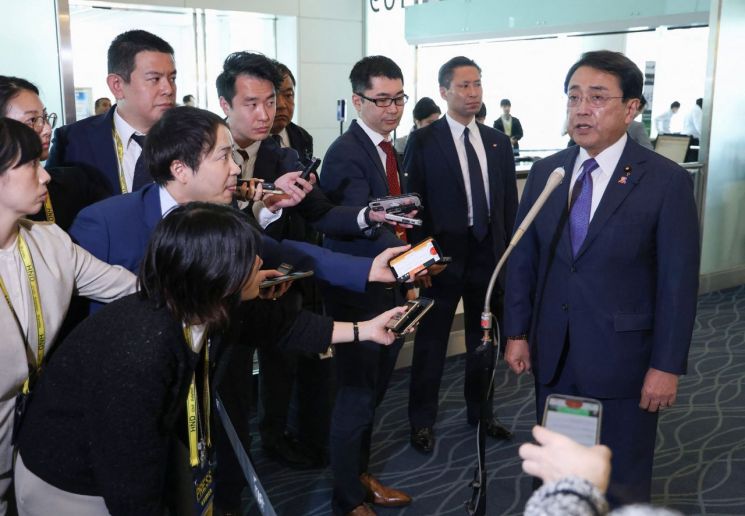 Ryosei Akazawa, Japan's Minister for Economic Revitalization in charge of customs, is answering questions from reporters at Haneda Airport in Tokyo, Japan, before departing for the United States on the morning of the 30th. Photo by AFP
The US-Japan tariff negotiations, considered a barometer for the upcoming South Korea-US tariff talks, will resume on May 1 (local time) in Washington, DC. Both sides are expected to narrow down the agenda for the negotiation table during this second round of talks, which comes two weeks after the initial meeting on April 16. Since President Donald Trump recently stated directly that tariffs and military issues are separate matters, there is speculation that the defense cost-sharing issue, which Japan considers sensitive, will be excluded from the negotiations.
Indirect Pressure from the US... Japan Maintains Cautious Stance
According to Japanese media reports, Ryosei Akazawa, Japan's Minister for Economic Revitalization in charge of customs, said before departing for the United States on the morning of April 30, "I always want to think about how to build a 'win-win' relationship and reach an agreement, and I hope to move forward step by step." Regarding the specific time of the talks, he stated, "We have agreed to hold discussions on the 1st (of next month), but the detailed schedule is undecided." In this regard, Kyodo News reported that the meeting is set for May 1, local time.
The United States is indirectly pressuring Japan by suggesting that the negotiations could proceed quickly, but Japan is maintaining a cautious approach. On April 25, President Donald Trump stated, "We are very close to an agreement with Japan (on tariffs)," and on April 29, US Treasury Secretary Scott Besant said that Japan aims to reach an agreement on tariffs before the House of Councillors (upper house) election, which is expected to be held on July 20. However, NHK reported that in Japan, there are reactions such as "We don't know the basis for President Trump's remarks" and "Isn't he trying to appeal the effects of tariffs to the public?"
If Defense Cost Agenda Is Excluded... Focus Likely to Shift to Trade Talks
The negotiating teams of both countries are expected to focus on trade-related discussions. This is because the United States has effectively indicated that defense costs, such as the stationing expenses of US forces in Japan, and the issue of the weak yen, which Japan had been concerned about, will be discussed separately from tariffs. On April 24 (local time), the Associated Press reported that President Trump stated at a White House press conference, "The military is another subject we will talk about, and we will not address this subject in any negotiations." Regarding the currency issue, Treasury Secretary Scott Besant also drew a clear line on April 24, saying at the US-Japan negotiations, "There are absolutely no currency targets," and that no specific exchange rate targets would be set.
Narrowing the scope to trade, the United States has pointed out that its products are not selling in Japan because Japan has not improved 'non-tariff barriers' in agricultural and automobile trade, while Japan has repeatedly requested that automobiles, steel, and mutual tariffs imposed by the United States be excluded from the negotiations.
Japan is considering increasing agricultural imports and significantly simplifying safety standard inspections to expand the volume of imported automobiles as so-called 'negotiation cards' to present to the United States. For agricultural products, it appears that the expansion of imports of US soybeans and corn has been virtually decided, and Nihon Keizai Shimbun (Nikkei) reported that a plan is being discussed to allocate about 70,000 tons of US rice separately within the tariff-free import quota. However, rice has long been considered a 'sacred cow' in Japan's trade negotiations, and there is a possibility that farmers, known as the support base of the ruling Liberal Democratic Party, may oppose the expansion of US rice imports.
In automobile trade, Japan is considering utilizing the 'Special Handling Program for Imported Cars' (PHP). This program currently applies to models with import volumes of 5,000 units or less, but Japan is considering raising the threshold to around 10,000 units to encourage increased imports of US cars. In addition, Japan is also considering simplifying the type approval process for US-made cars, which usually takes several months. Other negotiation cards Japan may present include cooperation in shipbuilding technology, such as icebreakers, and participation in the Alaska liquefied natural gas (LNG) development project.
Kyodo News predicted that Japan would adjust the level of its proposals while monitoring the US response, reporting, "Japan will also confirm (the negotiation's) priorities in talks with the United States." An official from Japan's economic ministry told Nikkei, "It is still unpredictable whether we will present specific cards during this visit to the United States."
© The Asia Business Daily(www.asiae.co.kr). All rights reserved.

















