Trump Says Tariff Talks with India Are Progressing Well
India Seeks to Fill the Gap Left by China
"19 Out of 24 Product Categories Selected for Expedited Negotiations"
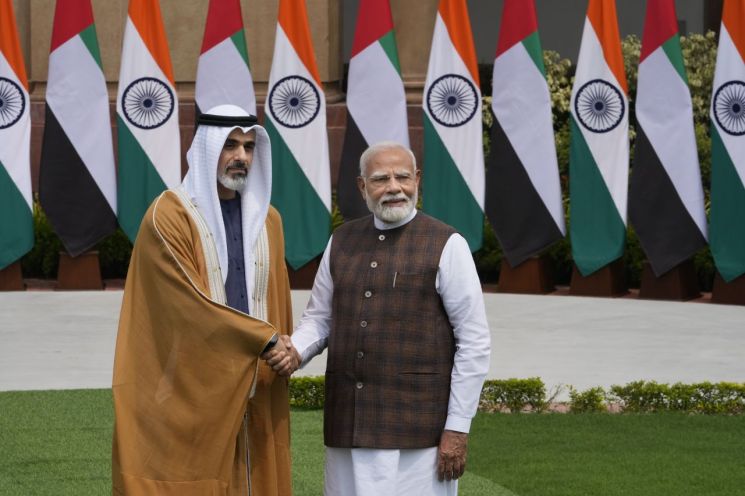 Indian Prime Minister Narendra Modi (right) shakes hands with Sheikh Khalid bin Mohammed bin Zayed Al Nahyan, Crown Prince of Abu Dhabi, during his visit to New Delhi on September 9, 2024 (local time). On the 30th, India is widely expected to become the first country to reach a trade agreement with the United States. Photo by Yonhap News Agency
India is widely considered the most likely country to reach the first trade agreement with the United States. India, which has responded most quickly to the United States' reciprocal tariff measures, is reportedly demanding that it be guaranteed the position of a "major supplier" in the U.S. market, which is now missing the Chinese supply chain.
According to reports from the Economic Times of India and Reuters on the 30th (local time), U.S. President Donald Trump told reporters at the White House the previous day that tariff negotiations with India are progressing very well, and in his view, the two countries will soon reach a trade agreement.
U.S. Secretary of Commerce Howard Lutnick also appeared on CNBC and, without naming the country, stated, "We have concluded negotiations with one country, but we are waiting for approval from the prime minister and parliament of the other side," adding that he expects approval soon. Indian media reported that the unnamed country is presumed to be India.
Reuters, citing an anonymous Indian government official, reported that India is considering proposing "future most-favored-nation (MFN) status" to the United States. Under this future MFN status, if India grants better tariff terms to another country than to the U.S. in the future, the same terms would also be applied to the U.S. The official explained, "This provision functions as a kind of future guarantee and is the only way to ensure the continuation of the agreement with the U.S." Another official stated, "India is willing to offer much more favorable terms to the U.S. than to the United Kingdom or the European Union," but added, "However, India wants the U.S. to guarantee that it will become the 'major supplier' in the supply chain that has been vacated by China."
Out of the 24 product categories traded between the two countries, 19 have reportedly been selected for expedited negotiations. It is expected that five categories with significant disagreements, such as agricultural products and military supplies, will be discussed in a second phase of negotiations. India is said to have proposed lowering current tariffs of 30 to 100 percent on U.S. frozen meat, various seafood, poultry, and fruit juices to a range of 0 to 5 percent. In return, India has reportedly demanded preferential tariffs for labor-intensive industries such as textiles, toys, leather goods, furniture, jewelry, and auto parts, as well as long-term preferential treatment for engineering products like pharmaceuticals and industrial equipment.
India has been the most agile country in responding to tariff risks since the launch of the second Trump administration. As India recorded an annual trade surplus of $45 billion (approximately 64.3 trillion won) with the U.S., President Trump called India a "very big villain in trade" during the last presidential election and pledged to correct the imbalance through tariffs. In response, India began lowering various tariffs targeting the U.S. as soon as the second Trump administration took office. Indian Prime Minister Narendra Modi also visited the White House, promising President Trump to conclude a trade agreement to reduce the trade deficit, purchase U.S. weapons, and expand energy imports.
Initially, the two countries aimed to expand bilateral trade to $500 billion (approximately 714.9 trillion won) by 2030 and to conclude the agreement by the end of this year. However, after President Trump announced reciprocal tariffs and decided to impose a 26 percent reciprocal tariff on India, negotiations have accelerated and a deal is now imminent. On the 21st, U.S. Vice President J.D. Vance met with Prime Minister Modi in New Delhi to discuss trade issues, among other topics.
© The Asia Business Daily(www.asiae.co.kr). All rights reserved.

![Clutching a Stolen Dior Bag, Saying "I Hate Being Poor but Real"... The Grotesque Con of a "Human Knockoff" [Slate]](https://cwcontent.asiae.co.kr/asiaresize/183/2026021902243444107_1771435474.jpg)















