Most Cases Occur in May... Seek Immediate Medical Attention if Symptoms Develop
"Use Repellents and Wear Light-Colored Long-Sleeved Clothing"
The Gwangju Health and Environment Research Institute has urged the public to exercise particular caution to avoid being bitten by Haemaphysalis longicornis ticks, which transmit Severe Fever with Thrombocytopenia Syndrome (SFTS), as outdoor activities increase during the spring outing season.
From April 7 to 18, the institute surveyed the distribution of Haemaphysalis longicornis ticks at 41 locations frequently visited by citizens, including neighborhood parks, hiking trails, and park golf courses.
The survey found at least one Haemaphysalis longicornis tick at 23 of the sites. The ticks were collected in areas such as grasslands, thickets, and hiking trails connected to wooded hills near some parks. Fortunately, none of the collected ticks tested positive for the SFTS virus.
According to the Korea Disease Control and Prevention Agency, an analysis of risk factors for SFTS infection among patients reported last year showed that the most common factors were working in rice paddies and fields, as well as performing maintenance tasks such as visiting family graves and mowing weeds.
Nationwide, tick bites most commonly occur between March and October, with the highest incidence rate reported in May. By body part, bites were most frequently found on the legs (21.9%), followed by the neck (15.5%) and abdomen (14.6%).
Not everyone bitten by a Haemaphysalis longicornis tick will contract SFTS. Before symptoms appear, infection cannot be confirmed even through testing. It is important to closely monitor for clinical symptoms for more than two weeks, and to seek medical attention immediately if symptoms develop.
If it is necessary to check whether a tick that has bitten a person is carrying the SFTS virus, a test can be requested at the Gwangju Health and Environment Research Institute through the nearest public health center, with results available within one to two days.
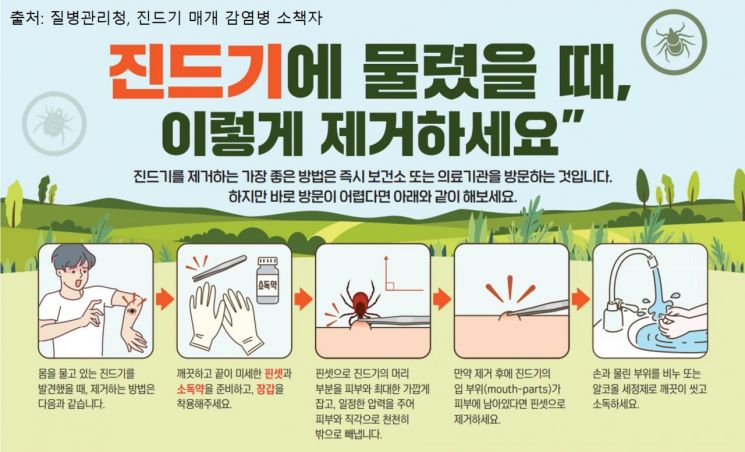
If bitten by a tick, use clean, fine-tipped tweezers to grasp the tick's head as close to the skin as possible. Apply steady pressure and slowly pull the tick out at a right angle to the skin. If the tick's mouthparts remain in the skin after removal, use tweezers to extract them. Wash and disinfect your hands and the bite area thoroughly with soap or an alcohol-based cleanser.
To prevent SFTS infection transmitted by Haemaphysalis longicornis ticks, use tick repellents during farm work or outdoor activities, and wear separate work clothes and everyday clothes. It is recommended to wear clothing that minimizes skin exposure, such as light-colored long-sleeved shirts, hats, neck scarves, socks, and gloves. Use a mat when sitting on grass, and avoid walking on mountain paths that are not part of designated hiking trails. Upon returning home, immediately shake off and wash your clothes, and check your body for insect bites or attached ticks while showering.
On April 30, Jung Hyuncheol, Director of the Gwangju Health and Environment Research Institute, stated, "This year, we conducted a survey on the distribution of Haemaphysalis longicornis ticks, including at park golf courses, to reflect the diverse range of outdoor activities enjoyed by citizens. As this is a period of frequent outdoor activities, there is a risk of exposure to wild ticks, so we hope everyone follows tick prevention guidelines to maintain a healthy daily life."
Meanwhile, on April 15, the first domestic SFTS case of the year was confirmed in Namwon, North Jeolla Province.
© The Asia Business Daily(www.asiae.co.kr). All rights reserved.

















