Kwanhun Debate at Korea Press Center
"Clumsy Political Calculation of 1+1=2"
Lee Junseok, the presidential candidate of the Reform New Party, drew a clear line regarding the possibility of joining the so-called "big tent" coalition discussed by conservative circles on the 30th, stating, "I have absolutely no intention of agreeing to a 'blind unification.'
At the Kwanhun Debate held at the Korea Press Center in Jung-gu, Seoul on this day, Lee said, "That (unification) will not happen. It is a clumsy political calculation that assumes one plus one will become two," expressing his stance.
Regarding his opposition to joining the big tent, he explained, "I cannot work with those responsible for the 12·3 Martial Law and the early presidential election," and added, "As someone who fought against such actions from the very beginning of the harsh regime, I believe that joining hands with those who indulged in delusions at the core of power, enjoying privilege, is something that common sense would not allow."
He also emphasized, "A coalition based solely on the goal of opposing a particular individual is bound to fail," and continued, "While the world is heated by the competition for supremacy in science and technology, for us to make opposition to a particular person the spirit of the times is a goal that is far too insignificant compared to our ideals and capabilities."
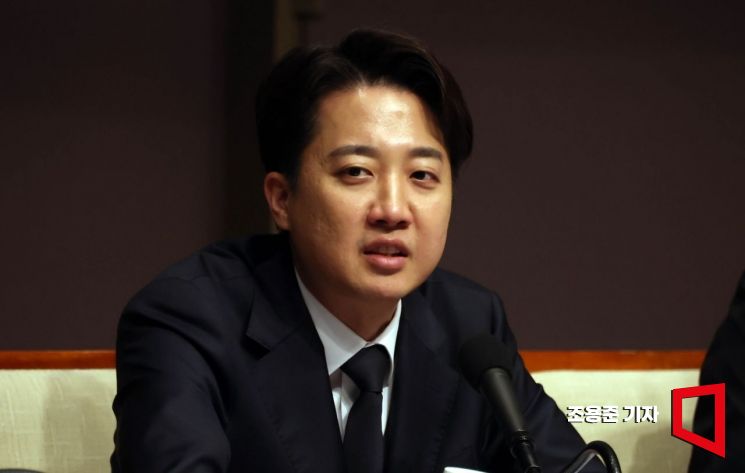 Lee Junseok, the presidential candidate of the Reform New Party, is attending the Kwanhun Debate held at the Press Center in Jung-gu, Seoul on the 30th, responding to panel questions. 2025.4.30 Photo by Jo Yongjun
He argued that the current big tent is nothing more than another form of factional politics. Lee stated, "Dividing politics into two sides, marked by dogmatism, runaway behavior, vetoes, and impeachments, has led to today's chaos," adding, "We cannot secure the future with the outdated notion that we can win by dividing camps into black and white and simply making our side bigger."
Regarding major policies, Lee said, "We should not just pay lip service to local autonomy, but actually grant authority and responsibility," and explained, "I will allocate 30% of corporate tax to local governments, while allowing each region to set its own tax rates and minimum wage, thereby increasing the responsibility of local politics and enabling growth through competition." He emphasized this as the first step toward overwhelming decentralization.
In the field of education, he stated that he would focus on creating schools that foster learning. Lee said, "Public education must thrive for the burden of private education to disappear and for the ladder of social mobility to be built," and insisted, "The tragedy of teachers making extreme choices in the classroom must end." To this end, he pledged, "We will restore teachers' authority and normalize the educational environment by implementing a state responsibility system for teacher lawsuits, strengthening punishment for false accusations, and introducing a detention system for problematic students."
If elected president, Lee said he would consult with National Assembly Speaker Woo Wonshik to appoint the Prime Minister through bipartisan agreement. He explained, "If I am elected president, the Reform New Party will have only two seats in the National Assembly. Therefore, we will be forced to practice coalition politics," and continued, "So, immediately upon election, I will consult Speaker Woo and request that the National Assembly recommend a Prime Minister through bipartisan consultation. If the parties fail to reach an agreement, I will ask the Democratic Party to recommend two candidates for Prime Minister, and I will choose one of them."
© The Asia Business Daily(www.asiae.co.kr). All rights reserved.

![Clutching a Stolen Dior Bag, Saying "I Hate Being Poor but Real"... The Grotesque Con of a "Human Knockoff" [Slate]](https://cwcontent.asiae.co.kr/asiaresize/183/2026021902243444107_1771435474.jpg)















