Ministry of Culture Announces Results of 2023 Regional Culture Survey
Average Values for 13 out of 18 Indicators Increase Compared to 2020
Among the 17 metropolitan local governments nationwide, Seoul, Gyeonggi, Sejong, Daegu, and Jeju ranked high in the Regional Culture Index, while Gangwon, North Gyeongsang, Daejeon, South Jeolla, and North Chungcheong recorded lower scores.
These results were confirmed in the "2023 Regional Culture Survey" released on April 30, 2025, by the Ministry of Culture, Sports and Tourism and the Korea Culture and Tourism Institute. The Ministry and the Institute announced the results of their assessment of the cultural environment and cultural disparities by region, as well as the calculated "Regional Culture Index" based on these findings.
This survey was conducted on 245 local governments nationwide, including 17 metropolitan governments, 226 basic local governments (cities, counties, and districts), and two administrative cities (Jeju City and Seogwipo City). The Ministry divided the survey into four categories: cultural policy, cultural resources, cultural activities, and cultural enjoyment, and further subdivided these into 36 regional cultural indicators for analysis.
The results showed that, among 18 indicators that could be compared in a time series with 2020, the average values for both metropolitan and basic local governments increased in 13 indicators. This generally indicates an improvement in regional cultural conditions.
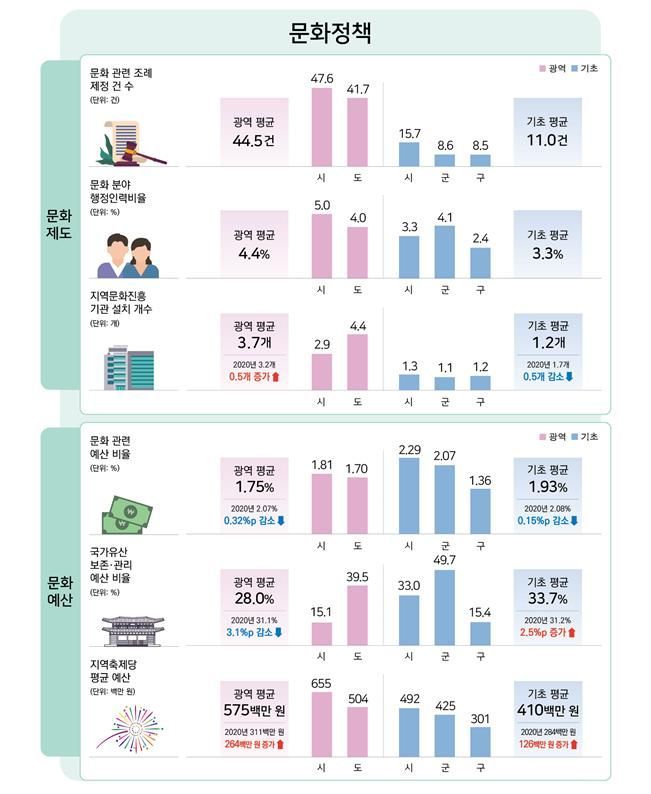
Among the main indicators in the cultural policy category, the proportion of cultural projects supported by local governments increased to 66.4% for metropolitan governments and 59% for basic governments, up by 10.2 percentage points and 2.9 percentage points, respectively, compared to 2020. The number of planned projects for the "Culture Day" initiative also rose, with 5.5 cases for metropolitan governments (a 17% increase) and 5.6 cases for basic governments (a 100% increase).
In the cultural activities category, the number of local cultural and arts organizations increased by 31.3% to 107.5 for metropolitan governments and by 29.5% to 7.9 for basic governments. The number of stage arts professionals per 500-seat cultural center also increased by 90.5% to 4 for metropolitan governments and by 84.6% to 2.4 for basic governments. However, the proportion of cultural budgets to total local government budgets was only 1.75% for metropolitan governments and 1.93% for basic governments, down by 0.32 percentage points and 0.15 percentage points, respectively, compared to 2020.
For the newly added indicator of accessibility to local cultural facilities, the average time taken from the center of a city, county, or district to reach cultural and arts facilities such as performance halls or cinemas (by car) was about 14 minutes, while the average time to reach everyday cultural facilities such as community culture centers or small libraries was about 5 minutes.

The Ministry and the Institute applied weights to each indicator and standardized them to calculate the Regional Culture Index, in order to comprehensively understand and analyze regional cultural conditions. The analysis showed that the Regional Culture Index was relatively higher in the Seoul metropolitan area than in non-metropolitan areas. However, among the subcategories, the cultural policy category, which reflects the institutional environment and policy support level of each region, was higher in non-metropolitan areas. The index was highest in urban areas, followed by urban-rural mixed areas and rural areas. The higher the financial independence of a local government, the higher its Regional Culture Index. The Ministry explained that, despite improvements in regional cultural conditions, the results indicate that cultural disparities remain between metropolitan and non-metropolitan areas, as well as between urban and rural regions.
The Regional Culture Survey is conducted every three years based on Article 11 of the Regional Culture Promotion Act.
The Ministry stated that, based on the results of this survey and the Regional Culture Index analysis, it plans to continue policy efforts to bridge regional cultural gaps, such as selecting regions with relatively poor cultural environments as "culturally vulnerable areas" and expanding support for cultural projects like the "Culture Day" program in those areas. Detailed results of this survey can be found on the "Culture Center" website.
© The Asia Business Daily(www.asiae.co.kr). All rights reserved.
![User Who Sold Erroneously Deposited Bitcoins to Repay Debt and Fund Entertainment... What Did the Supreme Court Decide in 2021? [Legal Issue Check]](https://cwcontent.asiae.co.kr/asiaresize/183/2026020910431234020_1770601391.png)
















