KITA: "Companies Should Utilize the Most Advantageous Agreement for Each Product Category"
As the United States implements high tariffs on Chinese goods, the Chinese market environment is changing, prompting calls for Korean companies to prepare for risks by restructuring their transaction models and modifying production lines.
The FTA and Trade Comprehensive Support Center at the Korea International Trade Association held the "2025 Changes in China's Trade Environment and Response Strategies Seminar" on April 29 at the Trade Tower in Samseong-dong, Gangnam-gu, Seoul.
This seminar was organized to review changes in China's trade environment and market trends resulting from tariff measures by a potential second Trump administration, and to explore response strategies for Korean companies. Over 100 executives and employees from export and import companies attended the event, which featured presentations on the latest trends in China's economy and market, China's foreign trade and investment policies, major impacts and response strategies related to changes in the global trade environment, and strategies for utilizing the Korea-China FTA and RCEP (Regional Comprehensive Economic Partnership).
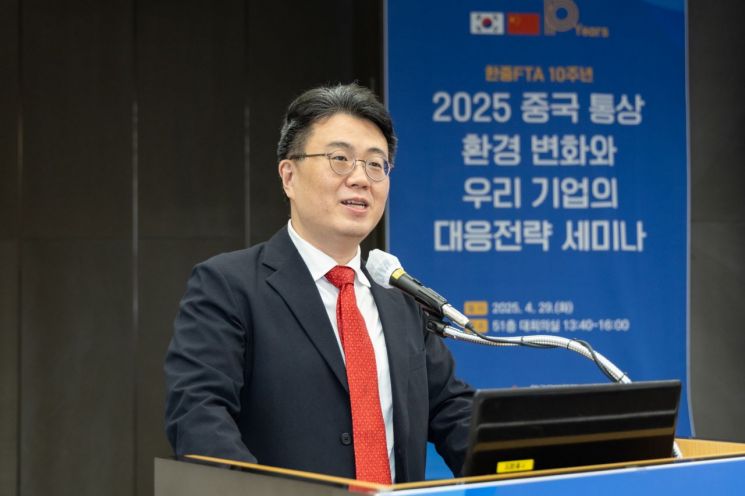 Joo Wonseok, head of the FTA and Trade Comprehensive Support Center at the Korea International Trade Association, is delivering the opening remarks at the "2025 Changes in China's Trade Environment and Response Strategies Seminar" held on the 29th at the Trade Tower in Samseong-dong, Gangnam-gu, Seoul. Photo by Korea International Trade Association
Park Seungchan, director of the China Management Research Institute, introduced promising industries emerging due to new consumer groups such as the elderly and "gold miss" demographic, as well as the Chinese government's policies to boost consumption, foster advanced industries, and achieve technological self-reliance in response to domestic and international crises such as the US-China trade conflict and domestic economic slowdown. Kim Hyunjun, director at Samil PwC, analyzed the US's reciprocal tariffs and the responses of major countries, emphasizing that Korean companies should prepare for supply chain risks by restructuring transaction models, modifying production lines, establishing new subsidiaries, and pursuing mergers and acquisitions (M&A).
Lim Geumseon, customs broker at the Korea International Trade Association's China Desk, compared the agreement tariff rates and rules of origin under trade agreements Korea has with China, including the Korea-China FTA, RCEP, and the Asia-Pacific Trade Agreement (APTA), advising companies to utilize the most advantageous agreement for each product category.
Joo Wonseok, head of the FTA and Trade Comprehensive Support Center, stated, "As the global tariff war intensifies, Korean companies are facing the dual challenges of supply chain restructuring and rising tariff costs. Companies should develop diverse market entry strategies tailored to changes in the Chinese market and actively utilize trade agreements such as the Korea-China FTA when necessary."
The FTA and Trade Comprehensive Support Center's China Desk, established in March 2015 to prepare for the implementation of the Korea-China FTA, is celebrating its 10th anniversary this year.
© The Asia Business Daily(www.asiae.co.kr). All rights reserved.

















