Korea's Machinery and Industrial Equipment Hit Hardest
Cost and Expense Reduction Preferred Over Expanding U.S. Production
Government Role Needed Through Tax Cuts and Financial Support
There are projections that, if the United States' tariff measures are fully implemented, the sales revenues of companies in South Korea, China, and Japan could decrease by approximately 4% to 7%. Despite the uncertainty in policy, companies are indicating that they do not intend to alter their existing investment plans, even in the face of potential sales declines.
According to a survey conducted by the Federation of Korean Industries (FKI) from March 31 to April 15, targeting 303 of the top 1,000 manufacturing companies by sales in the three countries, it is projected that, if the United States fully implements item-specific and reciprocal tariff measures, next year's sales revenues will decrease by an average of 4% to 7%.
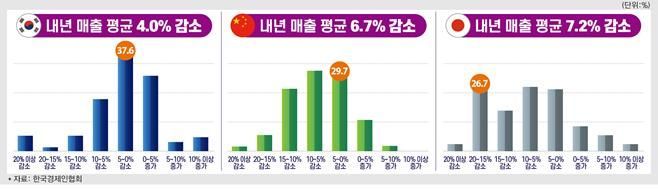
The expected decrease in sales for next year is -4.0% on average for South Korean companies, -6.7% for Chinese companies, and -7.2% for Japanese companies. Across the board, there was a high proportion of responses predicting a sales impact of 5% to 10% or more in major export sectors such as ▲semiconductors and electronics ▲automobiles and auto parts ▲machinery and industrial equipment ▲steel and metal products. For South Korea, the machinery and industrial equipment sector is expected to see the largest impact at -12.2%; for China, the steel and metal products sector at -11.7%; and for Japan, the semiconductors and electronics sector at -10.4%. On average across the three countries, steel and metal products are projected to experience the largest decline.
However, despite the impact of the tariff policies, the most common response in all three countries was that they would not change their investment plans. In particular, 28.7% of Chinese companies responded that they would increase investment. Regarding this, the FKI explained, "This reflects expectations for support from government policies aimed at achieving strategic technological self-sufficiency based on large-scale government subsidies, as well as hopes for a recovery in export competitiveness due to the weaker yuan."
In the current tariff environment, companies from South Korea, China, and Japan are prioritizing cost and expense reduction over expanding local production in the United States as their primary response strategy. In response to related questions, 46.0% of South Korean companies, 61.0% of Chinese companies, and 41.0% of Japanese companies selected 'cost and expense reduction' as their top response. The proportion of companies indicating plans to expand local production and investment in the United States was highest among Japanese companies at 21.0%.
When asked whether regional trade agreements such as the RCEP (Regional Comprehensive Economic Partnership), CPTPP (Comprehensive and Progressive Agreement for Trans-Pacific Partnership), and the Korea-China-Japan FTA (Free Trade Agreement) would help mitigate the impact of U.S. tariffs, Chinese companies gave the highest score (78.2 points). South Korean companies also gave a higher agreement score (38.6 points), while Japanese companies had a higher disagreement score (22.8 points) than agreement (20.8 points).
To respond to external conditions and management environment uncertainties arising from U.S. tariff risks, companies from South Korea, China, and Japan stated that an active role by their respective governments is necessary. South Korean and Japanese companies commonly hoped for ▲tax reductions ▲financial or subsidy support ▲diplomatic efforts to reduce tariffs. In contrast, Chinese companies prioritized ▲support for developing new markets ▲diplomatic efforts to reduce tariffs ▲investment in domestic industries, in that order, as roles for their government.
© The Asia Business Daily(www.asiae.co.kr). All rights reserved.


















