Maintaining an Anti-Trump Stance Consistent with the Election Campaign
Liberal Party Fails to Secure Majority but Remains in Power
Conservative Leader Concedes Defeat, Vows to Hold Government in Check
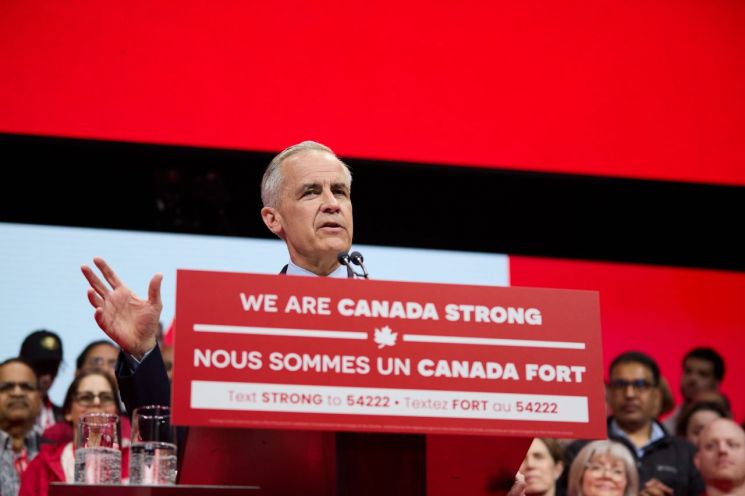 Mark Carney, Prime Minister of Canada, is giving a victory speech after winning the general election on the 28th (local time). Photo by EPA Yonhap News
"The long-standing relationship between Canada and the United States is now over."
Mark Carney, Prime Minister of Canada, made this statement during his victory speech after the general election held in Ottawa, Ontario, Canada, on the 28th (local time), according to reports from Reuters and Bloomberg News.
He said, "The open, US-led global trade system that enabled Canada's prosperity after World War II is now over," adding, "This is a tragedy, but at the same time, it is our new reality."
Prime Minister Carney also emphasized that the coming months will be challenging and will require sacrifice. He strongly warned against the economic threats posed to Canada by US President Donald Trump.
He stated, "The United States wants our land, our resources, our water, and our country," insisting, "This is not merely a threat." He continued, "President Trump is trying to break us so that the United States can own us," and firmly pledged, "But that will never, ever happen."
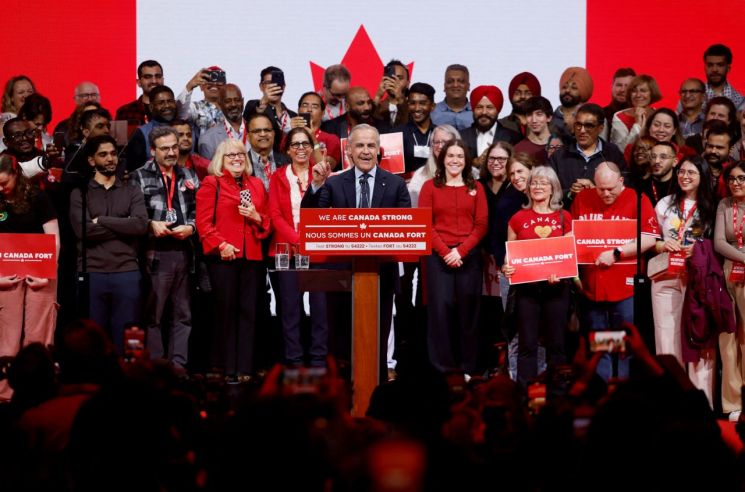 Prime Minister Kani is delivering a victory speech surrounded by supporters after winning the general election. Photo by EPA
Bloomberg News noted that these remarks are points Prime Minister Carney has consistently reiterated throughout the election campaign.
In this election, the Liberal Party failed to secure a majority (172 seats), but managed to retain its position as the ruling party. Pierre Poilievre, leader of the Conservative Party, conceded defeat and stated, "Our party will hold the government in check." As of 12:59 a.m. on the 29th, the Liberals were winning or leading in 164 of the 343 seats in the House of Commons, while the opposition Conservatives were winning or leading in 147 constituencies.
Previously, under former Prime Minister Justin Trudeau's leadership for over nine years, the Liberal Party's approval ratings had been declining due to dissatisfaction with high inflation and rising housing prices. Moreover, until earlier this year, the main opposition Conservative Party had widened its lead over the ruling Liberals to over 20 percentage points, making it seem likely that Pierre Poilievre would become the next Prime Minister of Canada.
Additionally, along with tariff pressure, President Trump's threat to annex Canada as the 51st state of the United States fueled anti-American sentiment among Canadians, which worked in favor of the Liberals in the general election. Prime Minister Carney rallied patriotic sentiment by emphasizing that Canada would never, in any form, become part of the United States, in response to the Trump administration's tariffs and threats to Canadian sovereignty.
Prime Minister Carney previously served as Governor of the Bank of Canada in February 2008, where he was credited with defending Canada's economy relatively successfully during the global financial crisis. From 2013 to 2020, he became the first foreigner to serve as Governor of the Bank of England (BOE), where he responded to the economic shocks caused by Brexit (the United Kingdom's withdrawal from the European Union).
© The Asia Business Daily(www.asiae.co.kr). All rights reserved.


















