Men: 28,734 won per hour, Women: 20,363 won per hour
Average monthly working hours: Regular workers 162.2 hours, Non-regular workers 105.8 hours
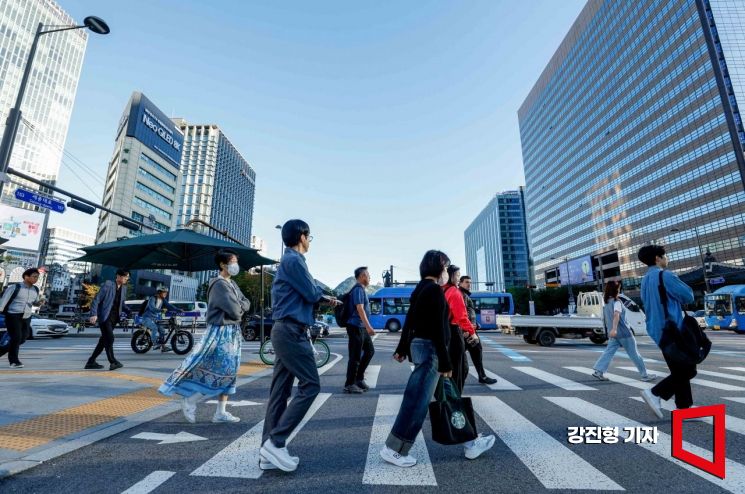 Office workers are heading to work at the Sejongno intersection in Jongno-gu, Seoul (photo to aid article understanding). Photo by Kang Jinhyung
A recent survey found that last year, the hourly wage gap between regular and non-regular workers returned to the level seen eight years ago in 2016. This gap has worsened more than ever since statistics began being compiled, due to factors such as a decrease in the number of working days and a lower wage growth rate for non-regular workers.
According to the "June 2024 Survey on Working Conditions by Employment Type" released by the Ministry of Employment and Labor on April 29, as of June last year, the total hourly wage per worker at businesses with at least one employee was 25,156 won, a 10.0% increase from the same month the previous year (22,878 won).
The total monthly wage increased by 2.7% over the same period. The significant rise in total hourly wage is attributed to a reduction of 2 working days on the calendar compared to the previous year, which led to a decrease of 10.8 working hours. By employment type, the total hourly wage for regular workers was 27,703 won, up 11.7%, while for non-regular workers it was 18,404 won, up 4.7%.
However, as of June last year, the total hourly wage for non-regular workers was only 66.4% of that of regular workers. This represents a decline of 4.5 percentage points from the previous year, marking the largest year-on-year drop since statistics began in 2008.
The ratio of non-regular workers' total hourly wage to that of regular workers had remained above 70% since 2020, but last year it fell back into the 60% range for the first time in five years since 2019 (69.7%).
An official from the Ministry of Employment and Labor analyzed, "For regular workers, most of whom are on a monthly salary or annual salary system, the decrease in the number of working days led to a greater increase in total hourly wage. Additionally, the low wage growth rate for non-regular workers, influenced by an increase in short-term workers, also played a role."
By gender, the total hourly wage was 28,734 won for men and 20,363 won for women. Women's wage level was 70.9% of men's, which also decreased by 0.2 percentage points from the previous year. Although this figure had been rising since 2016, it turned downward for the first time in eight years.
Meanwhile, as of June last year, the average monthly working hours stood at 146.8 hours, down 10.8 hours from the same month the previous year (157.6 hours). For regular workers, average monthly working hours were 162.2 hours, a decrease of 12.3 hours, while for non-regular workers, it was 105.8 hours, a decrease of 5.1 hours.
© The Asia Business Daily(www.asiae.co.kr). All rights reserved.

















