Used Like a "Master Key" During Emergency Dispatches
Resolving Areas Difficult for Fire Truck Access
"Zero Tolerance Policy" for Vehicles Obstructing Passage
The "119 Pass," which allows fire department personnel responding to fires in apartment complexes and other multi-family housing to enter common entrances like a master key, will be expanded nationwide. Additionally, the "priority signal system for emergency vehicles," which can reduce fire truck response times, will also be expanded, thereby improving conditions for rapid emergency response.
On April 29, the National Fire Agency announced the "2025 Comprehensive Plan for Rapid Disaster Site Response," which includes these measures. The fire authorities have set a target of "seven minutes" for arrival at fire scenes in order to minimize casualties, and are working to improve systems and regulations to achieve this goal. As of the end of last year, the nationwide average rate of fire trucks arriving at fire scenes within seven minutes was 69.2%. However, there are significant regional disparities due to factors such as increased traffic volume and narrow alleyways.
This plan includes: ▲ establishing a foundation for rapid on-site response ▲ resolving difficulties in fire truck access areas ▲ strict enforcement against illegal acts such as obstructing emergency vehicle passage.
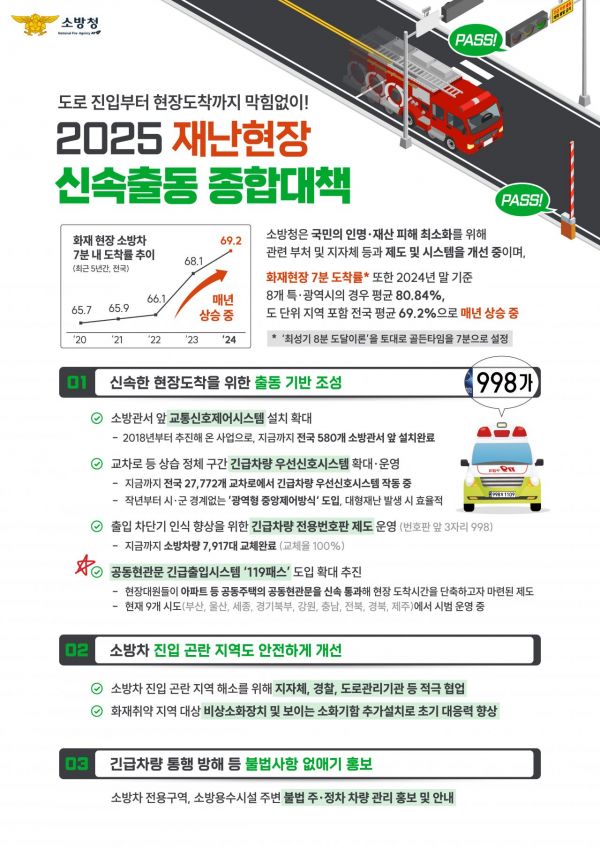
First, the installation of traffic signal control systems in front of fire stations will be expanded. This initiative began in 2018 and involves controlling the traffic lights in front of fire stations via a switch installed inside the station. Currently, such systems have been installed in front of 580 fire stations nationwide.
The "priority signal system for emergency vehicles," which allows emergency vehicles to have priority passage through signal control at congested intersections, hospital transport routes, and other frequently congested areas, will also be expanded. Last year, the system was newly introduced at 5,318 intersections nationwide, and it is now operational at 27,772 intersections in 18 provinces and cities.
In addition, last year, the National Fire Agency changed the first three digits of the license plates of 7,917 fire trucks and ambulances nationwide to "998." Agreements have also been reached so that when entering apartment complexes and multi-use facilities, barriers will automatically open upon recognizing the emergency vehicle license plates.
The emergency access system "119 Pass" will be expanded nationwide. The 119 Pass enables emergency responders to quickly pass through common entrances of multi-family housing during emergencies such as fires and rescues, thereby reducing the time to reach disaster sites. It is currently being piloted in nine provinces and cities, including Busan. The goal is to expand the introduction of the 119 Pass to 20% of the approximately 11,000 multi-family housing complexes nationwide by the end of this year, and to 40% by 2026. However, there is no legal mechanism to mandate the 119 Pass for multi-family housing; it can only be implemented if residents agree through their housing association councils.
Furthermore, the National Fire Agency plans to reduce the number of areas where fire truck access is difficult by more than 5% compared to last year, in cooperation with local governments. The number of such areas decreased from 1,009 in 2022 to 969 in 2023, and to 920 last year. The agency will improve traffic systems on roads with frequent illegal parking, enhance road markings for fire routes, and secure a minimum road width of 4 meters on fire truck access roads to improve driving conditions.
Strict measures will be taken against acts that obstruct the passage of emergency vehicles. The agency plans to actively publicize that if it is difficult to immediately identify the owner or occupant of a vehicle or object, compulsory measures can be taken without prior notice. Park Geuno, Director of the 119 Response Bureau at the National Fire Agency, emphasized, "If a vehicle or object is damaged, the fire department will cover the cost if the vehicle was parked legally, but if it was parked illegally, we will not provide compensation."
© The Asia Business Daily(www.asiae.co.kr). All rights reserved.

















