Lawsuit Filed Against Global Distributor 'Laser Components'
UPC Orders Sales Ban, Recall, and Destruction
Second Victory After LED Sales Ban in October Last Year
Global optoelectronics company Seoul Semiconductor announced on the 29th that it has won a lawsuit in France against the global distribution company Laser Components, which had infringed on its core optoelectronic semiconductor technology. This marks the second victory in the LED sector, following the world’s first sales ban ruling across eight countries by the Unified Patent Court (UPC) in October last year.
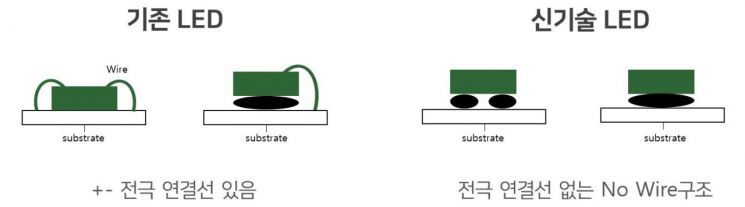 Comparison diagram of the composition between conventional LEDs and Seoul Semiconductor's new technology LEDs. Photo by Seoul Semiconductor
According to Seoul Semiconductor, the French division of the UPC, which oversees patents in 18 European countries, recognized that Laser Components had infringed on Seoul Semiconductor’s technology and ordered an immediate ban on product sales, as well as the recall and destruction of existing products already sold.
Laser Components is a global distributor specializing in electronic components in the United States, Europe, and Canada. It was confirmed that the company had sold products that infringed on Seoul Semiconductor’s “WICOP” technology?a robust, wire-free structure essential for micro LED technology developed by Seoul Semiconductor?leading to the legal dispute.
WICOP is a patented technology owned by an affiliate of Seoul Semiconductor Group. It is recognized as the world’s first innovative technology that overcomes the limitations of traditional LED manufacturing methods. WICOP technology is adopted as a key component in numerous models each year, including microLEDs, automotive headlamps, smartphone flashes, and backlights, all of which require ultra-miniaturization and high performance. Additionally, its compact yet robust structure has led to increased application in packaging products.
This technology is credited with overcoming the structural limitations previously associated with optoelectronic semiconductors. Unlike silicon semiconductors used in AI memory, optoelectronic semiconductors utilize various compound semiconductors such as gallium and indium, which previously required the positive and negative electrodes to be arranged vertically. As a result, traditional LEDs had to connect the upper and lower electrodes using gold wires. Seoul Semiconductor was the first in the world to overcome this limitation by developing the “No-wire” technology, which enables direct connection without gold wires. The No-wire technology maximizes light emission efficiency and features a robust structure with outstanding durability against temperature and humidity.
For the past 30 years, Seoul Semiconductor has focused exclusively on the optoelectronic semiconductor sector, establishing a unique position in the industry. The company holds approximately 18,000 patents. According to data published by Omdia in 2023, Seoul Semiconductor ranked first worldwide in the UV LED and LCD backlight sectors, and third overall in the LED sector.
© The Asia Business Daily(www.asiae.co.kr). All rights reserved.

















