Koalas Culled Due to Food Shortage After Wildfires
Experts Question State Government's Decision
Controversy has arisen after it was reported that 700 koalas were shot and culled from the air in Victoria, Australia. Authorities explained that the measure was taken to euthanize koalas suffering from the aftermath of wildfires, but some animal experts have expressed skepticism.
The Guardian reported on April 25 (local time) that local authorities in Australia had killed approximately 700 koalas in southwestern Victoria. It was reported that the authorities used aircraft to shoot the koalas from the air as a method of culling.
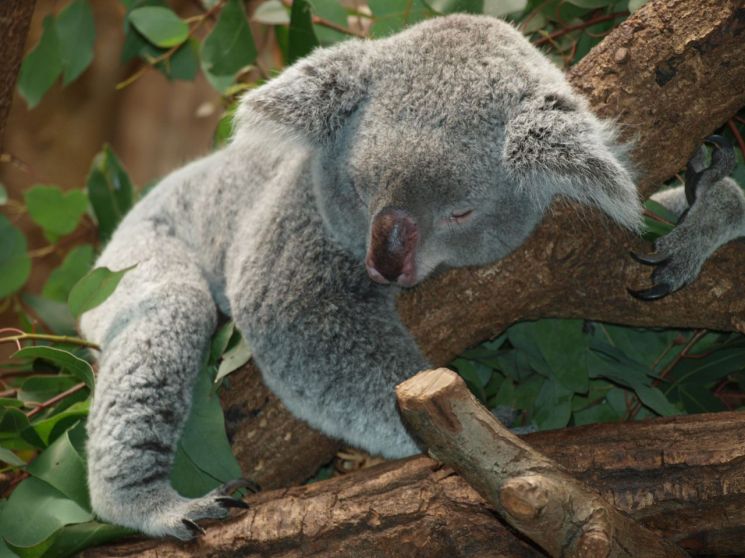
According to the Victoria State Government, a wildfire that broke out in March destroyed 2,200 hectares (ha), or about 6.65 million pyeong, of forest in Budj Bim National Park, Australia. The fire also destroyed the eucalyptus forests, the main food source for koalas, and if left unaddressed, the koalas in the area would inevitably face the worst food shortage in history. The state government stated, "We took this unprecedented measure to prevent further suffering for the animals."
The Guardian pointed out, "Aerial culling is commonly used to control invasive species such as deer or pigs," but added, "This is the first time aerial culling has been conducted for the welfare of wild animals."
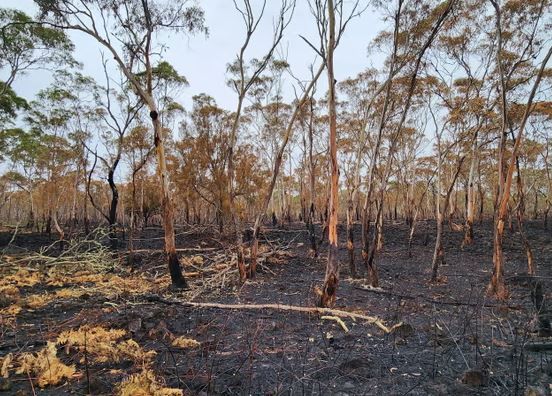 A national park destroyed by wildfire. The plants that serve as food for koalas have also been completely burned, and koalas are expected to soon face a food shortage crisis. Victoria State Government, Australia
James Todd, Biodiversity Chief at the Victoria Department of Energy, Environment and Climate Action (DEECA), emphasized to the media, "This decision was made carefully with advice from veterinarians and wildlife welfare experts." Currently, about 2,000 to 3,000 koalas inhabit Budj Bim National Park, and it is reported that many of them are already struggling to find food due to burns or injuries.
DEECA first used binoculars from helicopters to individually assess around 2,000 koalas at a distance of about 30 meters. Most of the koalas in the park showed signs of burns, such as singed or scorched fur, and reportedly showed little response to external stimuli. Todd explained, "Due to the rugged terrain and the risk of trees collapsing after the fire, ground access was difficult, which led to the decision for aerial culling," adding, "This decision was never made lightly."
However, some animal experts have expressed doubts about the state government's decision. Rolf Schlagloth, a koala researcher at Central Queensland University, told the media, "Even though it would have been more costly, a ground-based approach would have been preferable," expressing concern about the accuracy of aerial culling.
He pointed out, "The real problem is the failure to properly manage koala habitats and native plants," adding, "There are too many koalas, and (the trees that serve as koala food) have reproduced too little."
© The Asia Business Daily(www.asiae.co.kr). All rights reserved.
![Clutching a Stolen Dior Bag, Saying "I Hate Being Poor but Real"... The Grotesque Con of a "Human Knockoff" [Slate]](https://cwcontent.asiae.co.kr/asiaresize/183/2026021902243444107_1771435474.jpg)

















