Following Lotte, Hyundai, and Shinsegae, voluntary retirements underway
Shilla Duty Free posts operating loss in Q1
Company seeks to reduce fixed costs through workforce downsizing amid worsening profitability
Shilla Duty Free has initiated a voluntary retirement program. As profitability has significantly worsened due to the sluggish duty-free business, the company is seeking to reduce fixed costs by downsizing its workforce. With Shilla Duty Free now implementing voluntary retirements, all major duty-free operators?including Lotte, Shinsegae, and Hyundai Duty Free?are proceeding with staff reductions.
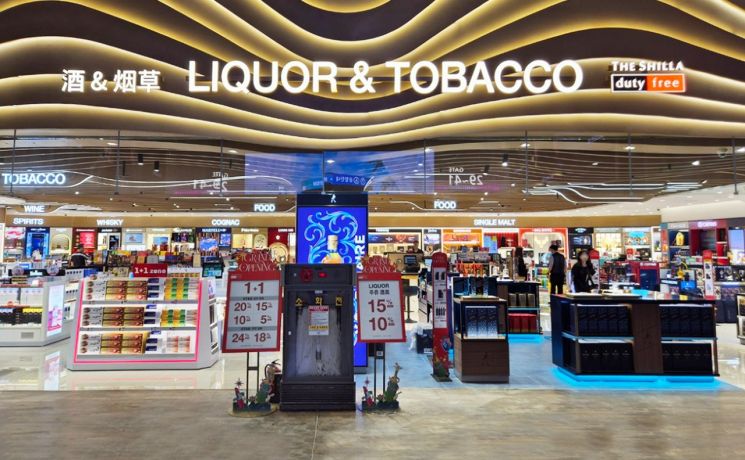 Shilla Duty Free, Liquor, Tobacco, and Food Store at Incheon International Airport Terminal 1. Courtesy of Shilla Duty Free.
According to the retail industry on April 28, Shilla Duty Free will begin accepting voluntary retirement applications confidentially starting this week. Although the specific scale has not been disclosed, Shilla Duty Free has issued internal notices regarding voluntary retirement at some branches. The notice states that the program targets employees aged 40 or older or those with at least five years of service; those who retire immediately will receive 1.5 times their annual salary as a lump sum; and those who retire after an 18-month leave of absence will receive their base salary during that period.
The voluntary retirement program is being offered to employees working at duty-free stores. A Hotel Shilla representative said, "Because the process is being conducted unofficially, we cannot disclose the scale or specific timeline," and added, "Hotel employees are not eligible for this program."
Shilla Duty Free decided to implement voluntary retirement because the downturn in the duty-free industry has persisted even after the end of the pandemic. In the first quarter of this year, Shilla Duty Free (the duty-free division of Hotel Shilla) recorded sales of 827.1 billion won and an operating loss of 5 billion won. Sales decreased by 0.4%, and operating profit turned into a loss compared to the previous year.
Before Hotel Shilla, Lotte Duty Free, Shinsegae Duty Free, and Hyundai Duty Free also undertook major restructuring efforts, such as returning licenses (business rights) in the domestic market and accepting voluntary retirements. Lotte Duty Free, which has the largest sales, withdrew from its Melbourne city store in Australia and Wellington Airport store in New Zealand in August and February last year, respectively, and is considering withdrawing from Guam Airport, where the contract expires in July next year. It is reported that about 100 employees left the company following a voluntary retirement program in the second half of last year. Furthermore, earlier this year, Lotte Duty Free ended contracts with Daigong, which accounted for the largest share of its sales, signaling a shift toward profitability-focused management.
Shinsegae Duty Free also returned its license for the Busan Centum City store, deciding to restructure its business around the Incheon Airport and Myeongdong locations. Hyundai Duty Free will end operations at its Dongdaemun store in July after returning its license and is reducing the sales area of its Trade Center store from three floors to two. Hyundai Duty Free is also offering voluntary retirement to employees with more than three years of service.
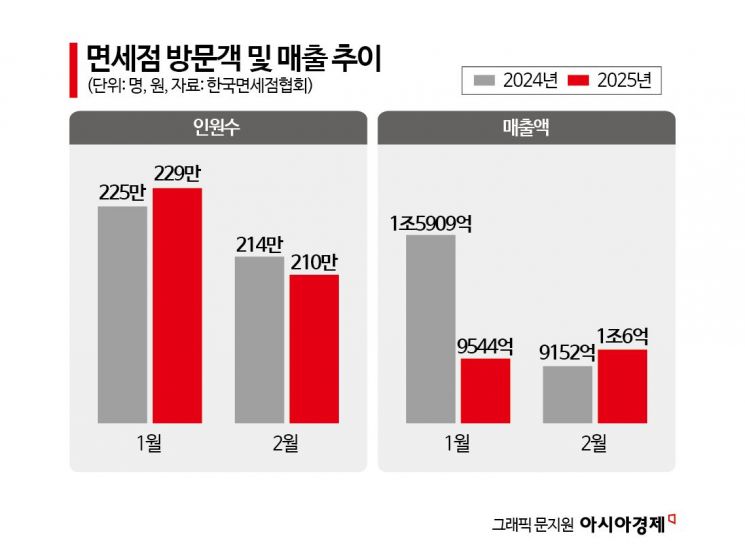
The duty-free industry expects that the downturn may deepen further this year and is undertaking aggressive restructuring. Although the number of foreign travelers has recovered to pre-COVID-19 levels, changing travel trends have prevented a significant increase in duty-free store visitors. The economic downturn in China has led to a sharp decline in group travelers to Korea, and with the won-dollar exchange rate approaching 1,490 won, visits from domestic customers to duty-free stores have also decreased.
According to the Korea Duty Free Shops Association, sales in March of this year stood at 744.81 million dollars (1.0739 trillion won, based on an exchange rate of 1,440 won). This represents a 16% decrease compared to sales of 891.15 million dollars in March of the previous year. The combined number of domestic and foreign visitors to duty-free stores was 2.3 million in March last year and 2.26 million in March this year, showing a similar level.
© The Asia Business Daily(www.asiae.co.kr). All rights reserved.


















