Kia Car-Sharing Now Allows Remote Vehicle Summoning
Ministry of Land, Infrastructure and Transport Grants 17 Regulatory Exemptions for Mobility Services
It will soon be possible to summon a car using remote control when using vehicle-sharing (car-sharing) services. While this is currently not allowed under existing laws, a special exemption will be applied to test and refine the technology. There is growing interest in whether this will help reduce inconvenience for both service users and operators.
On April 28, the Ministry of Land, Infrastructure and Transport announced that it had recently approved a regulatory sandbox demonstration exemption for Kia at a meeting of the Mobility Innovation Committee. A regulatory sandbox is a system that temporarily suspends or exempts certain regulations to allow the introduction of new technologies or services. The Mobility Innovation Committee, established under the Mobility Innovation Act, deals with technologies and services related to transportation.
Kia applied for a project titled "Demonstration of Advanced Mobility Services Using Remote Driving Technology." The system involves capturing images around the vehicle, then transmitting vehicle data in real time to a remote control center. The control center, upon receiving and analyzing this information, sends control commands to operate the vehicle remotely.
 This photo is not directly related to the article. Asia Economy DB
Although current technology is sufficient to enable remote vehicle control, the Road Traffic Act requires that the driver be inside the vehicle or in close proximity, and prescribes rules and obligations based on this assumption. Drivers are also required to take on-site actions when parking or stopping the vehicle, and must take specific measures in the event of an accident or breakdown.
The National Police Agency and the Ministry of Land, Infrastructure and Transport have decided to allow this exemption, stating that there is a need to define the concept of remote driving and to relax certain restrictions. They also noted that this could help address some limitations of autonomous driving technologies currently being developed in the industry. Additionally, they recommended that measures be put in place to prevent further damage in the event of accidents or breakdowns during remote operation. Additional safety standards are expected to be established as the demonstration project progresses.
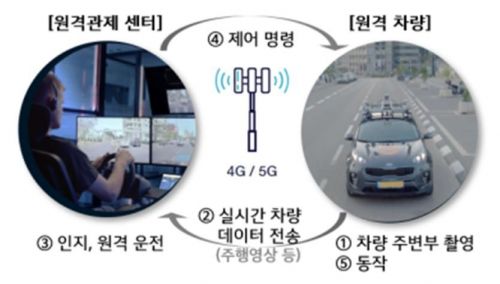 Overview diagram of vehicle remote control applied by Kia. Provided by the Ministry of Land, Infrastructure and Transport
The committee also granted exemptions for pedal misapplication prevention devices and speed limiters. Many unintended sudden acceleration accidents are caused by pedal misapplication, and a pilot project will be conducted to test safety technologies that use software to control such incidents. Under the current Automobile Management Act, it is prohibited to arbitrarily modify, install, or add software that could affect vehicle operation.
The Ministry of Land, Infrastructure and Transport plans to install these devices on a trial basis with prior consent from drivers, then verify their performance and safety before easing regulations. The applicant must prove that the new devices do not conflict with existing vehicle control systems. In addition, the committee approved measures such as granting composite transport licenses to allow commuter charter buses to operate on a demand-responsive basis in transportation-vulnerable areas outside of commuting hours, and allowing village taxis in remote and mountainous areas to be used for freight transport services.
Other exemptions were granted for systems such as automatic valet parking, which allows for the installation and operation of mechanical parking systems that can automatically park vehicles in apartment parking lots. Advanced driver assistance systems, advanced inspection equipment capable of testing these systems, and electronic control unit inspection standards were also included. In total, 17 demonstration exemptions were granted, covering areas such as used car battery rental, mobility support for transportation-disadvantaged groups, truck rental services, and mobile vehicle scrapping mediation. Prior to this meeting, a total of 33 demonstration exemptions had already been granted.
Kim Hongmok, Director of the Mobility and Automobile Bureau at the Ministry of Land, Infrastructure and Transport, said, "Through this mobility regulatory sandbox, we will be able to demonstrate projects that can lead innovation by integrating and converging transportation services," adding, "We will support the commercialization of various practical, everyday projects by assisting them from demonstration to business implementation."
© The Asia Business Daily(www.asiae.co.kr). All rights reserved.
![Clutching a Stolen Dior Bag, Saying "I Hate Being Poor but Real"... The Grotesque Con of a "Human Knockoff" [Slate]](https://cwcontent.asiae.co.kr/asiaresize/183/2026021902243444107_1771435474.jpg)
















