Responding to Climate Disasters Systematically Across Government
Proposals Include Plastic Phase-Out and Biodegradable Plastics
On Lee Jaemyung's '2040 Coal Phase-Out' and 'Energy Superhighway' Pledges
Han Warns of "Massive Job Losses and Enormous Costs"
On April 28, Han Donghoon, former leader and preliminary candidate of the People Power Party, pledged to establish a National Land and Energy Comprehensive Plan and to reorganize the Ministry of Environment into the Ministry of Climate and Environment in order to achieve a balanced approach to power stability, economic efficiency, and environmental sustainability.
On this day, Han unveiled his fifth policy vision, "Climate Response to Protect the People, Building a Robust Energy Powerhouse," which outlines his climate and energy strategy. He stated, "As public concern and anxiety over the climate crisis grow, it is more urgent than ever to prepare fundamental and systematic measures at the national level."
First, Han announced a plan to implement the National Land and Energy Comprehensive Plan, which would coordinate power, energy, and telecommunications infrastructure planning with highway and railway projects and ensure timely construction. He explained, "We will achieve the rapid expansion of low-cost power grids and ensure a stable electricity supply for future key industries such as artificial intelligence (AI) and semiconductors."
Han also introduced a plan to reorganize the Ministry of Environment into the Ministry of Climate and Environment, citing the limitations of addressing climate change at the level of individual ministries. He pledged to strengthen the control tower function by establishing a dedicated second vice minister for climate response.
Han promised, "The Ministry of Climate and Environment, relevant ministries, and local governments will work together to respond to climate disasters in a systematic, government-wide manner." He added, "By utilizing satellites and AI, we will scientifically predict the risks of disasters caused by climate change, such as large-scale wildfires and localized heavy rainfall, and implement proactive preventive measures."
Han also presented a "Plexit" (?-plastic) pledge to overwhelmingly strengthen the international competitiveness of South Korea's circular economy industry by focusing support on the development of core technologies for plastic innovation, such as biodegradable plastics, advanced recycling technologies, and plastic hydrogenation and fuel conversion. He emphasized, "We will grow the domestic circular economy industry to a scale of over 50 trillion won."
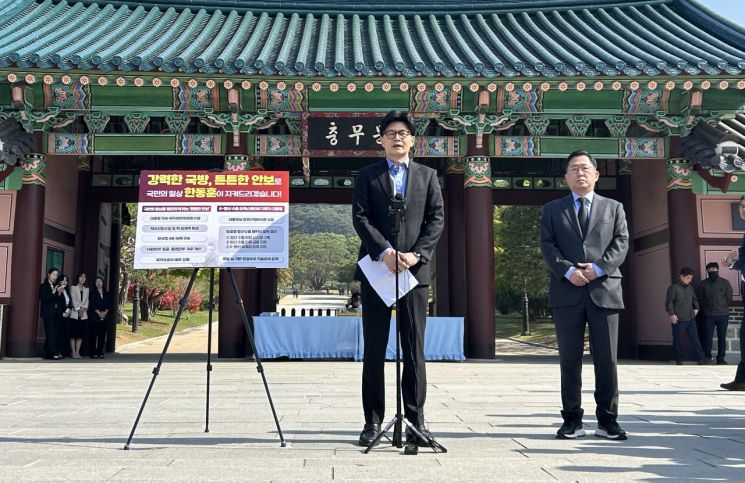
Han stressed that efforts should not be limited to simply reducing plastic production, but should also focus on enhancing resource circulation infrastructure through advanced technology and innovation to strengthen export competitiveness. He promised, "To this end, we will expand the biodegradable plastics market to over 10 trillion won annually by 2030, significantly increase investment in plastic recycling technology to raise the recycling rate to international standards, and focus support on the development of waste plastic fuel conversion technology to secure currently unused energy sources."
He also pledged to establish global climate leadership by fostering an "international carbon market hub." Han stated, "True greenhouse gas reduction is only possible by combining international cooperation with economic incentives," adding, "We will nurture climate tech companies, support their overseas expansion, provide quality jobs for young people, and advance South Korea as a leader in carbon finance."
Han criticized Lee Jaemyung, the Democratic Party's presidential candidate, for his "2040 coal phase-out" and "energy superhighway" pledges, expressing concerns about large-scale job losses and enormous budgetary burdens. Han pointed out, "Of the 61 coal-fired power plants nationwide, 28 are scheduled to be decommissioned by 2036, but if the remaining 33 are closed early by 2040, experts warn that more than 5 trillion won in stranded assets could result." He warned, "Rushing to phase out coal power without proper preparation could lead to the collapse of power plant regions and mass job losses."
He added, "The energy superhighway pledge deceives the public with a rosy outlook while hiding the enormous financial burden. If pushed forward without concrete plans and budget reviews, it will inevitably lead to higher electricity bills, causing hardship for all citizens and seriously undermining South Korea's industrial competitiveness."
Han especially recalled how the Moon Jaein administration's nuclear phase-out policy and the proliferation of renewable energy led to the country being covered with Chinese solar panels and brought the nuclear power ecosystem to the brink of collapse. He stressed, "The newly proposed 'Sunlight Pension' and 'Energy Superhighway' are highly likely to repeat the same mistakes."
He further urged, "To stabilize energy prices, which have a significant impact on inflation, and to protect industrial competitiveness, we must move away from excessive political correctness in the energy sector and build a realistic and rational energy mix." He emphasized, "As the foundation of the nation, energy policy must give balanced consideration to power stability, economic efficiency, and environmental sustainability."
© The Asia Business Daily(www.asiae.co.kr). All rights reserved.

















