Insight Session on U.S. Tariff Risks Hosted by AMCHAM
Experts from AlixPartners, Kim & Chang, and Others in Attendance
There is an analysis suggesting that the Trump administration's rapid and unpredictable tariff policies are aimed at restructuring global supply chains. There were also recommendations that, while preparing short-term measures to respond to an unpredictable future, a U.S. localization strategy is necessary to build a safer supply chain.
Sib Sibaram, Head of Asia at AlixPartners, stated at an Insight Session hosted by the American Chamber of Commerce in Korea (AMCHAM) at the Grand Hyatt Seoul on the morning of the 28th, "The era of frictionless global supply chains is over," and added, "We need to consider how to maximize localization strategies for the United States." AlixPartners is a global consulting firm specializing in crisis management and restructuring.
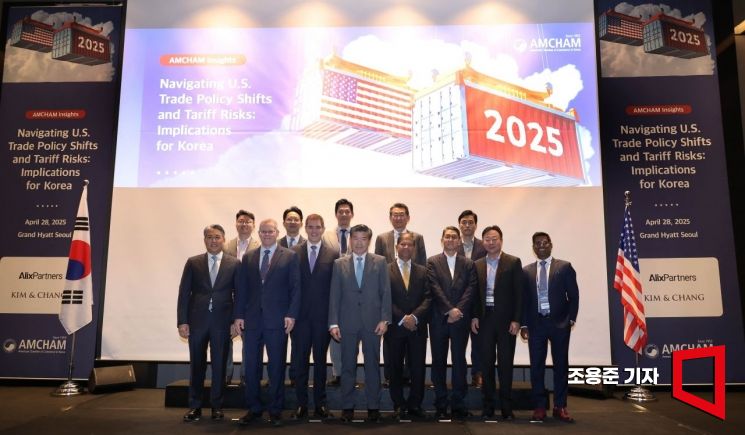 James Kim, chairman of the American Chamber of Commerce in Korea, and other attendees are taking a commemorative photo at the seminar on "Changes in U.S. Trade Policy and Its Impact on Korean Industry" held on the 28th at the Grand Hyatt Hotel in Yongsan-gu, Seoul. Photo by Jo Yongjun
Sibaram explained, "In the 1950s, U.S. manufacturing accounted for about 35% of private sector jobs, but recently this has decreased to 9.4%." He diagnosed that "the Trump administration's tariff policies go beyond simply reducing the trade deficit and are aimed at reshoring manufacturing back to the United States." He noted that the U.S. policy of restructuring supply chains for the benefit of its own companies presents challenges for countries such as Korea.
He viewed the 'restructuring of the value chain' as a very difficult task, and also noted that the final outcome is uncertain. He advised that companies need both short-term and mid-to-long-term measures to respond to uncertain market changes. In the short term, he explained that companies should establish a control tower, such as a war room, to consider tariff mitigation, maximization of cash liquidity, and price optimization in response to tariff imposition.
From a mid-to-long-term perspective, he advised that companies ultimately need to consider a 'localization strategy (Local for Local).' Sibaram said, "In addition to managing the global manufacturing footprint and considering facility investments, companies can look into ways to reduce the impact of tariffs through joint ventures and partnerships."
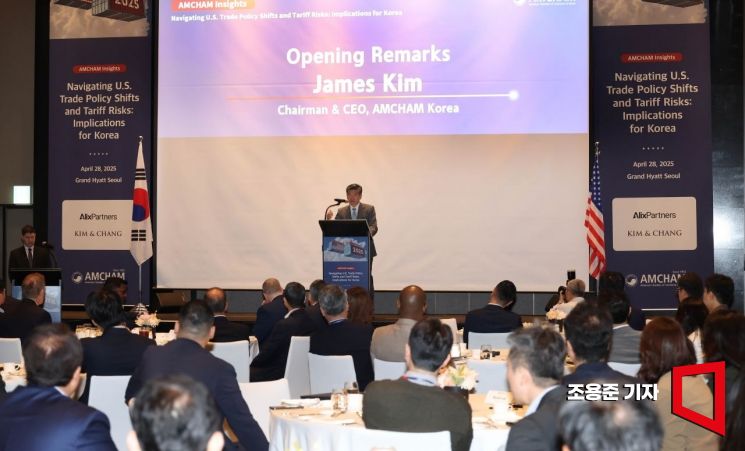 James Kim, Chairman of the American Chamber of Commerce in Korea, is speaking at the seminar "Changes in U.S. Trade Policy and Its Impact on Korean Industry" held on the 28th at the Grand Hyatt Hotel in Yongsan-gu, Seoul. Photo by Jo Yongjun
John Leonard, advisor at Kim & Chang and former Deputy Assistant Commissioner of Trade at U.S. Customs and Border Protection (CBP), introduced corporate compliance response strategies. He shared his experience being involved in the process of concluding the United States-Mexico-Canada Agreement (USMCA) during his time at CBP, and commented, "Looking at President Donald Trump's trade actions, it feels as if he accomplished in two months what other presidents would have done in eight years. It is very shocking."
There were also concerns raised that measures targeting China could be passed on to American consumers. Leonard stated, "If the tax exemption for Chinese products under $800 disappears starting from May 2, it will have a significant impact on American consumers." He also cited remarks by U.S. Treasury Secretary Scott Besant, saying, "A 145% tariff on China is not a sustainable figure, so U.S.-China dialogue needs to open quickly."
Additionally, he advised that when trade and tariff-related measures are announced by the U.S. administration, CBP issues guidance documents for importers, and companies should refer to these when responding.
Meanwhile, AMCHAM has announced its commitment to serve as a bridge to facilitate constructive dialogue between Korea and the United States based on public-private cooperation, especially at a time when geopolitical uncertainties and trade risks are intensifying.
© The Asia Business Daily(www.asiae.co.kr). All rights reserved.


















