A National Singer Who Embraced the Times and Sang for Generations
Reflecting on 66 Years of Song at Her Farewell Concert
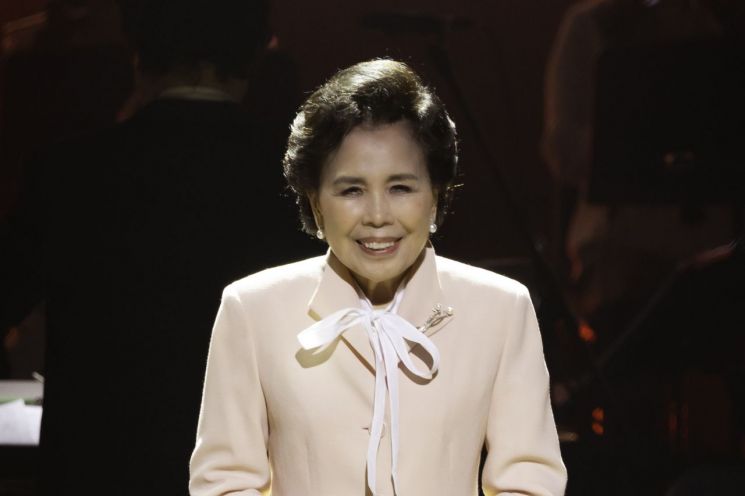 Singer Lee Mija is singing at the 'Traditional Korean Songs Tribute Performance Connecting the Pulse' held on the 27th at Sejong Cultural Center in Jongno-gu, Seoul. Photo by Showdang ENT
Lee Mija, the living legend of Korean popular music who has made countless audiences laugh and cry on innumerable stages, bid farewell to the stage. Marking the 66th anniversary of her debut, she held the traditional Korean songs tribute concert "Connecting the Maek (Pulse)" at the Grand Theater of Sejong Cultural Center in Jongno-gu, Seoul, on April 26 and 27, and shared her thoughts, saying, "It was lonely and difficult, but I was happy."
Born in Seoul in 1937, Lee Mija debuted in 1959 with "Nineteen-Year-Old Pure Love." With her clear and poignant tone, elegant vocalization, and restrained emotional expression, she instantly captivated the public.
The 1960s were a golden era for Lee Mija. Her 1964 release "Camellia Lady" became a sensational hit immediately after its release, but it also faced adversity when it was designated as a banned song under the government's moral purification policy at the time. Nevertheless, "Camellia Lady" transcended its era to become a beloved classic and set the record as the first million-seller in Korean music history.
Afterward, Lee Mija continued to represent the lives of ordinary people through her voice, releasing songs such as "The Teacher in the Island Village," "Goodbye Seoul," "Yellow Sail," and "Wild Goose Father." In a society rapidly changing due to industrialization and urbanization, her songs became a source of longing and comfort for those separated from their hometowns and families.
In the 1960s and 1970s, she also performed on international stages. In 1967, she held performances in Vietnam to encourage Korean soldiers stationed there, providing great comfort to those longing for home on the battlefield. Then, in 1972, she traveled to Germany to give special performances for Korean miners and nurses dispatched to West Germany. Korean expatriates, exhausted from hard labor in a distant foreign land, found solace and shed tears as they listened to Lee Mija's performances.
In 2003, she took the stage at the "Pyongyang Autumn Concert" held in Pyongyang, delivering a moving performance of "Camellia Lady" that resonated across the border between North and South Korea. This moment once again proved that Lee Mija is more than just a popular singer; she is a symbolic figure who bridges the pain and reconciliation of the Korean people.
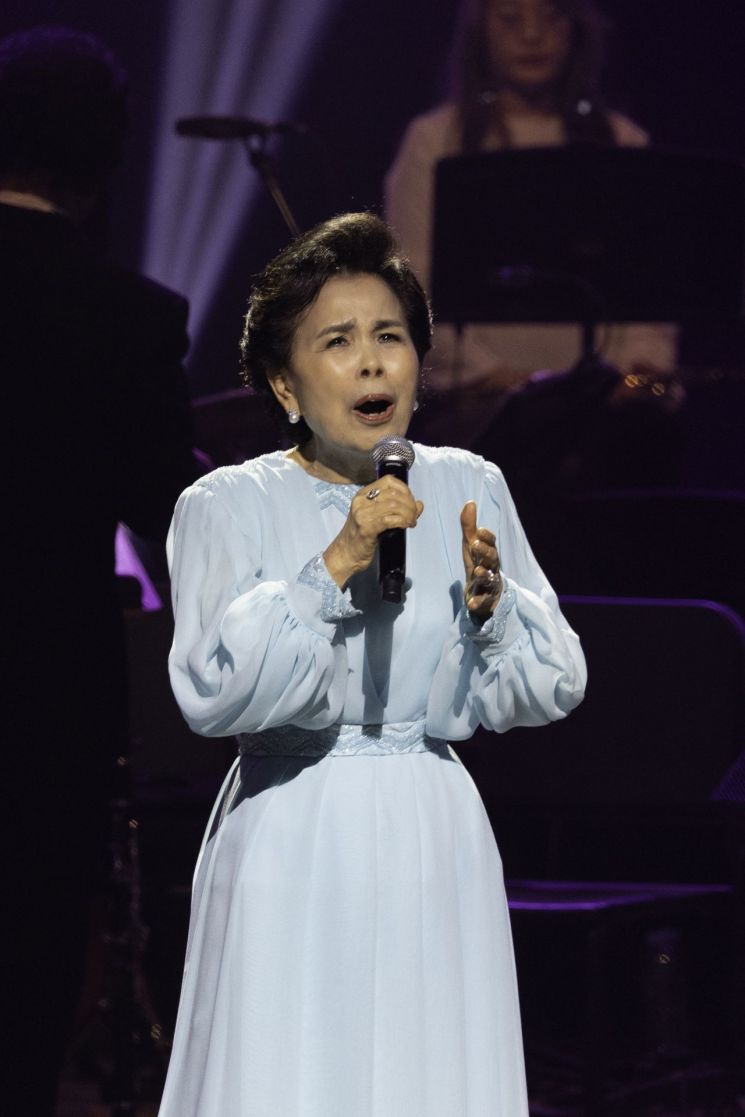 Singer Lee Mija is singing at the 'Traditional Korean Songs Tribute Performance Connecting the Pulse' held at Sejong Cultural Center in Jongno-gu, Seoul on the 27th. Photo by Showdang ENT
Lee Mija's vocal technique is unparalleled in the history of Korean popular music. Her clear sound, which soars unwaveringly even at high notes, her precise diction that conveys lyrics distinctly, and her sincere, unexaggerated emotional delivery are cited as reasons why she is loved across generations. In particular, her unique singing style, which expresses sorrow with restraint in each song, quietly touched the hearts of listeners. Lee Mija's voice conveyed sadness without wailing, and warmth without a smile.
Throughout the 1980s and 1990s, she continued her career with her unchanging voice, releasing songs such as "Rainy Yeongdong Bridge" and "Elegy of Twilight." Since the 2000s, she has held nationwide tour concerts and devoted herself to preserving traditional Korean music, maintaining her connection with the public. Notably, at her 60th anniversary concert in 2019, the audience rose in unison to give a standing ovation, celebrating Lee Mija's life in music.
In the context of modern and contemporary Korean history, Lee Mija was more than just a singer. For generations who endured war and division, industrialization and democratization, her songs served as "gateways to memory." She sang of the warmth that blossomed even amid poverty, the hardships of migration, and the pain of separation.
Upon her retirement, Lee Mija expressed, "I was able to come this far thanks to the love of so many people," adding, "Now, I want to live gratefully in the peace of everyday life, rather than through song." The "Camellia Lady" she sang on her final stage still left an unchanging resonance.
Though Lee Mija is departing, the songs she leaves behind will remain in the hearts of Koreans for a long time to come. Songs that have crossed eras, a voice that connects generations-Lee Mija's life was, in the end, a song.
© The Asia Business Daily(www.asiae.co.kr). All rights reserved.
![Clutching a Stolen Dior Bag, Saying "I Hate Being Poor but Real"... The Grotesque Con of a "Human Knockoff" [Slate]](https://cwcontent.asiae.co.kr/asiaresize/183/2026021902243444107_1771435474.jpg)

















