On April 28, North Korea officially acknowledged for the first time that it had dispatched troops to fight alongside the Russian military. This admission is drawing even more attention as speculation grows over the possibility of North Korean leader Kim Jongun visiting Russia to mark the 80th anniversary of Russia's Victory Day on May 9.
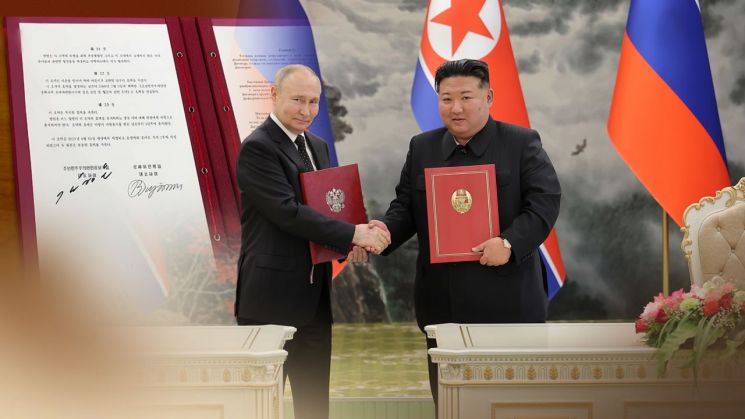
On this day, North Korea's Korean Central News Agency and the Workers' Party newspaper Rodong Sinmun reported a statement from the Central Military Commission of the Workers' Party that officially mentioned the deployment of troops to Russia. The military commission stated, "Based on the analysis and judgment that the current war situation corresponds to the invocation of Article 4 of the treaty on the comprehensive strategic partnership between the Democratic People's Republic of Korea (North Korea) and the Russian Federation, Comrade Kim Jongun decided to send our armed forces and notified the Russian side." This confirms that the deployment was a decision made by Kim Jongun. The statement continued, "Comrade Kim Jongun, in making the decision to participate, defined our military's involvement as a sacred mission to further solidify the traditional friendship and unity between the two countries, guarantee the development and prosperity of both nations, and defend the honor of North Korea."
The statement also conveyed that Kim Jongun emphasized, "A monument to military merit will soon be erected in our capital," and stressed the need to "take significant national measures to provide special treatment and care for the families of the veterans." There was no separate mention of North Korean prisoners of war captured by Ukrainian forces.
The international community widely recognizes that the current Russia-Ukraine war began with Russia's invasion of Ukraine. However, North Korea's military commission limited the deployment to the border region of "Kursk," stating, "The liberation operation in the Kursk region to repel the adventurous armed invasion by the Ukrainian authorities has ended in victory," and claimed, "The reckless political and military schemes of the Western powers and the Ukrainian authorities have been thwarted." The commission added, "We consider it an honor to be in an alliance with a powerful nation like Russia," and stated, "We are pleased that the participation of our military units has strengthened the combative bonds between North Korea and Russia and contributed to Russia's special military operation."
With North Korea and Russia now having formalized their participation and blood alliance, the likelihood of further visible military cooperation between the two sides has increased. North Korea's military commission emphasized, "The invincible combative friendship between the two countries, proven in blood, will greatly contribute to the expansion and development of North Korea-Russia relations in all areas."
Even before this official announcement of participation, North Korea and Russia were reportedly cooperating on joint drone production and the provision of air defense weapons. The same applies to the 5,000-ton-class new multipurpose destroyer Choi Hyeonho, unveiled by North Korea on April 26. The Choi Hyeonho, the largest destroyer built by North Korea to date, is believed to have benefited from Russian technical support, such as phased array radar and vertical launch systems (VLS). The same is true for the nuclear-powered submarine (SSBN) that Kim Jongun has mentioned as his next target.
According to a recent report by the Korea Institute for Defense Analyses (KIDA), the economic effect generated by North Korea as a result of the Ukraine war amounts to 28.7 trillion won. It is reported that North Korea prefers to receive compensation in the form of advanced weapons, goods, and technical support. There are growing concerns that this official participation may further materialize such "reciprocal benefits."
It is also noteworthy that the official announcement of the deployment comes at a time when speculation is rising over Kim Jongun's possible visit to Russia next month. There are expectations that Kim Jongun may visit Moscow on May 9, coinciding with Russia's Victory Day commemorating the end of World War II.
Lim Eulchul, a professor at Kyungnam University's Institute for Far Eastern Studies, stated, "In the future, cooperation between North Korea and Russia is expected to accelerate not only in the economic field but also in the military sector," adding, "In particular, North Korea's chances of acquiring advanced military technology from Russia have increased, which will further enhance North Korea's nuclear and missile capabilities and intensify the threat to the South Korea-U.S. alliance."
However, regarding the possibility of Kim Jongun's visit to Russia, Professor Lim said, "It cannot be completely ruled out, but the likelihood is relatively low," explaining, "This is because it is difficult for Kim Jongun to become the 'main character' on a multilateral diplomatic stage, and the Victory Day has little direct connection to the Battle of Kursk." He added, "It is expected that Kim Jongun will plan a separate special victory commemoration event to emphasize the victory at Kursk, and that a North Korea-Russia summit will take place at that time."
© The Asia Business Daily(www.asiae.co.kr). All rights reserved.

















