Impact of War: Sharp Increase in Europe and Middle East Last Year
Defense Spending and U.S. Withdrawal from European Security
European Military Expenditures Expected to Rise Further for Now
Due to factors such as the Russia-Ukraine war and the intensification of conflicts in the Middle East, global military spending last year increased by nearly 10% within a single year. With the launch of the second Donald Trump administration and a shift in the U.S. role regarding European security, as well as the European Union's "rearmament plan," military expenditures in Europe are expected to surge for the time being. President Donald Trump has also announced that he will address the issue of defense cost-sharing with allies such as South Korea separately from tariff negotiations, suggesting that military spending in some countries will rise even further this year.
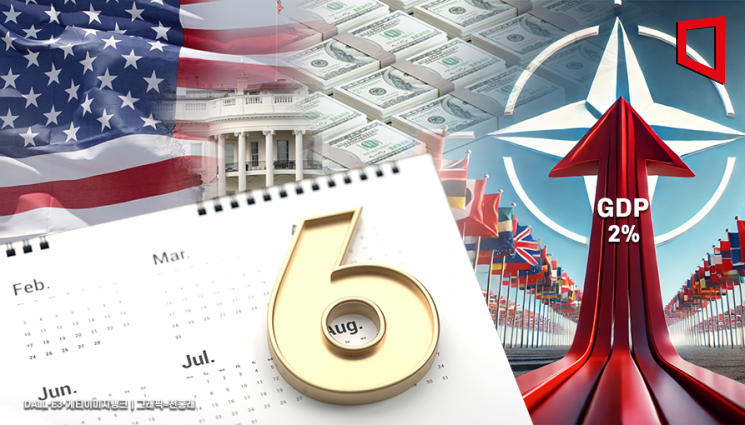
On April 28, Japan's Nihon Keizai Shimbun (Nikkei) reported, citing analysis by the Stockholm International Peace Research Institute (SIPRI) in Sweden, that total global military spending in 2024 reached a record high of $2.718 trillion (approximately 3,910 trillion won), up 9.4% from the previous year. The United States spent the most on military expenditures, followed by China, Russia, and Germany. South Korea, which is constantly exposed to threats from North Korea, spent $47.6 billion, a 1.4% increase compared to 2023.
According to Nikkei, military spending, which had been on the decline since the end of the Cold War, began to rise again in the 2000s, and the pace of increase accelerated after Russia invaded Ukraine in 2022. As countries competitively expanded their military budgets, the ratio of military spending to global gross domestic product (GDP) rose to 2.5%, up 0.2 percentage points from the previous year.
Xiao Liang, a researcher at SIPRI, pointed out, "There are increasing cases where security is prioritized at the expense of other budgets, and this could have significant impacts on society."
The nearly 10% increase in global military spending last year is attributed not only to conflicts in Ukraine and the Middle East, but also to escalating disputes in regions such as North Africa. In fact, last year, military spending surged mainly in Europe and the Middle East. In Europe, the growth rate of military expenditures jumped by 17% compared to the previous year, marking the highest level since the end of the Cold War in 1989. Nikkei reported that, in real terms excluding price fluctuations, this exceeded the levels seen at the end of the Cold War.
Military spending in Europe is expected to increase further starting this year. This is because President Trump is pressuring Europe to raise its defense spending, and as the United States pulls back from European security, European countries are left with no choice but to increase their defense budgets. As the security landscape on the European continent shifts, the EU announced a "rearmament plan" in March worth 800 billion euros (about 1,300 trillion won).
Lorenzo Scarazzato, SIPRI's Europe expert, said, "Europe is entering an era of soaring military spending for the time being," adding, "With the Trump administration taking office in January and the U.S. becoming less involved in European security, Western European countries need to take more autonomous responsibility for regional security than ever before."
In the Middle East, where the armed conflict between Israel and Hamas was especially intense, military spending rose by 15%. Israel spent $46.5 billion on its military last year. This represents a 65% increase from the previous year, the largest annual increase since the outbreak of the Second Middle East War in 1956.
There are predictions that global military spending could rise even further in the future. On April 25, President Trump publicly stated that he intends to address defense cost-sharing negotiations as a separate issue from tariffs, indicating that the defense cost issue will become a major topic going forward.
© The Asia Business Daily(www.asiae.co.kr). All rights reserved.

















