More Than 3,200 Army, Navy, Air Force, and Marine Corps Personnel Participate
On April 28, the Navy and Marine Corps conducted the "decisive action," the highlight of their joint amphibious operation.
The Navy and Marine Corps announced that since April 22, they have been conducting the "2025 First Half Joint Amphibious Training" in the Pohang area of North Gyeongsang Province to master the procedures for amphibious operations through joint asset deployment. On this day, they also carried out the decisive action to secure the amphibious landing objective.
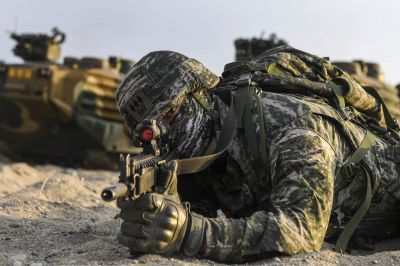
This amphibious training is being conducted at the brigade level, with more than 3,200 personnel from the Army, Navy, Air Force, and Marine Corps joint forces participating. Various multidimensional assets have been mobilized, including the Korean Amphibious Assault Vehicle (KAAV), the Marado-class large transport ship (LPH), landing ships (LST-I and LST-II), mobilized vessels, the Marineon (MUH-1) amphibious assault helicopter, and the Air Force's KF-16 fighter aircraft.
To enhance the realism of the training, the Navy and Marine Corps loaded most of the landing troops onto landing ships and mobilized vessels, conducting sea and air assaults in accordance with operational concepts. In particular, they selected training tasks aimed at preparing for the diversified threats of future amphibious operations and applied these tasks throughout the entire joint amphibious training.
In particular, they actively operated reconnaissance assets, including unmanned aerial vehicles, to achieve battlefield visualization for amphibious beach reconnaissance and ground operations. By simulating enemy unmanned aerial vehicles using drones, they also assessed the survivability and response procedures of maneuver units against threats such as enemy suicide drones during movement to the amphibious operation area.
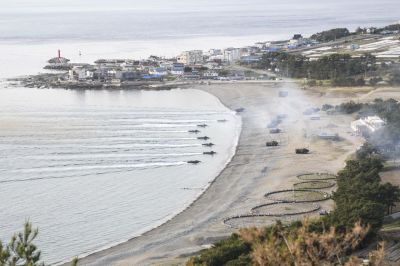
On the morning of April 28, starting with the initial assault by KAAVs on the Doksok-ri coast in Pohang at 6 a.m., the Navy and Marine Corps carried out the decisive action. The decisive action is considered the core of amphibious operations, in which the Marine Corps landing force, supported by naval gunfire and Air Force fighter aircraft, secures a beachhead and prepares to transition to ground operations.
Additionally, for the first time, the Marine Corps formed and deployed an obstacle-breaching task force (TF) centered on engineers to clear obstacles such as coastal embankments and waterways on the landing beach. Equipment such as armored bulldozers and MICLICs was deployed to clear minefields and obstacles, open exit routes, and support the smooth transition of the landing force to ground operations.
Cho Sunguk, Commander of the 53rd Amphibious Brigade and commander of the amphibious task force, stated, "The Navy and Marine Corps have become a one-team, enhancing their ability to project combat power from the sea through amphibious operations, and have strengthened their ability to respond to future diversified threats by actively utilizing unmanned assets."
Meanwhile, the Navy and Marine Corps plan to conduct additional training linked to this joint amphibious exercise through May 1, including joint coastal amphibious logistics support, deep infiltration of reconnaissance battalions into enemy territory, joint cargo airdrops, and combined arms combat, in order to further strengthen unit-level mission execution capabilities.
© The Asia Business Daily(www.asiae.co.kr). All rights reserved.


















