Liberal Party Support Rises Amid Growing Anti-American Sentiment
Conservative Party Loses Ground as Trade Tensions Escalate
As tensions rise between the United States and Canada following U.S. President Donald Trump's threat of a "51st state merger," Canada will hold a general election on April 28 (local time) to choose its next leader. With anti-American sentiment spreading in Canada, support for the ruling Liberal Party, led by Prime Minister Mark Carney, has rebounded, leading to speculation that the party is likely to extend its hold on power.
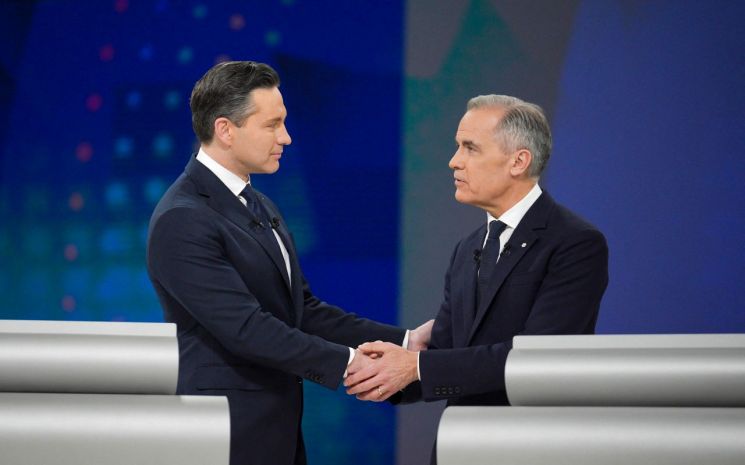 Pierre Poilievre, leader of the Conservative Party of Canada (left), and Mark Carney, leader of the Liberal Party. Photo by AFP Yonhap News
According to aggregated polling data released by Canadian broadcaster CBC, as of April 26, the Liberal Party's approval rating stood at 42.5%, 3.8 percentage points ahead of the Conservative Party's 38.7%.
The poll results showed that the probability of the Liberal Party securing a majority of at least 172 seats on its own was 74%. While the probability of winning the election with the most seats, but not an outright majority, was 17%. Combined, the Liberal Party's overall probability of winning the general election was 91%.
The Liberal Party, led by former Prime Minister Justin Trudeau for over nine years, had seen its support decline due to dissatisfaction over high inflation and rising housing prices. The unpopular ruling Liberals were widely expected to lose to the opposition Conservatives in various polls until former Prime Minister Trudeau announced his resignation in January, making it almost certain that Pierre Poilievre, leader of the Conservative Party, would become the next Canadian prime minister.
However, within just three months of President Trump's inauguration, the Conservatives' approval rating has fallen behind. In addition to tariff pressures, President Trump's mocking criticism?threatening to make Canada the 51st state of the United States?has fueled anti-American sentiment among Canadians, which appears to have worked in favor of the Liberals.
Poilievre is seen as being disadvantaged in the election due to his image as the "Canadian Trump," especially amid the ongoing trade war. In contrast, Carney, an "economic expert" who previously served as governor of both the Bank of Canada and the Bank of England, has managed to boost support not only among progressive voters but also among centrist and conservative voters, despite lacking political experience, by positioning himself as a stable candidate to handle the trade war with the United States.
However, some analysts note that, as the campaign enters its final stage, the gap between the Liberals and Conservatives is narrowing again, and the election is becoming highly competitive. If neither side secures a majority and a minority government is formed, political uncertainty could persist.
Meanwhile, with the response to President Trump emerging as a key election issue, the campaign atmosphere has become highly charged. According to AFP, a total of 7.3 million voters participated in early voting from April 18 to 21, marking a 25% increase compared to the 2021 general election.
© The Asia Business Daily(www.asiae.co.kr). All rights reserved.

















