Development of Pure Organic Photoelectrode Resistant to Acid and Alkali
Corrosion and Delamination Issues Solved with All-Organic Photoelectrode
A technology has been developed that makes eco-friendly hydrogen production using solar energy more stable and economical.
This technology overcomes the corrosion and delamination issues of conventional organic photoelectrodes by fabricating the entire photoelectrode, a key component in hydrogen production, from organic materials.
The research team led by Professor Jinyoung Kim at the UNIST Graduate School of Carbon Neutrality, in collaboration with Professor Jaesung Lee's team from the Department of Energy and Chemical Engineering at UNIST and Professor Wuhan Young's team from the Department of Chemistry at Korea University, has developed an "all-organic photoanode" that does not use any metal oxides.
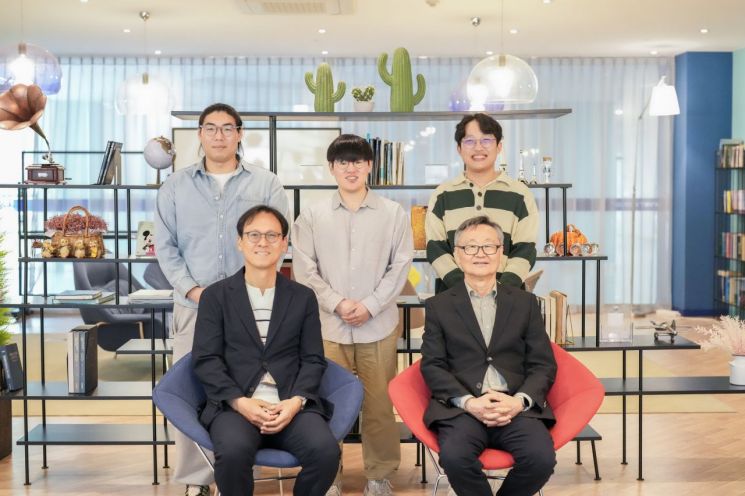 Research team Professor Jinyoung Kim (bottom row left), Professor Jaesung Lee (right). Provided by UNIST
Solar-powered hydrogen production utilizes a technology in which a photoelectrode immersed in water is exposed to sunlight, triggering an electrochemical reaction at the electrode surface that splits water into hydrogen and oxygen. To efficiently produce hydrogen and oxygen in this process, acidic and alkaline solutions are used, respectively. However, the metal oxide electron transport layers commonly used in organic photoelectrodes are easily corroded or delaminated from the organic layers in acidic or alkaline aqueous solutions, resulting in low stability.
 Professor Wuhan Young, Korea University.
The research team addressed this issue by developing an all-organic photoelectrode using an n-type self-assembled monolayer (SAM) and a p-type polymer electrolyte layer. The n-type SAM, an organic material that replaces metal oxides, enhances adhesion between the substrate and the organic photoactive layer and maximizes electron transfer efficiency.
In addition, the p-type polymer electrolyte layer coated on the surface of the photoelectrode selectively transports holes and increases hydrophilicity at the surface, thereby improving contact efficiency with the aqueous solution.
The developed organic photoelectrode recorded a high photocurrent density of 7.92 mA/cm² in an acidic environment containing L-ascorbic acid. Photocurrent density is a direct indicator of the hydrogen production rate. Furthermore, the electrode demonstrated excellent stability by maintaining over 90% of its initial performance for two hours without any additional protective layer or metal encapsulation.
Professor Jinyoung Kim stated, "This research fundamentally solves the pH sensitivity and delamination issues that conventional photoelectrodes have faced. In particular, this is the first time an n-type self-assembled monolayer has been applied to a photoanode, demonstrating the practicality of a fully organic structure composed entirely of organic materials on the electrode surface. This technology will be widely applicable not only for eco-friendly hydrogen production but also in the development of various organic-based photoelectrochemical devices."
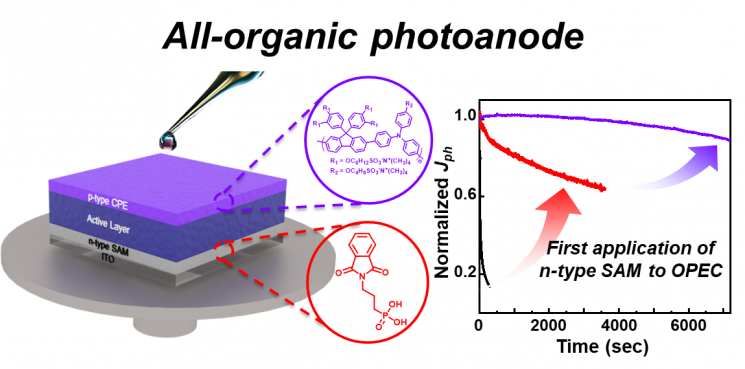 Structure and performance of the highly stable all-perovskite photoelectrode developed by the research team.
This research was co-led by Dr. Jiwoo Yeop and Dr. Jinwook Lee from UNIST, and Jaehun Son, an integrated master's and doctoral student at Korea University, as first authors.
The results were published in the international journal ACS Energy Letters on March 14.
This research was supported by the National Research Foundation of Korea (NRF) under the Ministry of Science and ICT.
© The Asia Business Daily(www.asiae.co.kr). All rights reserved.


















