Exchange Rates Are Easily Politicized, Require Technical Understanding
Positive Aspects Seen in the Results of the 2+2 Economic Dialogue
Monetary Policy Cannot Be Hastened by Focusing Only on Growth
"We Should Also Turn Crisis Into Opportunity Like Europe"
"It is not bad news that the U.S. Treasury Department and our Ministry of Economy and Finance have agreed to negotiate exchange rate issues separately. The U.S. Treasury, like our Ministry of Economy and Finance, is a group of experts on exchange rates. They have a high level of understanding of how we are working to prevent currency depreciation."
Lee Changyong, Governor of the Bank of Korea, made these remarks on the 25th (local time) during a meeting with the accompanying press corps of the Group of Twenty (G20) finance ministers and central bank governors at a restaurant near the International Monetary Fund (IMF) headquarters in Washington D.C., USA. He offered this positive assessment in relation to the previous day's Korea-U.S. 2+2 economic dialogue, where the two countries agreed to discuss exchange rates (monetary policy) separately through the relevant ministries.
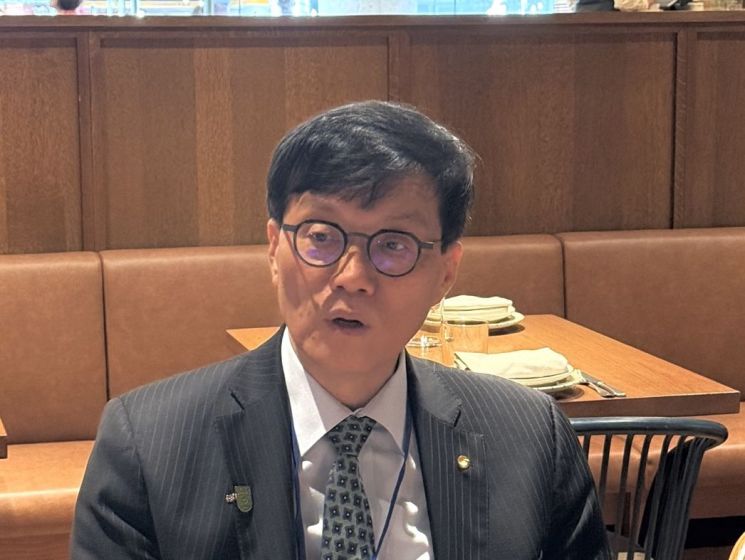 Lee Changyong, Governor of the Bank of Korea, is holding a meeting with the accompanying press corps of the Group of Twenty (G20) finance ministers and central bank governors on the 25th (local time) at a restaurant near the International Monetary Fund (IMF) headquarters in Washington D.C., USA. Accompanying G20 press corps
Governor Lee explained, "In recent months, the depreciation of our currency has been driven by political and other issues, which are difficult to explain. However, when the U.S. Treasury and our Ministry of Economy and Finance, who understand the technical aspects, discuss the matter, it allows for a professional conversation, separate from politics." He further emphasized, "Unless you are an economist, you may not fully understand exchange rates. Since exchange rates are easily politicized, it is better for experts to discuss them among themselves."
Regarding the overall outcome of the economic dialogue, he said, "It is fortunate that uncertainty has been reduced," and "there are positive aspects." He pointed out, "Three things are key: First, both sides understood the timing and the negotiation method. Second, the U.S. responded positively to Korea's proposal. Third, we explained that, due to our internal procedures, the final agreement will need to be made in July after the new government takes office."
Governor Lee also mentioned that, during his trip, uncertainty caused by the impact of U.S. tariffs was a major topic in meetings with officials from various countries. He added, "Europeans said, 'A crisis should be used as an opportunity for restructuring,' and I believe the same applies to Korea." Currently, there is growing discussion in Europe about accelerating structural reforms such as the delayed Banking Union and Capital Markets Union.
Governor Lee also stated, "Even though many countries have revised their economic growth forecasts downward, this does not mean a global recession." He continued, "Even if tariffs are lowered in other countries, if tariffs between the U.S. and China remain above 100%, there are concerns about a paralysis of the global supply chain, and the risk of an economic downturn is not alleviated." He added, "Whenever representatives from various countries gather, there is frequent discussion about the need for compromise between China and the U.S."
Regarding calls for a rapid easing of domestic monetary policy, he responded, "That is only considering growth. The central bank cannot focus solely on growth." He questioned, "Can we really move quickly and blindly when uncertainty is increasing?" He emphasized, "Rather than relying only on headlights in a tunnel, it is better to turn on the lights and proceed when our eyes have adjusted to the darkness." He also noted that interest rates are "in a downward trend."
Amid continued declines in domestic economic indicators, when asked about the possibility that the Bank of Korea may significantly revise its growth forecast in next month's economic outlook, he said, "It is difficult to comment now," citing variables such as tariffs and fiscal policy. Regarding his earlier, exceptional mention of the need for a supplementary budget at the beginning of the year, he said there were unavoidable circumstances and added, "I will not be discussing fiscal policy for the time being."
Governor Lee visited Washington D.C. to attend the G20 finance ministers and central bank governors meeting and the IMF-World Bank (WB) Spring Meetings. He is scheduled to return to Korea on the 29th after meeting with central bank governors from various countries, IMF officials, and executives from global financial institutions.
© The Asia Business Daily(www.asiae.co.kr). All rights reserved.

















