Asan Institute Report:
Concerns Over "Worst-Case Scenario"
If U.S. Forces Korea Are Reduced While North Korea Retains Nuclear Weapons
Amid projections that North Korea-U.S. talks could resume as early as this year, concerns have been raised that a reduction or withdrawal of U.S. Forces Korea while North Korea's nuclear weapons remain would represent the "worst-case scenario" for South Korea.
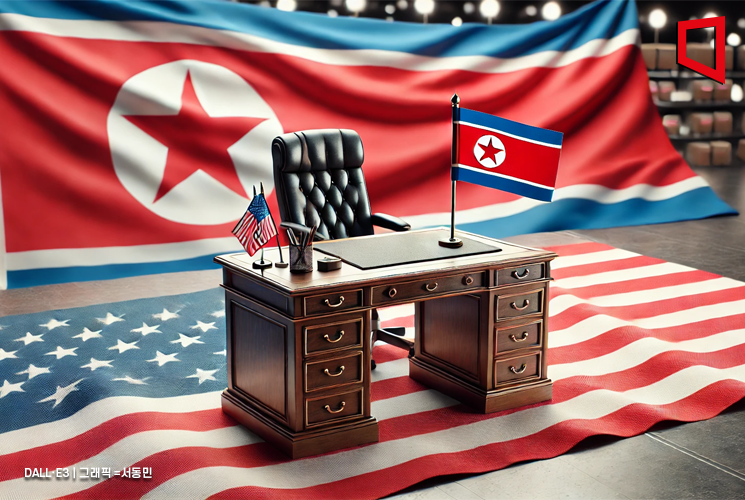
On April 25, Kim Dongseong, Visiting Research Fellow at the Asan Institute for Policy Studies, released a report titled "Prospects for North Korea Policy under a Second Trump Administration in 2025 and South Korea's Response." He stated, "Whether or not the U.S. changes its North Korea policy will have a significant impact on South Korea's security, as it is closely linked to the policy on the stationing of U.S. Forces Korea." He emphasized that this scenario is "a situation that South Korea should be highly wary of."
He broadly outlined two possible directions for U.S. policy toward North Korea. One is a "top-down" approach, led by President Donald Trump, who already has experience in dialogue with North Korean leader Kim Jong Un, aiming for a comprehensive resolution of the North Korean nuclear issue. The other is the so-called "interim steps" approach, which would sequentially demand North Korea to halt nuclear testing, freeze its nuclear program, dismantle intercontinental ballistic missiles (ICBMs), reduce its nuclear arsenal, and eventually denuclearize, with compensation offered at each stage.
Kim expressed concern that "the problem arises when the give-and-take between North Korea and the U.S. is not mutually equivalent, or when the sequence of denuclearization procedures is reversed, resulting in what is called a 'bad deal.'" He also pointed out that "there could be a situation in which South Korea, a direct stakeholder in the North Korean nuclear crisis on the Korean Peninsula, is effectively excluded from discussions on North Korean denuclearization." He added, "The U.S. may focus solely on eliminating the threat that North Korea's nuclear weapons and missiles pose to the U.S. mainland."
He reiterated, "The worst outcome for South Korea would be if North Korea's nuclear weapons remain while the deterrence capability of the South Korea-U.S. combined forces is weakened, or if U.S. Forces Korea are reduced or withdrawn altogether."
While Kim prefaced that the likelihood is very low, he also suggested, "It is possible to envision a scenario in which Trump expands the objectives of North Korea-U.S. negotiations to include 'luring North Korea' and 'restructuring the alliance framework on the Korean Peninsula,' and Kim Jong Un responds positively to this." He continued, "If such a scenario unfolds, South Korea should actively pursue measures to strengthen the alliance's nuclear deterrence, including the redeployment of tactical nuclear weapons, to ensure the credibility of U.S. extended deterrence."
Regarding the timing of a possible resumption of North Korea-U.S. talks, he said, "If major U.S. foreign policy issues, including the Ukraine-Russia war and the Israel-Hamas war, show signs of resolution, a second Trump administration is likely to refocus on the risks posed by North Korea's nuclear weapons." He predicted, "U.S. engagement with North Korea could begin in earnest as early as 2025."
Kim advised, "To safeguard South Korea's security and national interests, it is necessary to clearly define South Korea's objectives for North Korea policy, ensure adherence to the principles of denuclearization of North Korea and establish a cooperative system with the U.S. and other relevant countries, prepare negotiation proposals in advance and share them with the U.S., remain vigilant against any loss of security for South Korea and maintain deterrence against North Korea, pursue both pressure and containment, and induce and guide changes in North Korean society." He added, "Strengthening the South Korea-U.S. alliance is also an essential foundation for enhancing policy coordination on North Korea, so South Korea should work to secure and reinforce mutual policy affinity with the U.S., reaffirm its economic contributions and strategic value to the U.S., and actively engage in negotiations over the cost-sharing for U.S. Forces Korea."
© The Asia Business Daily(www.asiae.co.kr). All rights reserved.

















