Industries Most Affected by U.S. Reciprocal Tariffs: Automotive, Hardware, and Technology
"Automakers Expected to Expand Production in the U.S."
Global credit rating agency Fitch Ratings has projected that the automotive industry will be most affected by the United States' reciprocal tariffs. The analysis suggests that, because the U.S. market represents a significant share and tariffs could dampen consumer sentiment, automotive demand will be directly impacted.
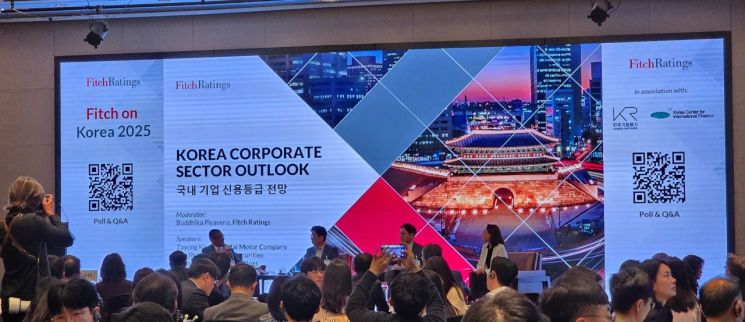
On April 25, Fitch Ratings held a panel discussion on the outlook for domestic corporate credit ratings during the second session of the 'Fitch on Korea 2025' conference at the Conrad Hotel in Yeouido.
Buddhika Prasad Piyasena, Head of Asia-Pacific Corporate Ratings at Fitch Ratings and the moderator for the session, explained, "Since the third quarter of last year, the ratings of Asia-Pacific companies have turned negative," adding, "There has been a greater degree of negative movement since early April this year." He further stated, "If reciprocal tariffs are implemented, the sectors most affected will be automotive, technology (Tech), and hardware."
First, regarding hardware within the tech sector, the panel predicted that reciprocal tariffs would significantly impact Samsung Electronics and LG Electronics if fully implemented. Park Jungmin, Senior Director at Fitch Ratings, explained, "As of last year, half of the electronic products imported by the U.S. come from the Asia-Pacific region," and added, "If tariffs are imposed on countries like Vietnam, it will have a considerable impact on Samsung Electronics and LG Electronics, which use these countries as manufacturing hubs."
The panel also predicted a significant impact on the semiconductor sector. The U.S. government had previously decided to temporarily exclude items related to smartphones, computers, and semiconductors from reciprocal tariffs. Park said, "Although Korean semiconductors have been excluded from tariff regulations, if tariffs are imposed, there will likely be a negative impact, and in that case, supply chains will be reorganized."
Park further projected that the automotive sector would be the most affected. However, he noted that changes in credit ratings would vary by company. He stated, "Tariffs will indeed have a negative effect on finished vehicle manufacturers, but the situation will differ for each company," and explained, "There will be variations depending on the location of production facilities, pricing power, and supply chain configuration for each company."
Park added, "However, no company will be completely free from the effects," and continued, "While the impact will differ by brand, currently all automotive companies are taking a wait-and-see approach, but ultimately, price increases are expected." He added, "If prices rise, consumer sentiment will likely weaken."
BMI, a subsidiary of Fitch, also forecasted that sales of compact cars in the U.S. would reach 15.7 million units this year, representing a 0.3% decrease. This contrasts with the previous forecast of a 2.4% increase.
In this context, Fitch expects that finished vehicle manufacturers will mitigate the impact of tariffs by increasing production at their U.S. facilities. Park explained, "Automakers are likely to increase production volumes in the U.S.," and added, "For manufacturers and parts suppliers to invest in the U.S., there needs to be policy transparency, particularly regarding whether tariffs will remain in place throughout the investment period."
Hyundai Motor plans to increase production in the region or adjust its sales strategy to overcome the impact of U.S. tariffs. Koo Jayong, Executive Vice President and Chief Investor Relations Officer at Hyundai Motor Company, stated, "If the production capacity of our U.S. manufacturing base is expanded, it will be possible to produce 700,000 to 800,000 units locally going forward."
Koo added, "One of our countermeasures is to readjust our product mix," and explained, "Some of the units produced in the U.S. are currently being sent to Canada, but we are considering supplying those units through other regions."
Meanwhile, there was also an opinion that the bond issuance market is currently in a wait-and-see mode due to U.S. tariffs. Kim Minjip, Director of Debt Capital Markets at Mizuho Securities, said, "Currently, tariffs and trade policy, as well as inflationary pressures and concerns about growth prospects, are affecting the market," and added, "Because the market is in a state of uncertainty, it is taking a wait-and-see approach."
However, he predicted that issuance volumes would remain steady. Kim explained, "Korean issuers generally have high credit ratings, so there is a large volume of A and AA-rated issuances," and added, "With the volume of maturing debt increasing, issuance volumes are expected to remain steady." He continued, "Looking at the dollar market, funding costs are higher compared to the won market, but I believe that in 2025 and 2026, issuance volumes will continue to be steady and stable."
© The Asia Business Daily(www.asiae.co.kr). All rights reserved.

















