Number of Self-Employed in Gwangju Drops by 13,000 in 5 Years
Self-Employed with Employees Down by 16,000
Business Closures Rise Due to Weakened Consumer Sentiment
Regional Non-Manufacturing Business Sentiment Remains Below Standard
"Presidential Election Pledges Must Include Regional Economic Recovery Measures"
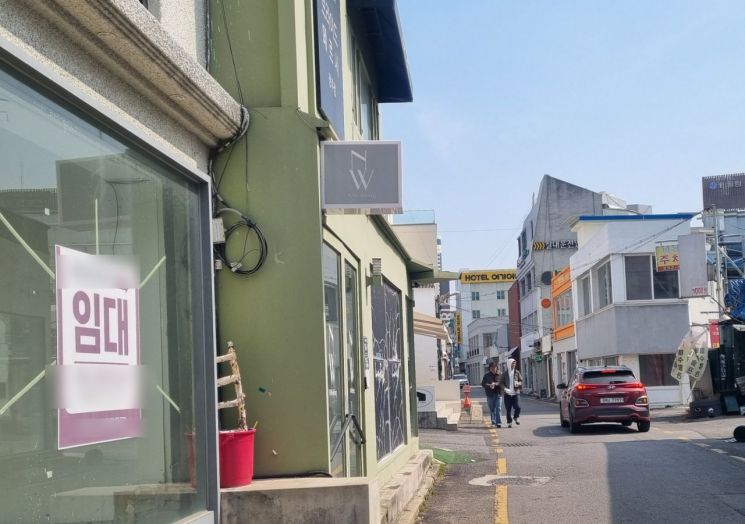 On the afternoon of the 24th, a rental banner was hung at a commercial building in Donggu, Gwangju. Photo by Min Chanki
As an early presidential election is being held following the impeachment of former President Yoon Suk-yeol, there is a growing demand for major campaign pledges in Gwangju and Jeonnam to reflect the needs of people's livelihoods.
With the prolonged slump in domestic demand and the so-called "three highs" (high interest rates, high prices, and high exchange rates) leading to an increasing number of small business closures, the local economy is perceived to be worsening. As a result, there are calls for the next president to prioritize policies that support small and medium-sized enterprises (SMEs) in order to restore and revitalize the regional economy.
According to Statistics Korea on April 24, the number of self-employed people in Gwangju as of March was approximately 144,000. This is a decrease of about 13,000 compared to December 2020, when the COVID-19 pandemic was ongoing and the number stood at 157,000.
By year, the numbers for each December were approximately 157,000 in 2020, 144,000 in 2021, 142,000 in 2022, 154,000 in 2023, and 144,000 in 2024, showing a steady decline.
In particular, the number of self-employed people with employees dropped sharply. While about 49,000 self-employed people had employees in 2020, as of last month, the number had fallen to 39,000, a decrease of 10,000 over four years.
In the case of Jeonnam, as of March, the number of self-employed people was about 295,000, a slight increase from 288,000 in 2020. However, the number of self-employed with employees plummeted from 44,000 in 2020 to 38,000 as of March. Meanwhile, the number of self-employed without employees surged from 245,000 in 2020 to about 258,000 as of March.
This trend is attributed to the prolonged domestic economic downturn, which has weakened consumer sentiment and led to more business closures. Additionally, as debt mounts due to large loans, more self-employed individuals are running their businesses alone in an effort to cut labor costs.
In fact, a survey by the Gwangju Chamber of Commerce and Industry, which indexes key business activities such as sales and production, showed that the second quarter BSI (Business Survey Index) for food and beverage companies in Gwangju was 53, a sharp drop of more than half compared to 108 in the first quarter. Companies cited a decrease in economic consumption activities due to the economic downturn and sluggish consumption, rising raw material costs due to the exchange rate increase, and a decline in foreign visitors as reasons.
According to a March survey by the Bank of Korea Gwangju-Jeonnam Headquarters on business sentiment in Gwangju and Jeonnam, the non-manufacturing business sentiment index stood at 90.2, still below the standard level. The main difficulties cited by non-manufacturing businesses were sluggish domestic demand (25.9%), labor shortages and rising labor costs (23%), uncertain economic conditions (11%), and intensified competition (9.4%).
Kim, a 45-year-old who has been running a snack shop in Unam-dong, Buk-gu for seven years, said, "To save on labor costs, I reduced the number of part-time workers and increased the hours I work alone. Sales keep declining, so labor costs are the first thing I have to cut. When I first took over the shop, not only was I unable to recover the premium, but there was no one interested in moving in, so I have no choice but to keep running the business."
As small and medium-sized businesses and self-employed individuals are struggling to survive under the weight of the "three highs"?high interest rates, high prices, and high exchange rates?there is a growing call from the local business community for early presidential election pledges to include measures to revive domestic demand.
The Gwangju Employers Federation has proposed support measures such as: expanding financial support including low-interest refinancing loans; deferring payments of taxes such as value-added tax and corporate tax to reduce cost burdens; and increasing the issuance of local currency to stimulate domestic demand.
A representative of the Gwangju Employers Federation said, "The business sentiment index for companies in Gwangju has failed to recover to the standard level for 11 consecutive quarters since the third quarter of 2022. Measures to revive the stagnant regional economy must be included in the early presidential election pledges," he said.
© The Asia Business Daily(www.asiae.co.kr). All rights reserved.

















